Women on Wheels
By Muhammad Mohsin Iqbal
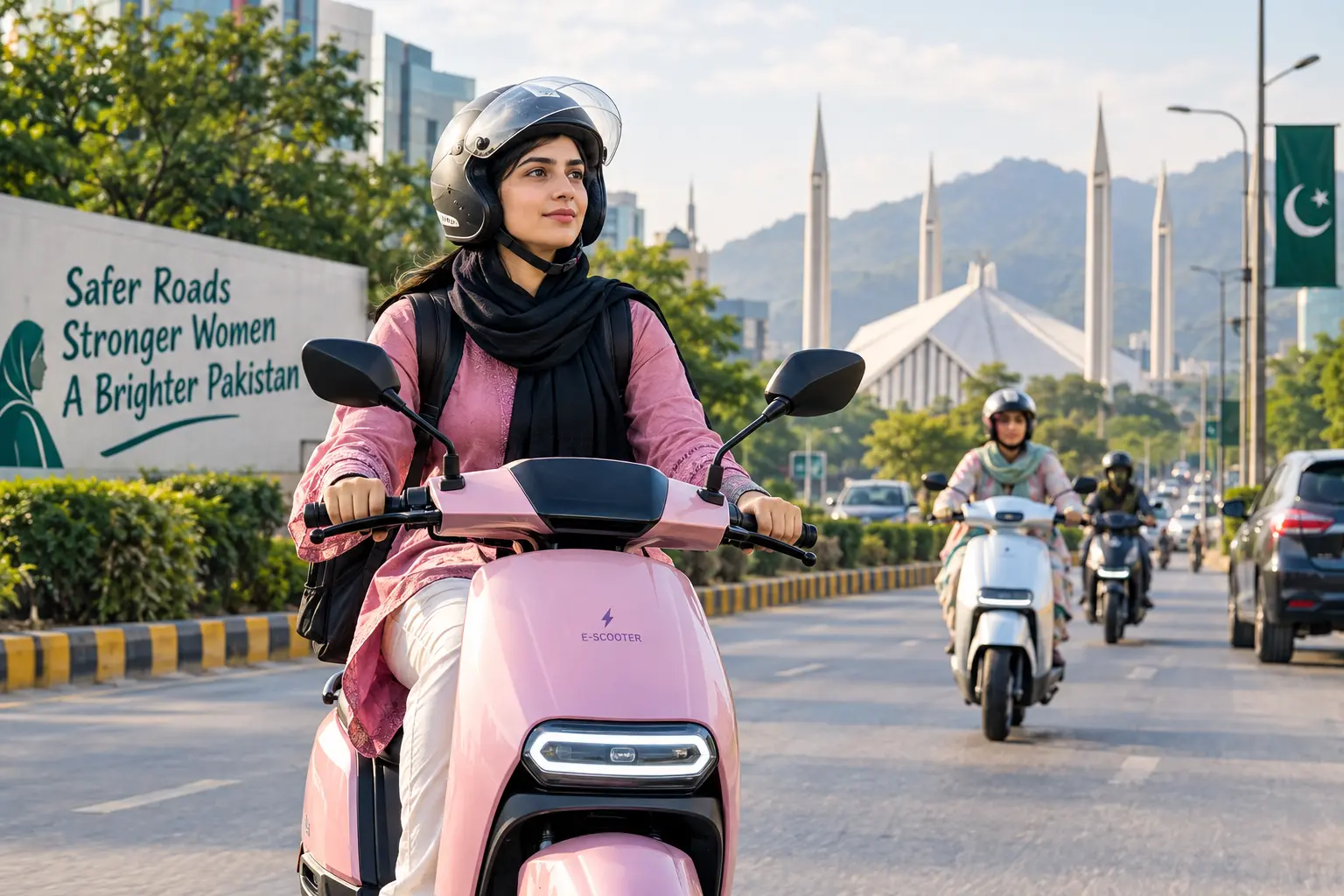
The freedom to move independently is often taken for granted, but for many women in Pakistan, it remains an aspiration negotiated against social expectations, transport constraints and concerns about personal safety. The growing number of women riding motorcycles and electric scooters is beginning to change this reality. Yet, if this modest revolution is to endure, the state must ensure that women can exercise their freedom without being subjected to harassment, intimidation or unnecessary risk.
The economic circumstances encouraging this change are difficult to ignore. Instability in the Middle East and uncertainty surrounding global energy supplies have renewed concerns about petroleum prices. For a country heavily dependent on imported energy, fluctuations in international oil markets translate into higher transport costs and additional pressure on household budgets. As families struggle to manage the rising cost of living, electric scooters offer a relatively economical alternative for short urban journeys. For women, particularly students and working professionals, their significance extends well beyond fuel savings.
In cities such as Islamabad, Rawalpindi, Lahore and Karachi, women are increasingly using electric scooters to reach educational institutions, offices and markets. For some, the choice means no longer waiting for an unreliable bus; for others, it reduces dependence on family members or expensive ride-hailing services. The time saved can be spent on education, employment or family responsibilities. In this sense, independent mobility is not merely a matter of convenience. It is closely connected with women’s economic participation and access to opportunity.
This development is not unusual in international terms. In Vietnam, Thailand, Indonesia and India, motorcycles and scooters have long been part of everyday life, with women using them for work, education and domestic responsibilities. In densely populated cities, two-wheelers offer affordability and flexibility that larger vehicles cannot always provide. Electric models are extending these advantages while reducing dependence on conventional fuels. Pakistan’s growing community of women riders is therefore participating in a broader transformation in urban mobility, although social attitudes and infrastructure continue to shape the pace of change.
The difficulty is that the freedom offered by a scooter can be undermined by the behaviour of other road users. Women riders have reported unwelcome remarks, aggressive overtaking, deliberate obstruction and excessive honking. Such conduct can turn an ordinary journey into an experience of apprehension. Even when an incident does not result in physical injury, the fear of repetition may discourage a woman from riding again. The consequences are particularly serious for those whose employment or education depends on affordable and reliable transport.
The problem should not be confused with the act of riding itself. A woman on a motorcycle is neither inviting attention nor challenging the lawful rights of others. She is using a public road under the same rules that govern every other citizen. The responsibility for harassment rests with the perpetrator, not with the woman who chooses an independent means of transport. A society that celebrates women’s education and professional achievement must also accept the practical conditions that make both possible.
Moral appeals are necessary, but they cannot substitute for effective public policy. The first requirement is accessible training. Women should be able to learn riding, emergency braking, defensive manoeuvres and traffic regulations in a supportive environment. Programmes such as Women on Wheels have demonstrated the value of practical instruction in building confidence. Their reach should be expanded beyond major urban centres, with female instructors available wherever possible. Proper licensing must remain an essential requirement, accompanied by enforcement of traffic laws for all riders without discrimination.
Protective equipment deserves equal attention. Properly fitted helmets, reflective clothing, functioning lights and mirrors, and instruction on securing loose garments can reduce avoidable risks. Distinctive pink helmets, if voluntarily preferred by women, might help identify participants in certain assistance programmes. However, colour-coded equipment should not be mistaken for a meaningful safety strategy in itself. Women must not be required to make themselves conspicuous merely to receive protection, and the same standards of road safety should apply to everyone.
Technology could provide another layer of reassurance. A discreet emergency button integrated into a helmet or mobile phone could transmit a rider’s location to a designated response centre when she feels threatened. Connected, where technically feasible, with existing police helplines and Safe City systems, such a facility could help authorities respond more quickly. Its usefulness would depend on reliable connectivity, safeguards for personal data, clear procedures for handling alerts and, above all, a prompt police response. Technology can assist protection, but it cannot replace competent institutions.
Enforcement must also become more responsive. Traffic police should treat deliberate intimidation and dangerous driving as matters requiring attention, while complaints of harassment should be recorded and investigated without delay. Existing helplines and women’s protection mechanisms need wider publicity so that riders understand how to seek assistance. Better street lighting, safer road surfaces, effective traffic management and visible patrols would improve security for women and men alike. Authorities should also maintain reliable data on accidents and harassment complaints involving female riders, enabling policies to be shaped by evidence rather than anecdote.
Pakistan already has a general legal framework governing road safety, licensing and the use of helmets, alongside constitutional guarantees of dignity, equality and personal security. The challenge is to translate these principles into consistent practice. A dedicated female rider safety and mobility policy could bring together transport departments, police, local governments and women’s protection institutions. It could establish emergency response protocols, strengthen training programmes and ensure that schemes providing subsidised or free electric scooters are supported by licensing assistance and continuing safety guidance.
There is little value in distributing vehicles if the women receiving them remain afraid to use them. Nor should safety measures become a pretext for restricting women’s movement or advising them to avoid public roads. The objective must be to make those roads safer, not to transfer the burden of preventing harassment onto its potential victims.
The growing presence of women riders offers Pakistan an opportunity to reconsider what genuine empowerment entails. Independence cannot be measured solely by the possession of a vehicle; it must also be reflected in the freedom to use it without fear. An electric scooter may appear to be a small instrument of change, but for a student seeking education or a woman earning her livelihood, it can widen the boundaries of possibility. The measure of progress will be whether society allows that possibility to flourish through responsible conduct, effective enforcement and equal respect for every citizen’s right to travel.