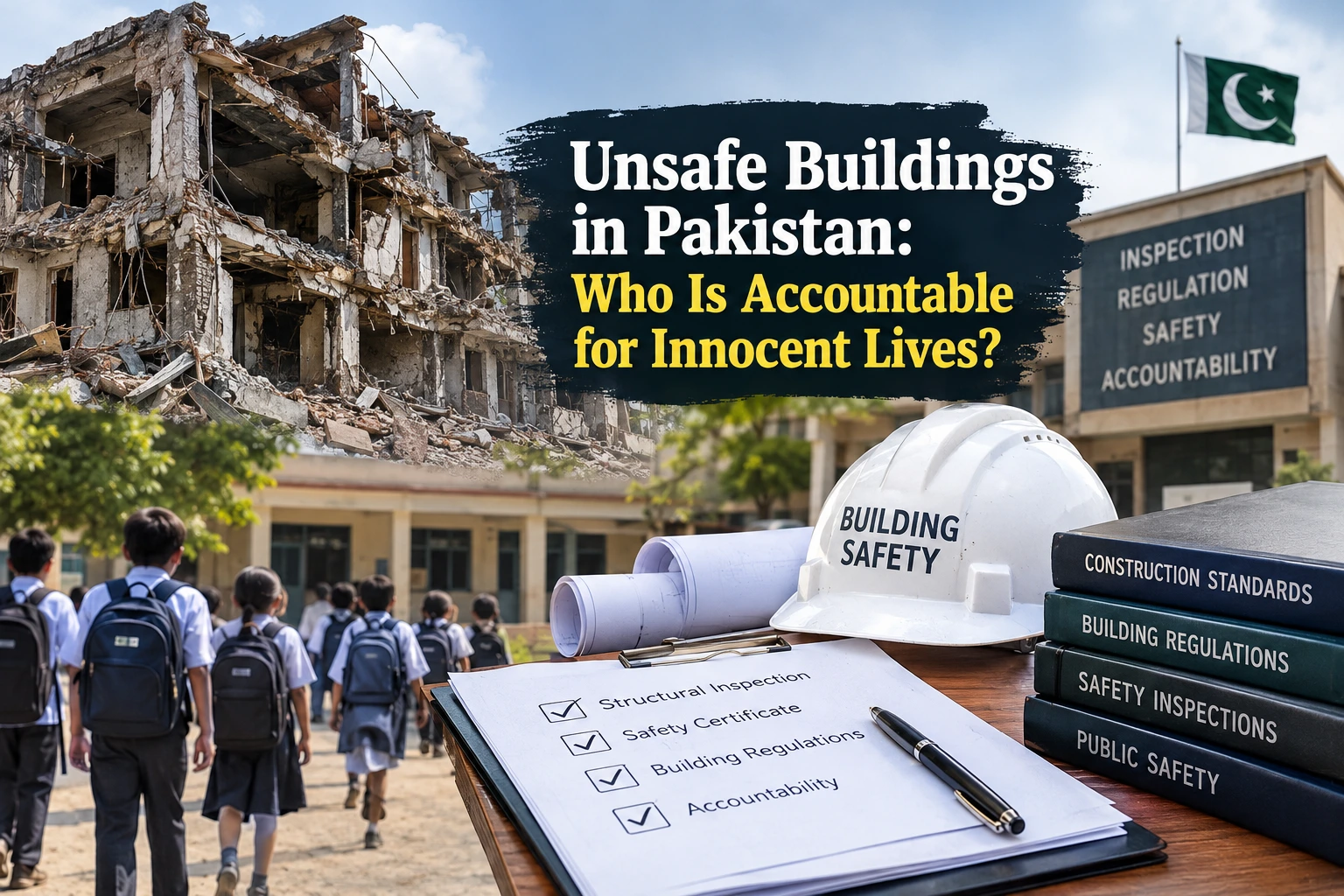
School collapses and unsafe buildings raise urgent questions about construction standards, regulatory failures, corruption and accountability
(By Amir Muhammad Khan)
The collapse of school buildings, homes and other unsafe structures in Pakistan is more than a series of tragic accidents. These incidents raise troubling questions about construction standards, safety inspections, regulatory oversight and the accountability of those responsible for protecting human lives.
Why do authorities often act only after a tragedy claims innocent lives? And why do promises of reform frequently fade once public attention shifts elsewhere?
The reported Peshawar school tragedy, in which 35 children were said to have died, has renewed concerns about building safety and regulatory failures. Questions have emerged about the school’s registration, structural fitness and the technical capacity of the relevant regulatory authorities. These details require independent verification, but the broader issue demands immediate attention.
Pakistan’s Building Safety Crisis Demands Accountability
A building’s registration should never replace a proper structural safety assessment. Authorities must establish whether qualified engineers inspected the premises, whether the structure met applicable standards and whether officials followed the required procedures.
If a building was unsafe, how was it allowed to operate as a school? If it had been certified as safe, who issued that certification, and on what technical grounds?
These questions cannot be answered through official statements alone. Independent investigations must examine the evidence and identify any failures by property owners, contractors, engineers or regulatory officials.
The public deserves clear answers, particularly when children and other vulnerable people are at risk.
Following a tragedy, governments often announce financial assistance for bereaved families. Such support may help cover immediate expenses, but it cannot compensate parents for the loss of a child.
Human life is priceless. Compensation cannot replace justice, and condolences cannot substitute for accountability.
Public funds used for relief also come from taxpayers. Families deserve more than financial assistance; they deserve a credible investigation, fair legal proceedings and assurances that similar tragedies will be prevented.
Would those offering compensation consider the same amount sufficient if they had lost their own children?
The question is not whether grieving families should receive assistance. They should. The real question is whether compensation becomes a substitute for identifying and holding responsible those whose proven negligence contributed to a disaster.
Weak Enforcement and Corruption Undermine Public Trust
Pakistan has repeatedly witnessed the announcement of inquiry committees after major incidents. Yet public confidence suffers when investigations produce no clear explanations or when their findings do not lead to meaningful action.
A cynical saying captures this distrust: “If you are caught taking a bribe, pay another bribe to get released.” It may not describe every case, but it reflects public frustration with perceived corruption and weak enforcement.
The solution is not another announcement without follow-through. Authorities must publish investigation findings where legally permissible, explain the action taken and ensure that proven misconduct results in appropriate legal or departmental consequences.
Unsafe Buildings Require Urgent Inspections
Building collapses can result from several factors, including substandard materials, faulty structural designs, poorly constructed roofs, unauthorised additional floors, excessive rooftop loads, water damage and inadequate maintenance.
Cracks, leaking roofs and other warning signs should trigger professional assessments. Where a structure presents an immediate danger, authorities must take timely steps to restrict access or evacuate occupants.
The problem extends beyond schools. Residential buildings, tuition centres, commercial premises and public facilities also require effective safety oversight.
Reports concerning building inspections in Islamabad and roof-collapse incidents elsewhere in Pakistan further underline the need for reliable, publicly accessible safety records. However, reported survey totals and nationwide casualty figures should be checked against official records before being treated as established facts.
When a building collapses, investigators must examine more than the immediate physical cause. They should establish whether the design complied with applicable standards, whether construction materials met specifications, whether unauthorised alterations occurred and whether officials fulfilled their legal duties.
The same principle applies to incidents involving fires, gas explosions and other building-related emergencies. Investigations should assess fire safety arrangements, emergency exits, evacuation procedures and compliance with relevant regulations.
Where the same department responsible for approving a building is involved in examining its failure, independent technical oversight can help protect the credibility of the inquiry.
Responsibility must be established through evidence, not political affiliation or public pressure. Any person or official found culpable should face due process and the consequences prescribed by law.
Following a school tragedy, safety audits and instructions to relocate students from dangerous buildings are important steps. But such measures must continue long after the headlines disappear.
Every province should maintain a systematic programme for inspecting government and private educational institutions. Schools identified as unsafe should not continue operating until authorised technical assessments establish that they can safely accommodate students.
Authorities must also help ensure that low-income families can access affordable, safe education. Poverty should never force children to study in buildings that put their lives at risk.
Six Steps to Prevent Future Building Collapses
1. Conduct professional inspections. Qualified engineers and authorised technical personnel should assess schools, tuition centres, residential buildings and other high-risk structures.
2. Classify buildings by risk. Authorities should identify buildings that are safe, require repairs or pose an immediate danger. Structures presenting serious risks should be evacuated when necessary.
3. Publish safety records. Accessible records should identify unsafe buildings, required repairs, compliance deadlines and the status of corrective action, while respecting legitimate privacy and security requirements.
4. Establish independent inquiries. Major collapses should trigger technically competent investigations into construction defects, maintenance failures and possible regulatory negligence.
5. Enforce the law fairly. Investigations, departmental proceedings and judicial outcomes should be handled transparently, with due process and appropriate penalties for proven violations.
6. Protect students and vulnerable residents. Educational institutions and residential buildings must meet applicable safety requirements. Authorities should prioritise children and people who have limited alternatives when a building becomes unsafe.
Pakistan Must Act Before the Next Tragedy
The reported Peshawar tragedy must become a turning point rather than another forgotten headline. The same urgency applies to incidents in Lahore, Karachi, Islamabad and other parts of the country.
Governments must replace temporary reactions with continuous inspections, effective enforcement, independent investigations and transparent accountability.
The real question is not simply why buildings collapse. It is why warning signs may go unaddressed, why safety requirements may not be enforced and why decisive action so often follows the loss of innocent lives.
Who is responsible? The answer must emerge from credible investigations, evidence-based findings and lawful proceedings—not merely another inquiry committee or press conference.
Until Pakistan makes building safety a continuous public responsibility, preventable tragedies will remain a serious threat to children, families and communities.