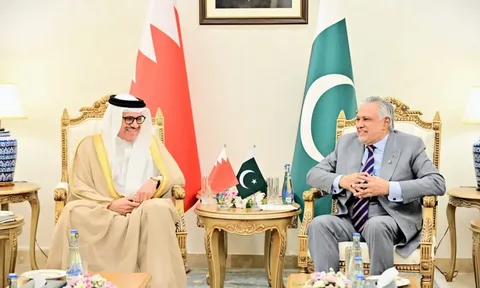
Pakistan and Bahrain have agreed to set up a joint working group on trade and investment. They also committed to finalising the GCC-Pakistan Free Trade Agreement, according to Bahrain’s Foreign Minister Dr Abdullatif bin Rashid Al Zayani. The announcement came on Thursday in Islamabad.
The move gives Pakistan Bahrain trade a clearer institutional path. It also brings the long-pending GCC Pakistan free trade agreement back into focus. Here is what was decided and why it matters.
Background: A Long-Standing Partnership
Pakistan Bahrain relations go back more than five decades. Pakistan was one of the first countries to establish diplomatic relations with Bahrain, in August 1971. Al Zayani noted that October 14 will mark 55 years of diplomatic ties. People-to-people links are just as strong. Pakistan’s ambassador in Bahrain has said more than 100,000 Pakistanis live there. That community has long acted as a bridge between the two countries.
Where Trade Stands
Trade volumes have stayed modest compared with the political goodwill. The Pakistani ambassador has previously said Pakistan mainly exports agricultural and food items such as meat, fish and vegetables to Bahrain, and imports oil and petrochemical products, with the balance of trade favouring Bahrain. Officials now want to change that picture.
Details: What Was Agreed in Islamabad
The understanding came during the third session of the Pakistan-Bahrain Joint Ministerial Commission, co-chaired by Al Zayani and Deputy Prime Minister and Foreign Minister Ishaq Dar. The two sides signed agreed minutes covering more than 15 areas of cooperation. These include trade, investment, energy, food security, information technology, labour mobility, health and education.
New Working Groups
Two working groups are central to the Pakistan Bahrain trade deal framework. One covers trade and investment, and another, on energy, will meet next month to discuss oil, gas and minerals. The groups are meant to turn broad promises into specific projects.
The Trade Target
Both countries agreed to accelerate efforts to double bilateral trade to $1 billion within three years. Dar reaffirmed Pakistan’s commitment to the $1 billion target set earlier. The wording suggests current trade is roughly half that figure, though the sources do not give an exact number.
GCC Pakistan Free Trade Agreement
Bahrain said it would use its presidency of the Gulf Cooperation Council to speed up the signing or approval of the free trade agreement. The deal was said to be near finalisation in late 2025. Al Zayani added that progress will be reviewed at the fourth session of the commission in Bahrain next year.Quotes and Official Statements
Al Zayani described the relationship in warm terms. He called it “very healthy and strong.” He also stressed that both sides want practical results from their cooperation.
Dar struck a similar note. He called the commission session “comprehensive and productive” and pointed to opportunities in agriculture, energy, tourism and business-to-business engagement. He also said the free trade agreement would help raise both imports and exports.
Impact: Why This Matters for Pakistan and the Gulf
For Pakistan, a GCC Pakistan free trade agreement could open easier access to six Gulf markets. Pakistan’s exports are still concentrated elsewhere. The United States took about 20 percent of Pakistan’s exports in FY26, followed by China at 9 percent, while Saudi Arabia accounted for just 2 percent. Gulf demand is a clear area for growth.
For Bahrain, the deal offers a larger supply of food, textiles and skilled labour. It also supports Gulf efforts to diversify trade partners. Regional security, including safe navigation through Hormuz and Bab el-Mandeb, was also on the agenda, showing how closely trade and stability are linked.
Business Community Role
Dar stressed that government efforts alone are not enough. He said stronger government-to-government and business-to-business links are needed to reach the trade target. Exporters in food, textiles and light engineering may be the first to benefit if tariffs fall.
Conclusion: What Comes Next
The immediate step is the energy working group meeting next month. After that, the trade and investment group will need to produce a work plan with specific products and dates. Those details will show whether the $1 billion target is realistic.
The bigger test is the GCC Pakistan free trade agreement itself. Bahrain’s GCC presidency gives the process momentum, and officials will review progress in 2027. Until the deal is signed, Pakistan Bahrain trade will depend on the new working groups delivering results.
Frequently Asked Questions (FAQs)
Who is Pakistan’s biggest trading partner?
It depends on whether you count exports, imports or both. The United States was Pakistan’s largest export destination in FY26 with about 20 percent of exports, while China was the biggest source of imports and the largest trade deficit partner, at $16.85 billion. Because China dominates imports, it is generally considered Pakistan’s largest overall trading partner. The United States is the biggest buyer of Pakistani goods. The UAE and Saudi Arabia are also major sources of imports, especially energy. What are Pakistan’s top 10 exports?
Pakistan’s exports are dominated by textiles and garments, followed by food products, leather goods, sports goods, surgical instruments and light engineering products. Within these groups, items such as cotton fabrics, knitwear, bed linen, rice, leather products and sporting goods are among the best known. Exact rankings change from year to year, so check the latest State Bank of Pakistan or Pakistan Bureau of Statistics data before citing a specific top ten list.
What are the top 10 imports of Pakistan?
Pakistan’s total merchandise imports in FY 2025-26 were about $68 billion. The largest categories are energy products such as petroleum and LNG, followed by machinery, chemicals, edible oils, fertilizers, pharmaceuticals, electrical machinery and industrial raw materials. Imports come mainly from regional partners and include energy products, machinery, raw materials and electronics. The precise top ten order varies by year and by data source.
How many Pakistanis live in Bahrain?
Estimates vary by source and date. Pakistan’s ambassador in Bahrain said in January that more than 100,000 Pakistanis live there. President Asif Ali Zardari has spoken of over 120,000 Pakistanis living and working in Bahrain. An earlier embassy estimate was around 80,000. Because the figures differ, it is safest to say that roughly 100,000 or more Pakistanis live in Bahrain, with many working in security, services and construction.
What is the GCC Pakistan free trade agreement?
It is a proposed trade pact between Pakistan and the six-member Gulf Cooperation Council. The aim is to reduce tariffs and other barriers so goods and services can move more easily between Pakistan and Gulf states. Dar said signing the agreement would help increase imports and exports. No signing date has been announced, but Bahrain says it will push the process forward during its GCC presidency.