(By Amir Muhammad Khan)
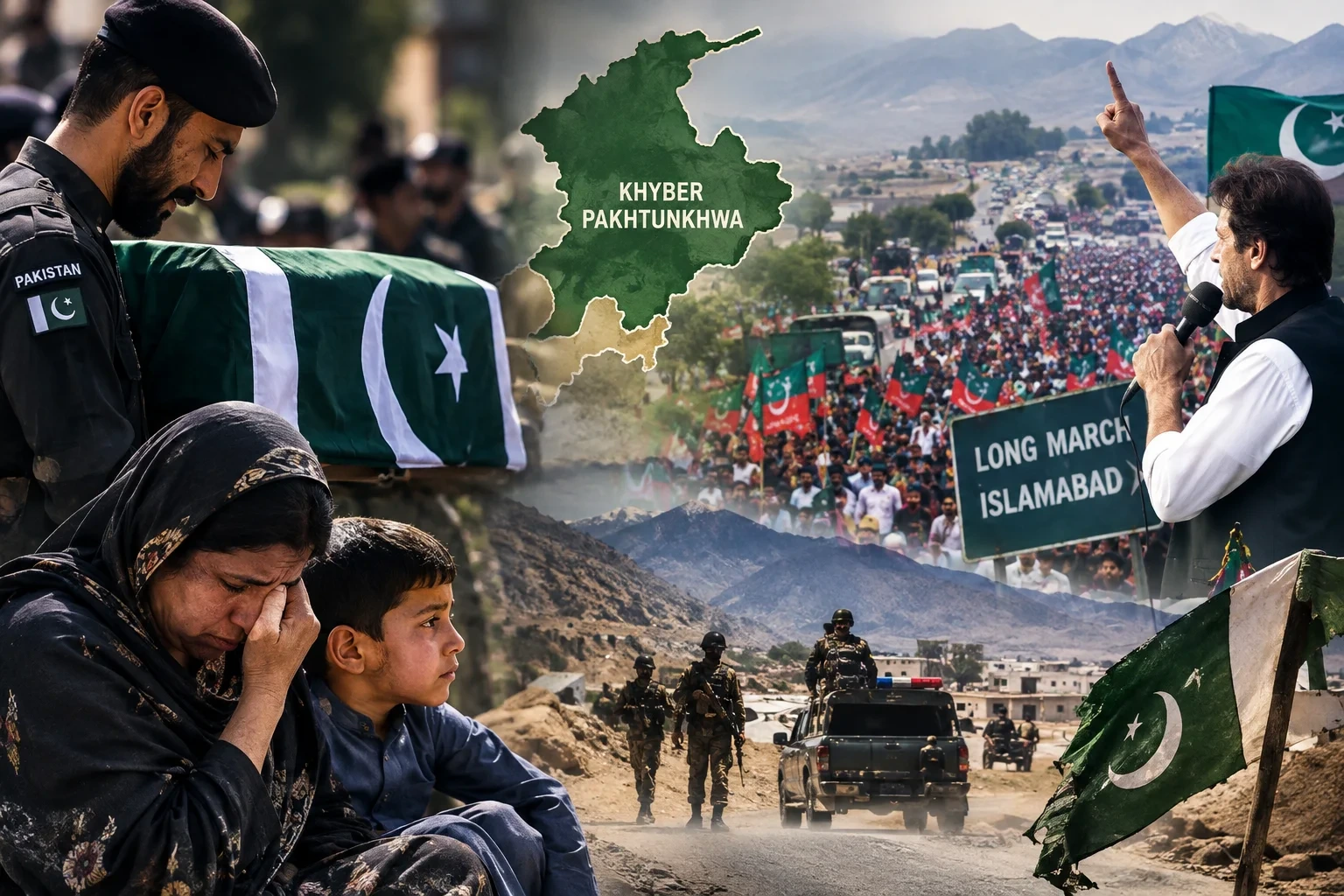
Once again, the people of Khyber Pakhtunkhwa are living under the shadow of fear, uncertainty and terrorism. Almost every day brings another painful story.
A police officer is martyred in one place. A soldier loses his life in another. Elsewhere, civilians face attacks on roads, markets and security checkpoints.
At such a difficult time, an important question must be asked: how long will the people of Khyber Pakhtunkhwa continue to carry the dead?
The province needs security, good governance and economic development. Yet, political confrontation continues to dominate public attention.
Khyber Pakhtunkhwa Faces a Security Challenge
The debate has intensified because Khyber Pakhtunkhwa Chief Minister Sohail Afridi is leading a PTI long march toward Islamabad. The march began from Lakki Marwat on October 4 and is demanding the release of PTI founder Imran Khan.
The author argues that the Chief Minister should give greater priority to provincial governance and security. In his view, the use of provincial political energy for a long march raises questions about the government’s priorities.
These concerns come as Pakistan faces a serious militant threat. According to the Pakistan Institute for Conflict and Security Studies, 225 militant attacks were recorded across Pakistan in September 2026. The attacks caused 259 deaths and 242 injuries.
Khyber Pakhtunkhwa remains one of the major areas affected by militant violence.
For ordinary families, however, political arguments often come second. Their main concern is simple: will their sons return home safely?
PTI-Government Talks End Without Agreement
The political crisis became more complicated after negotiations between the federal government and PTI failed.
According to reports, counterterrorism cooperation was one of the major issues in the talks. Federal Interior Minister Mohsin Naqvi accused Chief Minister Sohail Afridi of undermining the negotiations. PTI has presented its own position on the dispute.
The failure of talks was followed by the Islamabad march.
The author questions whether continued political confrontation can solve the province’s security and governance problems. He argues that the Chief Minister’s responsibilities extend beyond party politics.
Once a politician becomes Chief Minister, his responsibility covers the entire province. That includes PTI voters, opposition voters and citizens who may support no political party.
The Human Cost of Political Conflict
Behind every security statistic is a family.
A martyr leaves behind parents, children, siblings or a spouse. A widow may spend years seeking financial assistance. Children may grow up without their fathers.
Therefore, terrorism cannot be treated only as a political talking point.
The author also raises questions about the province’s response to militant violence and the broader debate over Afghanistan. However, claims about foreign involvement and responsibility for attacks remain contested and should be assessed through evidence rather than political statements alone.
The people of Khyber Pakhtunkhwa have already made enormous sacrifices for Pakistan. Their history includes decades of conflict, displacement and terrorism.
They deserve peace.
What Do the People of KP Want?
The central question is not whether political leaders have the right to protest. They do. Political parties also have the right to demand the release of their leaders and raise constitutional or political issues.
The deeper question is about priorities and responsibility.
Can political confrontation continue indefinitely while terrorism threatens ordinary citizens?
Can a province prosper without sustained attention to security, education, health and economic development?
The people of Khyber Pakhtunkhwa need answers.
Imran Khan may remain an important political figure for PTI supporters. However, the people of the province also have immediate needs. They want safe roads, functioning institutions, economic opportunities and protection from terrorism.
The province cannot afford endless confrontation.
Its people have already carried too many coffins.
The time has come for political leaders to decide whether their priority is continued confrontation or a serious effort to restore peace and improve governance in Khyber Pakhtunkhwa.