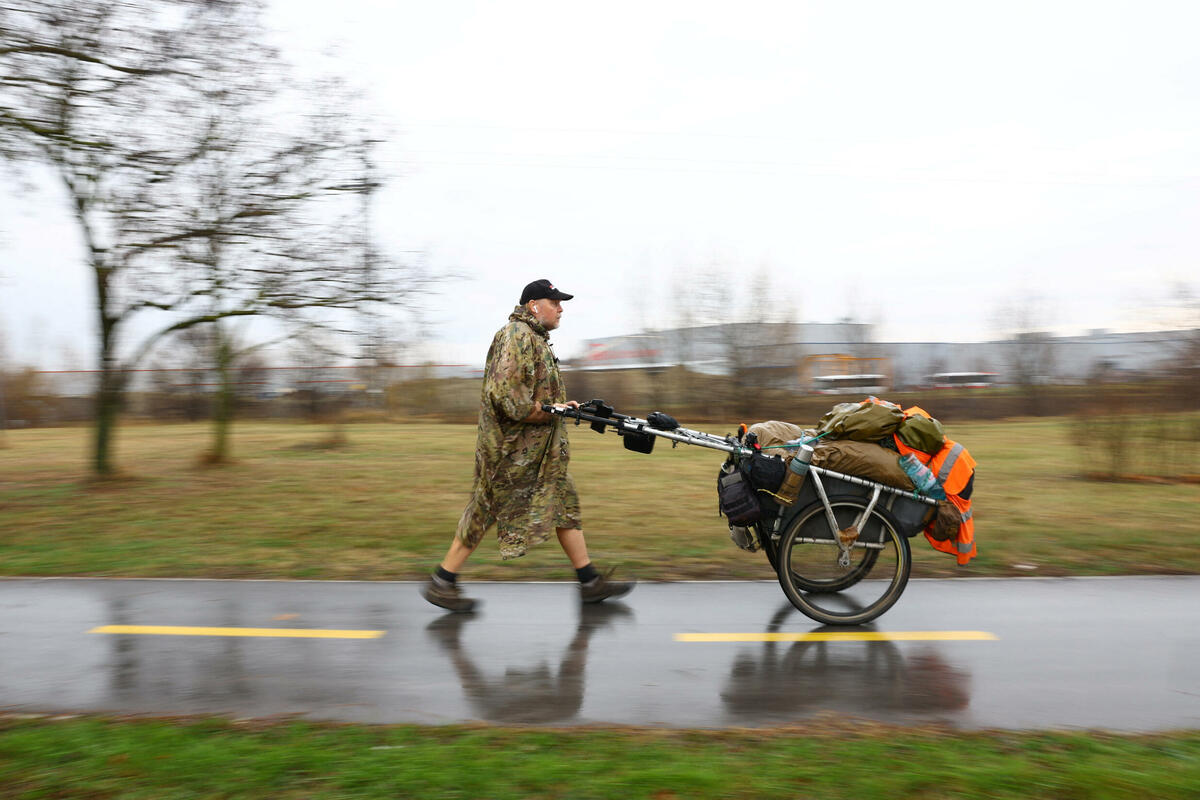
Most journeys measured in decades belong to history books, not living adventurers. Karl Bushby’s round-the-world walking journey is the exception. Since 1998, the former British paratrooper has been on a single, unbroken walk from the southern tip of Chile to his childhood home in Hull, England — a route now estimated at close to 50,000 kilometres.
How the Journey Began
Bushby left Punta Arenas, Chile, on November 1, 1998, setting two personal rules that have defined the expedition ever since: he would not use any motorised transport, and he would not return home until the walk was physically complete. He originally expected the trip to take around twelve years.
Nearly three decades later, that estimate has more than doubled, not because Bushby slowed down, but because the world around him kept changing.
The Obstacles Along the Way
Early in the expedition, Bushby crossed the Darien Gap, the dense, roadless jungle between Colombia and Panama long considered one of the hardest overland routes on Earth. He then walked the length of North America before attempting the most unusual leg of the trip: crossing the frozen Bering Strait on foot from Alaska into Russia in 2006.
What followed were years of visa disputes and detentions that stalled his progress through Russia. Later, the war in Ukraine closed off his planned route north, forcing a detour through Kazakhstan, Uzbekistan and Turkmenistan. Unable to enter Iran, he chose an unlikely alternative: swimming across the Caspian Sea, a crossing that took roughly a month to complete in 2024.
Reaching Europe
By 2025, Bushby had crossed back into Europe via Istanbul, walking through Turkey, Bulgaria, Romania, Hungary and Austria before reaching Germany and France. Each border added new paperwork, and periodic breaks in Mexico allowed him to reset visa allowances without breaking the unbroken nature of his route, since he always resumed from the exact point he had paused.
The Final Barrier
The last obstacle in this long-distance walking journey turned out to be one of the smallest distances on the map: the roughly 33-kilometre English Channel. Bushby had hoped to walk through the Channel Tunnel’s service corridor, but Eurotunnel declined the request over safety concerns. Swimming became the only remaining option under his self-imposed rules, and French authorities granted permission for the attempt in early September 2026.
Why It Matters
Bushby’s expedition is widely regarded as one of the most ambitious attempts at a continuous, transport-free circumnavigation on foot. Beyond the physical distance, the journey has become a case study in persistence through financial setbacks, a global pandemic, and shifting international politics — all while maintaining the same basic rule set from day one.
Frequently Asked Questions
Where is Karl Bushby now in 2026?
Karl Bushby is currently on the French coast near the English Channel, having completed almost the entire overland portion of his route. He is awaiting favourable conditions to attempt the Channel swim, which is the final major obstacle before he can walk the remaining distance to Hull, England.
Did a man walk for 27 years?
Yes, Karl Bushby has been walking continuously, with planned pauses at border points, since November 1998. By 2026, his journey had reached 27 to 28 years, making it one of the longest documented walking expeditions in modern history, covering nearly every major landmass between South America and Europe.
Why has Karl Bushby taken so long?
The length of the journey reflects the scale of the obstacles rather than any lack of progress. Bushby has navigated the Darien Gap, the frozen Bering Strait, visa restrictions across Russia and Central Asia, a global pandemic, funding shortages, and now Channel-crossing negotiations — each adding months or years to a route that was never going to be simple.