Summary
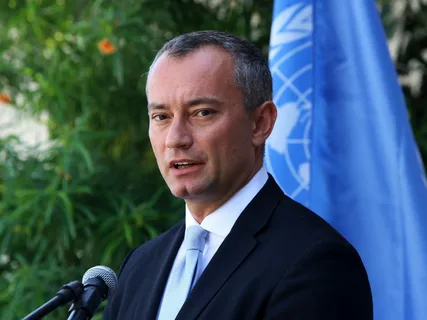
A senior official at the US-backed Board of Peace said on Monday that the two-state solution is close to becoming unworkable. He pointed to two things happening at once: the stalled follow-through in Gaza and worsening West Bank escalation. Nickolay Mladenov, the high representative for Gaza, made the remarks while speaking at the Hili Forum in Abu Dhabi, and his warning lands at a moment when the ceasefire process in Gaza is still only partly implemented.
Background
The Board of Peace was set up to oversee a US-backed ceasefire and reconstruction plan for Gaza, one that grew out of President Donald Trump’s 20-point comprehensive proposal. Its job includes running Gaza’s transitional administration, supervising reconstruction, and pushing forward a broader Israel Palestine conflict settlement built around eventual Palestinian self-governance. A roadmap accepted by Hamas on July 30 laid out a process for handing over weapons, to be supervised by the International Stabilisation Force, a new unit meant to deploy once conditions in Gaza allow it.
At the same time, the West Bank has been under sustained pressure. Violence there has been climbing steadily since the war in Gaza began after Hamas’s October 7, 2023 attack on Israel, and it hasn’t really let up since. More than 500,000 Israeli settlers now live in the occupied territory alongside roughly three million Palestinians, and settlement expansion has kept eating into the land Palestinians would need for a viable future state.
Details
Mladenov didn’t hedge much. He said that if Gaza keeps going the way it’s going, or if the comprehensive plan doesn’t move into its next implementation phase, the two-state solution becomes “practically impossible.” His reasoning comes down to control on the ground: more than half of Gaza is currently held by the Israeli military, while less than half remains under Hamas. Split control like that, he argued, leaves no credible route to an actual political settlement.
He also flagged weapons as the sticking point holding everything else up. Demilitarization has to happen before broader steps can follow, he said, describing the scale of militarization inside Gaza as far bigger than most people realize. Getting there requires three things moving together: transitional governance actually functioning, decommissioning of weapons proceeding, and an Israeli military withdrawal in Gaza.
The timing of his remarks isn’t incidental. They came a day after Jared Kushner, the White House envoy and Trump’s son-in-law, told reporters in Kyiv that Israel’s upcoming elections were making Israeli leaders “a little irrational” on Gaza policy — a comment that suggests Washington sees domestic Israeli politics as one more obstacle to steady implementation of the plan.
Quotes
Mladenov put it plainly: “if Gaza continues the way it is now, or does not move into implementing… the plan that we have under the comprehensive plan, the two-state solution will become practically impossible.” On the militarization problem specifically, he said flatly, “you can’t go in if there’s guns.”
Impact
If Mladenov’s assessment holds up, it has consequences well beyond Gaza’s borders. A two-state solution has been the working framework — however battered — behind nearly every major diplomatic push on the Israel Palestine conflict for three decades. Losing it as a viable option would leave the region without an agreed destination, not just a rough road there.
Regionally, Arab and Muslim-majority states that joined the Board of Peace, including Pakistan and Qatar, have staked real political capital on this plan working. A collapse would weaken the case, made repeatedly at the UN Security Council, that the ceasefire and a credible path to Palestinian self-determination can be pursued together. It would also complicate the West’s approach: several European governments have already imposed sanctions tied to settler violence, arguing that settlement expansion is what’s actually foreclosing the two-state option on the ground.
Conclusion
Where this goes next depends on whether the comprehensive plan’s second phase actually gets moving — weapons decommissioning, transitional governance, and a phased Israeli withdrawal from Gaza. Mladenov’s language suggests the Board of Peace sees a narrowing window, not a closed one. Whether that window stays open probably comes down to what happens in the West Bank just as much as what happens in Gaza, and to whether Israel’s elections end up hardening positions rather than opening room to negotiate.
FAQs
Why did Palestine reject the two-state solution?
This is a common misreading of the history. Palestinian leadership — the PLO and later the Palestinian Authority — has, at various points, accepted the principle of two states, including in the 1988 declaration of independence that implicitly recognized Israel within the pre-1967 lines, and in negotiations at Camp David (2000), Taba (2001), and Annapolis (2007-08). What Palestinian negotiators have rejected are specific proposals they viewed as offering non-contiguous, disconnected territory without real sovereignty, security control, or a resolution on Jerusalem and refugees. Hamas, which governs differently from the PLO/PA, has historically rejected recognizing Israel outright, though it has at times signaled openness to a long-term truce based on 1967 lines without formal recognition. So the honest answer is: it depends which Palestinian faction and which specific proposal you’re asking about — there’s no single, blanket Palestinian rejection of the concept itself.
Does Palestine agree to a two-state solution?
The Palestinian Authority’s official position, reaffirmed repeatedly at the UN and in statements from President Mahmoud Abbas, supports a two-state solution based on the 1967 borders with East Jerusalem as the capital of a Palestinian state. This is also the position most Arab League and OIC member states have endorsed, including through the 2002 Arab Peace Initiative. Hamas’s position is more complicated: it has occasionally floated a long-term hudna (truce) built around a state in the 1967 borders without formally recognizing Israel’s legitimacy, which most international mediators don’t consider equivalent to accepting a two-state solution in the way Israel or Western governments define it. So broadly, yes — official Palestinian diplomacy backs the two-state framework, even as the practical path there remains contested and, per Mladenov’s comments, increasingly narrow.
Why is Israel against a two-state solution?
Not all of Israel is against it — Israeli public and political opinion is split, and the position has shifted a lot depending on who’s in government. The current Israeli coalition, along with a significant part of the political right, opposes Palestinian statehood on security and ideological grounds: concerns that a Palestinian state could become a launchpad for attacks (a fear reinforced for many Israelis by October 7), claims rooted in religious or historical attachment to the West Bank, and skepticism that any Palestinian government could guarantee lasting security. Other parts of the Israeli political spectrum, particularly on the center and left, continue to support a two-state outcome as the only realistic way to preserve Israel as both a Jewish-majority and a democratic state long-term. Continued settlement expansion under successive governments is often cited by critics, including UN officials, as evidence that a two-state solution is being made physically harder to implement regardless of what any government says it supports.