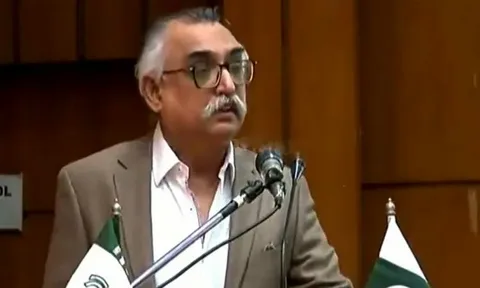
Jamaat-i-Islami has sent a Rs1 billion defamation notice to former Federal Board of Revenue chairman Shabbar Zaidi. The party accuses him of making unfounded corruption allegations against it during a recent podcast appearance. Zaidi says he has passed the notice to his lawyer.
The dispute is the latest in a string of controversies trailing Zaidi since he left government in 2020. He remains one of Pakistan’s most quoted voices on tax policy and the state of the national economy, and his public remarks routinely draw pushback from politicians, parties, and government agencies alike.
Background
Syed Muhammad Shabbar Zaidi is a Karachi-born chartered accountant who served as the 26th chairman of the Federal Board of Revenue. Prime Minister Imran Khan appointed him to the post in May 2019. He held the role for less than a year before being removed in April 2020.
During his brief tenure, Zaidi introduced the Asset Declaration Scheme, an amnesty program with a July 2019 deadline. Government figures at the time credited the scheme with “whitening” roughly Rs3 trillion in previously undeclared assets and generating about Rs70 billion in revenue from some 137,000 declarants. The scheme drew criticism too, since Khan had earlier condemned tax amnesties as tools that let “corrupt elements” launder wealth.
Since leaving the FBR, Zaidi has built a public profile as an economic commentator. He appears frequently on television and podcasts, where he offers blunt assessments of Pakistan’s fiscal health. In one widely reported 2021 speech at Hamdard University, he said the country was, in his words, not a “going concern” and effectively bankrupt. He later said the remarks had been “cherry-picked” from a longer talk.
The Jamaat-i-Islami Notice
The current dispute traces back to a podcast interview in which Zaidi is alleged to have described Jamaat-i-Islami as the “establishment’s firewall,” a party that helps “dilute” public protests. JI’s Karachi chapter, acting on the direction of general secretary Taufiquddin Siddiqui, instructed lawyer Tahir Iqbal Malik to issue the notice on July 27.
According to JI’s statement, the notice accuses Zaidi of making “serious allegations against the party, including secret funding, bribery, corruption, political deception, betrayal of public interests, and alleged collusion with state elements.” The party says these claims spread across YouTube, Facebook, X, TikTok, and WhatsApp after the original interview.
JI’s notice does not just ask for damages. It also demands that Zaidi produce evidence: the identity of whoever allegedly paid the money, who received it, the amount, the date and place of the transaction, the payment method, supporting bank records, details of which protest was allegedly suppressed, and any witnesses. Failure to substantiate the claims, the notice suggests, would strengthen the party’s defamation case.
Contacted by Dawn, Zaidi confirmed he had received the notice and said he had forwarded it to his legal team for advice. He has not yet issued a detailed public response to the specific allegations JI raises.
A Pattern of Disputes
This is not the first legal or regulatory dispute Zaidi has faced since leaving public office. In late October 2025, the Federal Investigation Agency’s Anti-Corruption Circle in Karachi registered a case against him, alleging that Rs16 billion in unauthorized income tax refunds were issued during his time as FBR chairman. The FIR claimed the funds went to entities including Habib Bank, Engro, and DG Khan Cement, some of which the FIA said had previously been clients of Zaidi’s private audit and consultancy practice, raising conflict-of-interest questions.
That case did not last. Within days, the FIA’s Karachi division withdrew it, formally cancelling the FIR and closing it as a “C-Class” file with a discharge report. Separately, the FBR itself had earlier cleared Zaidi of similar allegations. A 2022 report submitted to the Public Accounts Committee by FBR Member Mir Badshah Khan Wazir found no evidence that Zaidi had personally instructed field offices to issue the disputed refunds, and noted that the companies involved were large, tax-compliant corporate entities.
Zaidi has also continued to weigh in on live policy debates. Earlier this month, he argued that Punjab’s economic performance has become a drag on the national economy, telling interviewers that the province has grown overly dependent on remittances while its agriculture and textile sectors have declined. He suggested that, on a province-by-province balance sheet, Punjab would actually show a negative position compared with Sindh, Balochistan, and Khyber Pakhtunkhwa.
Impact
The defamation notice adds another layer of friction between a prominent economic commentator and a major political party, at a moment when public trust in state institutions and financial transparency remains a live issue in Pakistan. How JI proceeds, whether it files a formal defamation suit in court or waits for Zaidi’s response, will likely shape how open commentators feel about criticizing political parties on air.
The broader pattern also matters. A former tax chief cleared of corruption allegations twice, in 2022 and again in 2025, while now facing a defamation claim over separate remarks, illustrates how contested Pakistan’s institutional accountability process can be. Cases against high-profile former officials are opened, closed, and reopened in the public eye, often without clear final resolution.
Conclusion
Zaidi has said he is seeking legal advice before responding formally to Jamaat-i-Islami’s notice. Whether the party moves to file suit, and whether Zaidi produces the evidence JI has demanded, will determine the next stage of this dispute. Given his history of outspoken commentary on Pakistan’s economy and institutions, it is unlikely to be his last public controversy.
Frequently Asked Questions
Who is Shabbar Zaidi in Pakistan?
Shabbar Zaidi, full name Syed Muhammad Shabbar Zaidi, is a Pakistani chartered accountant who served as the 26th chairman of the Federal Board of Revenue from May 2019 to April 2020. He was appointed by then-Prime Minister Imran Khan and is known for introducing the 2019 Asset Declaration Scheme. Since leaving office, he has become a frequent television and podcast commentator on Pakistan’s tax system and broader economic condition, and his remarks often generate public debate.
Who is Shabbar?
“Shabbar” refers to Syed Muhammad Shabbar Zaidi, commonly known in Pakistani media simply as Shabbar Zaidi. He is a chartered accountant by profession and a former head of the country’s federal tax authority, the FBR. Outside government, he runs an audit and consultancy practice and continues to comment publicly on fiscal policy, tax administration, and the state of Pakistan’s economy.
What are some examples of corruption in Pakistan?
Pakistan has seen a range of corruption cases across government departments over the years, including allegations involving tax refunds, procurement contracts, and misuse of public funds by officials at various levels. Cases are typically investigated by bodies such as the National Accountability Bureau (NAB) and the Federal Investigation Agency (FIA). Outcomes vary widely: some cases result in convictions, others are withdrawn or closed for lack of evidence, as seen in the FIA’s decision to cancel its 2025 case against Shabbar Zaidi after an initial inquiry.