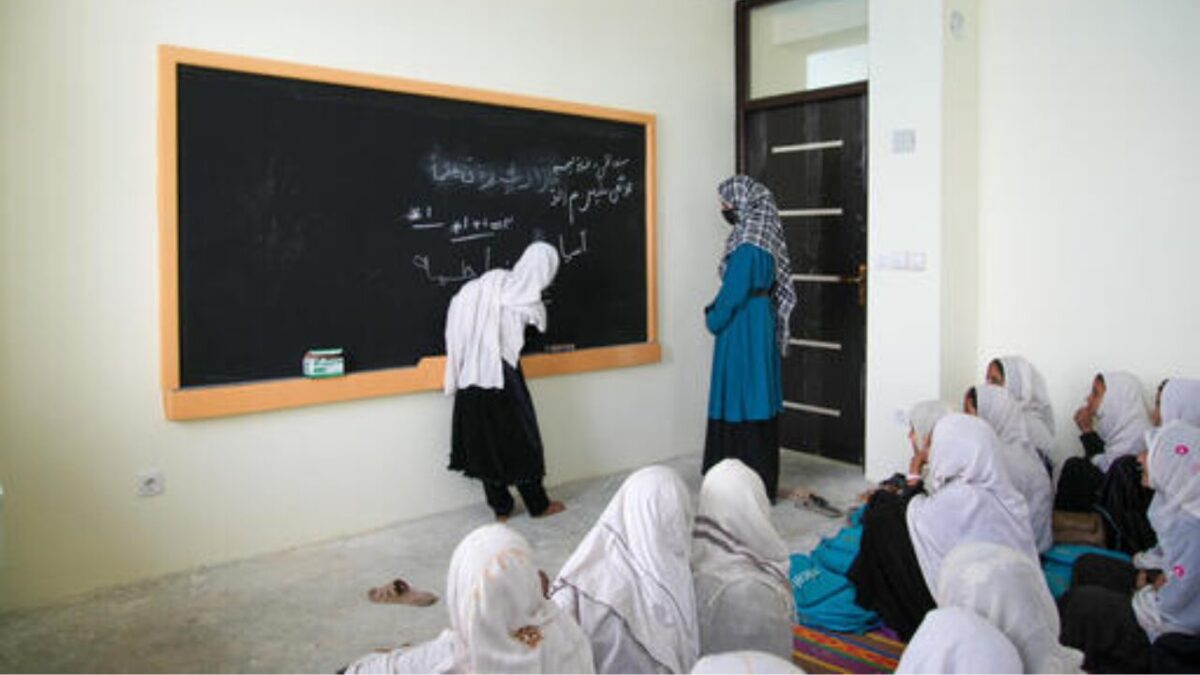
Afghanistan remains the only country on earth where a government has formally barred girls from secondary and higher education. Five years after the Taliban seized power, roughly 2.2 million adolescent girls are still shut out of classrooms beyond grade six, according to UNESCO and UNICEF.The restriction has not eased. It has hardened into policy, decree by decree, since August 2021.
Background: How the Ban Took Shape
The Taliban returned to power in August 2021. Girls’ secondary schools closed first, in March 2022. Universities followed in December of that year. By January 2023, the Taliban had gone further, banning girls from even sitting university entrance exams.
Since then, the group has issued more than 70 separate decrees affecting women’s rights, according to UNESCO. Many target public life directly: work, movement, and now, increasingly, the media. A 2024 “virtue and vice” law bars women from speaking on the radio and forbids any public depiction of human figures.
Primary schools technically remain open to girls. But enrollment there has slipped too, hit by social pressure, safety concerns, and families simply losing faith that education leads anywhere under current rules.
The Numbers Behind the Headlines
A UNICEF analysis released in April 2026, titled “The Cost of Inaction on Girls‘ Education and Women’s Labour Force Participation in Afghanistan,” lays out the scale in blunt terms. Since the ban began, at least one million girls have been directly denied secondary schooling. If nothing changes by 2030, that number climbs past two million.
The workforce is already thinning. Female representation in Afghanistan’s civil service dropped from 21 percent to 17.7 percent between 2023 and 2025 alone. The number of female teachers in basic education fell from close to 73,000 in 2022 to around 66,000 by 2024, a decline of more than 9 percent.
UNICEF projects Afghanistan could lose up to 20,000 women teachers and 5,400 healthcare workers by 2030 if restrictions hold. That is not an abstract loss. It is classrooms without teachers and clinics without staff, in a country where women are often the only professionals rural families will trust to treat their daughters.
The economic toll is measurable too. Restrictions on girls’ education and women’s employment are already costing Afghanistan roughly 84 million dollars a year in lost output, according to the UNICEF report, with the damage compounding the longer the policy stays in place.
Quotes: What Officials Are Saying
UNICEF Executive Director Catherine Russell has been direct about what is at stake. She said Afghanistan cannot afford to lose the future teachers, nurses, doctors, midwives and social workers who keep essential services running, warning that this is exactly the trajectory the country is on if girls stay excluded.
UN Women’s Executive Director Sima Bahous has pressed a similar point at the start of each new academic year, calling on the Taliban to let girls return to school and describing the exclusion as a clear violation of their basic rights.
Notably, a UN Women Gender Alert published in 2026 found something the Taliban may not want highlighted: opposition to the ban is not a foreign talking point. Across gender and income lines, Afghans overwhelmingly support girls’ right to an education, and roughly 40 percent of Afghan women say they still imagine a future where things change for the better.
Impact: Regional and Global Consequences
The fallout reaches beyond Afghanistan’s borders. Aid agencies operating in the region warn that a generation raised without secondary schooling for half its population will need decades to recover, even if policy shifts tomorrow.
Regionally, Pakistan and other neighboring states continue to host large Afghan refugee populations, many of them families who left specifically so daughters could keep studying. That migration pressure is not slowing down.
Globally, the ban has become a reference point in human rights diplomacy. UNESCO’s January 2026 report, “Banned from Education: A Review of the Right to Education in Afghanistan,” documents the legal and institutional dismantling of girls’ schooling since 2021 and has been cited repeatedly by UN bodies pushing for the restrictions to be reversed.
Despite the ban, aid groups have not walked away. In 2025, UNICEF says it supported more than 3.7 million children in public schools and reached 442,000 children through community-based learning programs, two-thirds of them girls. Over 230 schools were built or rehabilitated during the same period.
Conclusion: What Comes Next
There is no sign the Taliban intends to reverse course in the near term. Every UN statement on this issue, going back to 2022, has repeated some version of the same appeal, and every year the ban has simply continued.
What has changed is the data. Agencies now have five years of numbers showing exactly what the policy costs, in teachers, in healthcare workers, in GDP, in the mental health of an entire generation of girls confined to their homes. UNICEF has flagged rising rates of early marriage and anxiety among affected girls as a direct consequence of the exclusion.
Whether that evidence moves the policy is another question. For now, the 2.2 million girls waiting outside grade seven remain exactly where they were a year ago, and the year before that.
FAQs
What is the literacy rate for females in Afghanistan?
Afghanistan already had one of the lowest female literacy rates in the world before the Taliban takeover, and the secondary education ban has worsened the gap since 2021. UNESCO figures place female literacy well below the regional average, with rural areas facing even steeper shortfalls, since schools there were often the only source of formal education for girls in the first place.
How can I help Afghan girls?
International organizations including UNICEF, UNESCO, and UN Women run active programs supporting community-based learning, online education, and advocacy for Afghan girls, and they accept donations and volunteer support through their official channels. Beyond donating, sharing verified reporting, supporting resettlement and scholarship programs for Afghan students abroad, and pressuring elected representatives to keep the issue on diplomatic agendas are all concrete ways individuals can contribute.
In which country is it most difficult for girls to get an education?
Afghanistan currently holds that distinction, and not by a small margin. It is the only country in the world with a formal, government-enforced ban on secondary and higher education for girls, a status confirmed repeatedly by UNESCO and UNICEF reporting through 2026, making it the starkest case of state-imposed educational exclusion anywhere today.