In the name of Allah, the Most Gracious, the Most Merciful
The Kitchen: The Last Trench of Family Survival
By Mian Iftikhar Ahmed
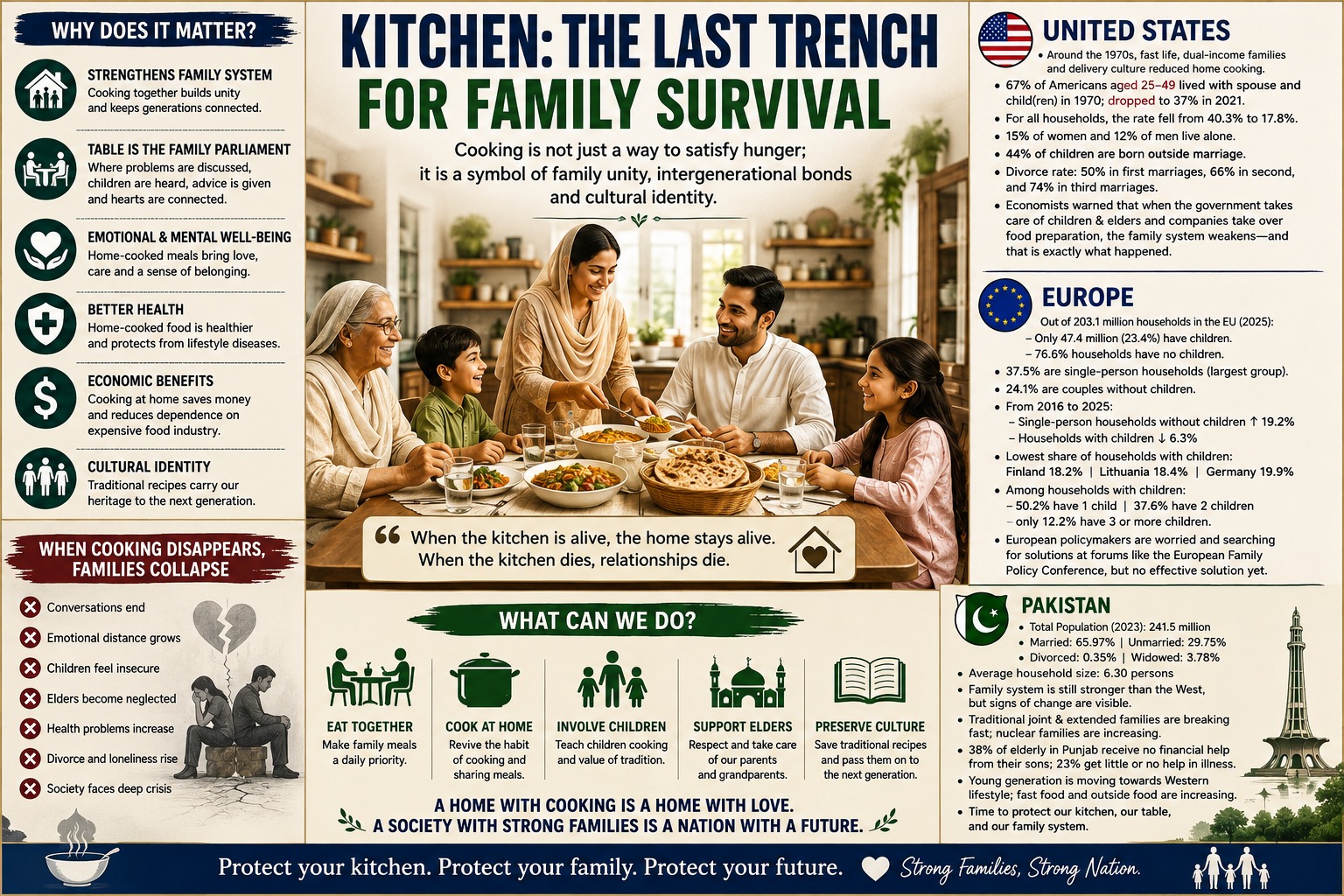
This title may seem heavy and alarming, but when we examine statistics, historical facts, and research from international think tanks, it becomes clear that this is no exaggeration. Cooking is not merely a means to satisfy hunger; it is a symbol that represents family unity, intergenerational connection, and cultural identity. When cooking ceases in homes, cracks begin to appear in the very foundation of the family system. This article explores the reality of what happens when the practice of home cooking disappears, examining its effects on family, health, economy, and civilization as a whole. It also looks at what lessons we can learn from the experiences of America, Europe, and Pakistan. This is a subject being researched worldwide, and Pakistani think tanks are also expressing concern in their reports about this growing trend.
The act of cooking is not merely a practical necessity but carries deep symbolic significance. When a woman or a man kneads dough with their hands, chops vegetables, and cooks curry on the stove, they are actually creating an aroma that binds the entire household together. This is the same aroma that makes a child feel at home upon returning from school, the same flavor that brings comfort to a husband after a long day of exhaustion, and the same scent that evokes memories of one’s mother for the elderly. When this chain breaks, the house becomes merely a collection of walls and a roof where people come and go but remain disconnected from one another. The dining table is the parliament of the family where the day’s problems are discussed, children share their worries, fathers give advice, mothers offer consolation, and everyone shares in each other’s joys and sorrows. When this table becomes empty, conversation dies, silence and loneliness become part of the home, and then comes a day when family members become strangers to one another. These are the early warning signs that later take the form of major social crises.
In America, this transformation began around the 1970s when increasing female employment, the fast pace of urban life, and the rise of delivery culture reduced the practice of home cooking. People began prioritizing convenience and time-saving, and ordering food from outside or eating fast food became the norm. Along with this, a remarkable transformation occurred in the American family structure. According to the Pew Research Center, in 1970, 67 percent of American adults aged 25 to 49 lived with their spouse and one or more children, but by 2021 this figure had dropped to 37 percent. If we look at all households, the Census Bureau reports that this rate fell from 40.3 percent to 17.8 percent. This is not merely a numerical change; behind it lies a complete cultural and social revolution that has shaken the very foundations of American society. A large number of people have started living alone, with fifteen percent of women and twelve percent of men living in single-person households. In this twenty-first-century America, forty-four percent of children are born outside of marriage, the divorce rate for first marriages has reached fifty percent, for second marriages it is sixty-seven percent, and for third marriages it is seventy-four percent. None of this is accidental; it is the price of a society that abandoned home-cooked meals and the family dining table. Economists had already warned about this transformation, saying that when the government takes over the care of children and the elderly, and private companies take over food preparation, the family system would weaken, and that is exactly what happened.

The situation in Europe is even more alarming than in America. According to Eurostat data for 2025, out of 203.1 million households in the European Union, only 47.4 million, or 23.4 percent, have children, while the remaining 76.6 percent are childless. Among these, the largest group is single-person households, comprising 37.5 percent of all households, followed by childless couples at 24.1 percent. Between 2016 and 2025, single-person households increased by 19.2 percent, while households with children declined by 6.3 percent. The lowest rates of households with children are found in Finland at 18.2 percent, Lithuania at 18.4 percent, and Germany at 19.9 percent. Within the European Union, 50.2 percent of households with children have only one child, 37.6 percent have two children, and only 12.2 percent have three or more children. These figures clearly demonstrate the deep connection between home cooking and the family system. Where cooking declined, families disintegrated, and where families disintegrated, cooking declined. European policymakers are worried by these numbers and are attempting to find solutions through forums like the European Family Policy Conference, but no effective solution has yet emerged.
In Pakistan, the situation is not yet as severe as in America and Europe, but signs of change are becoming apparent. According to Pakistan’s 7th Population and Housing Census 2023 conducted by the Pakistan Bureau of Statistics, the total population of Pakistan is 241.5 million, of which 65.97 percent are married while 29.75 percent are unmarried. The proportion of divorced individuals is only 0.35 percent, and widows and widowers account for 3.78 percent. The average Pakistani household size is 6.30 persons. These figures indicate the relative strength of the family system compared to America and Europe. However, despite these positive indicators, the joint family system in Pakistan is rapidly breaking down. Research by the Pakistan Institute of Development Economics shows that the traditional joint and extended family system is rapidly disintegrating, being replaced by nuclear families, and as a result, the elderly are increasingly being left without support. A survey in Punjab found that 38 percent of elderly men and women receive no financial support from their adult sons, and 23 percent rarely or never receive any help from their children during illness. The decision-making structure in Pakistani families is largely patriarchal, with one study showing that 99 percent of families operate under a patriarchal system where the head of the household or husband makes decisions alone. While this patriarchal system has traditionally been strong, cracks are now appearing as women become empowered through education and employment, demanding inclusion in decision-making.
Regarding the future of Pakistan’s family system, experts are divided, but most agree that the traditional joint family of the past is not returning; rather, the family is taking on new forms. The question is whether these new forms will be as strong as the old ones. The answer depends on how we manage this transition. If we allow these changes to occur without any plan, the results could be devastating, with the elderly becoming helpless, children receiving weak upbringing, and society plunging into a psychological crisis. However, if we consciously understand this change and develop new social structures accordingly, the core functions of the family—emotional support, transmission of values, and care for the vulnerable—can be maintained even in new forms. Pakistani society still accords a central place to the family, and if we provide proper direction in time, we can learn from the experiences of America and Europe to chart a better course.
Key institutions conducting policy research on family planning and demographic issues in Pakistan include the Pakistan Institute of Development Economics, the Sustainable Development Policy Institute, the Pakistan Institute of Legislative Development and Transparency, and the Institute of Policy Studies. Research from these institutions reveals that Pakistan’s family system is at a critical juncture where the traditional system is breaking down and the new system has yet to fully take shape. The Sustainable Development Policy Institute is emphasizing the need to create media awareness about family planning and reproductive health, working with the United Nations Population Fund to bridge the gap between policy and practice. According to research from the Pakistan Institute of Legislative Development and Transparency, family influence runs deep in Pakistani politics, with 55 to 60 percent of elected members of the 2018 National Assembly belonging to politically connected families, which has a profound impact on the democratic process. While this family influence poses a challenge to democracy on one hand, on the other hand it demonstrates that the family remains a powerful institution in Pakistani society.
The cessation of home cooking has profound health implications. Home-cooked food is always superior to outside food because it uses quality oil, balanced spices, and most importantly, is made with love. When home cooking stops, people become dependent on delivery and fast food, which are laden with substandard oil, artificial flavors, and excessive sugar and salt. The result will be obesity, diabetes, heart disease, and high blood pressure at younger ages. Pakistani genetics are particularly susceptible to these diseases, and if we adopt this dietary path, our coming generations will face severe medical challenges in the decades ahead. According to the World Health Organization, diets high in processed foods increase the risk of heart disease, diabetes, and obesity by more than 30 percent, and regular home-cooked meals are associated with better nutrition, lower obesity rates, stronger family bonds, and improved mental health. This epidemic began in America and Europe in the final decades of the last century, and today large portions of their populations suffer from these diseases, while governments and pharmaceutical companies profit from this crisis. If this trend spreads in Pakistan, our already weak healthcare system will be unable to bear the increasing burden, and millions will lose their lives prematurely.
Another dimension of the cessation of cooking is economic. Home-cooked food is not only healthier but also more economical. A housewife can prepare a plate of lentils and rice for about one hundred rupees, whereas ordering the same food from outside would cost six to eight hundred rupees. If home cooking stops, household budgets for food will increase by forty to fifty percent monthly, breaking the backs of middle and lower-class families. Pakistan is already suffering from inflation and rising prices, and such additional expenses would push millions of families toward poverty. At the same time, when the woman of the house stops cooking, she will begin to feel useless, and her role will be reduced to merely making purchases and placing delivery orders. This will increase anxiety and depression among women, leading to more conflicts between spouses, resulting in domestic violence and divorce. This combination of economic pressure and emotional distance will hollow out families from within, and then the same scene will unfold that we see today in America and Europe.
The American and European experience is an open lesson for us that if we do not take care of our family system and our kitchen in time, the situation that took fifty years to develop in America and Europe could manifest in Pakistan in just twenty years. Our elders used to carry home-cooked food even while traveling, considering it part of their culture and identity, but today, even while at home, we consider ordering food from outside as a convenience. This change may seem very minor on the surface, but its social, health, economic, and psychological effects are deep and lasting. We must understand that the kitchen is not just a stove and pots; it is the cradle of family civilization, the school of children’s upbringing, the guarantor of the elderly’s dignity, and the bridge of love between husband and wife. When the kitchen falls silent, the soul of the home falls silent, and then the house becomes merely a building where people live but become strangers to one another.
There is still time to revive our kitchens—not just the stove, but the relationships and the love that flourish around it. We must teach our children the taste of home-cooked food, seat them around the table for conversations, and make them feel that the aroma and flavor of home are far superior to any outside food. We must make room for the elderly at this table and learn from their experiences so that generations remain connected to one another. Women should view cooking not as a burden but as a mission in which the entire family participates and supports one another. Men should also play their part in the kitchen so that this process becomes a shared responsibility, further strengthening family bonds. Let us not turn our homes into restaurants and our families into mere social media friends. A bedroom does not make a home; a kitchen connects a family, and it is through the kitchen that a nation’s civilization and identity remain alive. This is not just about cooking; it is about our survival, our identity, and the future of our coming generations. If we do not pay attention today, tomorrow it will be too late, and we will fall into the same crisis from which America and Europe are struggling to escape.