

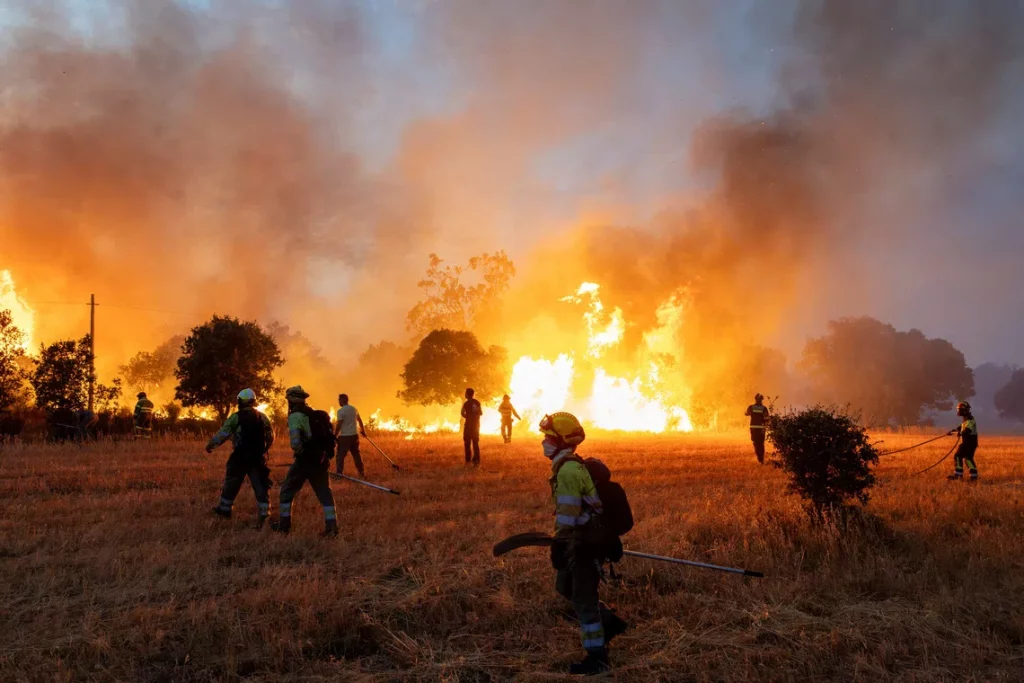

The wildfire crisis has intensified sharply this summer, with major blazes reported simultaneously in France, Spain, Greece, the United States, and Pakistan. From helicopters colliding while battling flames in Greece to hundreds of structures damaged in Washington state, the scale of this year’s fire season has renewed global debate over what is driving the wildfire crisis and whether current prevention systems are keeping pace.
Background
So, what is wildfire, exactly? A wildfire is an uncontrolled fire that burns through vegetation such as forests, grasslands, or brushland, often spreading rapidly depending on weather conditions, terrain, and available fuel. Unlike controlled agricultural burns, wildfires can move unpredictably and threaten homes, wildlife, and human life within hours of ignition.
The wildfire crisis is not new, but its scale has grown substantially over the past several years. The wildfire crisis 2022 season was particularly severe across Europe, with France, Spain, and Portugal recording some of their worst fire seasons on record amid extreme heat waves. That year set a troubling precedent for the increasingly destructive fire seasons that have followed since.
This year’s crisis follows a similar pattern. France recently announced its wildfires had been brought under control after blazes tore through the country’s southwest, an area described by officials as having burned through land four times the size of Paris at the height of the crisis. More than 60,000 residents were forced to flee their homes, some by boat, to escape fires racing toward the Atlantic coast near Bordeaux.
Details
In Greece, two firefighting helicopters collided while battling an active wildfire, a stark reminder of the physical danger firefighting crews face even with modern aerial resources. Greek authorities have deployed extensive air support throughout the summer as fires have repeatedly threatened populated areas across the country.
Meanwhile, wildfires in Washington state have damaged at least 600 structures, according to recent reports, adding to a US fire season already strained by dry conditions across the Pacific Northwest. The scale of destruction reflects a broader trend seen across the western United States, where wildfire seasons have grown longer and more intense over the past decade.
Pakistan has faced its own share of this year’s wildfire crisis. A massive blaze in Kotli Sattian destroyed more than 3,000 hectares of forest tree cover, prompting officials from the Ministry of Climate Change and Environmental Coordination to describe forest fires as becoming the “new normal” across the country. Similar fires have also struck Khyber Pakhtunkhwa’s Lower Dir district and the Kirthar mountain range in Sindh in recent seasons.
Understanding wildfire causes is central to addressing the crisis. Natural triggers include lightning strikes, particularly common in dry, thunderstorm-prone regions of the western United States and Arizona. Human-caused wildfires, however, remain the dominant factor globally, resulting from unattended campfires, discarded cigarettes, faulty electrical equipment, agricultural burning that spreads out of control, and, in some cases, deliberate arson.
This raises a common question people search for directly: is wildfire a natural disaster? Wildfires are generally classified as natural disasters when they result from natural ignition sources like lightning and are intensified by natural conditions such as drought, extreme heat, and high winds. However, because a large share of wildfires today are triggered or worsened by human activity, including land-use changes and climate change itself, many researchers now describe the modern wildfire crisis as a hybrid disaster shaped by both natural and human factors.
Quotes
Mohammad Saleem, spokesperson for Pakistan’s Ministry of Climate Change and Environmental Coordination, told Dawn that recent forest fires were not isolated incidents but a warning sign of a new climate reality facing the country, pointing to rising temperatures, prolonged dry spells, and erratic rainfall as conditions that make ignition and rapid fire spread increasingly likely.
French President Emmanuel Macron urged firefighting crews to “hold firm” against the blazes threatening the country’s Atlantic coast, according to NBC News, as authorities mobilized roughly 2,500 firefighters along with 18 planes and helicopters, including support from other European nations.
Saleem also emphasized the role of local communities in prevention efforts, noting that residents living closest to forests serve as the frontline protectors against wildfire risk, and that investing in their training and engagement remains among the most effective long-term defenses available.
Impact
The global impact of this year’s wildfire crisis extends well beyond the immediate destruction of homes and forest land. Smoke from large-scale fires has repeatedly degraded air quality in nearby cities, creating respiratory health risks for vulnerable populations, a pattern seen previously during Pakistan’s 2024 Margalla Hills fires, which worsened air quality across Islamabad.
Economically, the damage adds up quickly. Washington state’s 600 damaged structures and France’s massive burned area both represent significant financial losses tied to rebuilding, insurance claims, and lost agricultural or forest resources. Tourism-dependent regions, including parts of coastal France and Greece, have also reported disruption during peak summer travel season.
The broader climate dimension of the wildfire crisis is drawing increasing scientific attention. Research published in NPJ Climate and Atmospheric Science has linked intensifying heat events across South Asia to elevated wildfire risk, identifying Pakistan as a regional hotspot for increasingly severe and synchronized heat waves that dry out vegetation and reduce soil moisture.
Conclusion
As fire seasons grow longer and more destructive across multiple continents, governments are facing renewed pressure to invest in prevention infrastructure, early warning systems, and community-level forest stewardship programs. It’s an open question whether current firefighting capacity can keep pace with a wildfire crisis that increasingly spans Europe, North America, and South Asia at the same time.
For now, officials in each affected region continue urging caution, with authorities in France, Greece, Washington, and Pakistan all warning that dry, hot conditions could fuel further outbreaks before the season winds down.
Frequently Asked Questions
What are the main causes of wildfires?
Wildfires are caused by a mix of natural and human factors, with lightning strikes representing one of the most common natural ignition sources, particularly in dry regions prone to thunderstorms. Human activity, however, accounts for the majority of wildfires worldwide, including unattended campfires, discarded cigarettes, faulty power lines, sparks from machinery or vehicles, agricultural burning that escapes control, and occasional deliberate arson. Climate conditions such as prolonged drought, extreme heat, low humidity, and strong winds don’t start fires on their own, but they significantly increase the speed and intensity with which any spark, natural or human-caused, can turn into a large-scale wildfire.
Are there wildfires in Pakistan?
Yes, wildfires have become an increasingly frequent and severe problem across Pakistan in recent years, affecting regions including Khyber Pakhtunkhwa, Kashmir’s Kotli Sattian area, and the Kirthar mountain range in Sindh. Officials from Pakistan’s Ministry of Climate Change have directly linked this trend to rising temperatures, prolonged dry spells, and erratic rainfall patterns tied to broader climate change impacts across South Asia. Poor forest management, difficult mountainous terrain that limits firefighting access, and a lack of modern equipment have further compounded the challenge, often forcing rescue teams to rely on traditional firefighting methods in remote areas.
What to do if trapped in fire?
If you find yourself trapped by a wildfire, staying low to the ground is critical since smoke and toxic gases rise, and cleaner air is typically found closer to floor level in enclosed spaces or near open ground outdoors. If escape isn’t possible, seek out an area already burned, a body of water, or a clearing with minimal vegetation, since these locations have reduced fuel for the fire to continue spreading. Cover your nose and mouth with a damp cloth if available to reduce smoke inhalation, avoid areas with dense vegetation or narrow canyons that can funnel fire and heat, and call emergency services immediately if you have any signal or connectivity, giving your exact location so responders can reach you as quickly as possible.