

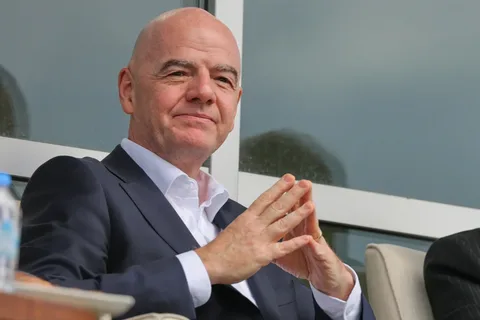

FIFA President Gianni Infantino is facing the most serious challenge of his decade in power, after the head of European football leagues declared his position “unacceptable” following the collapse of a secret plan to sell World Cup commercial rights to private investors. As pressure mounts for his resignation, interest has surged in Gianni Infantino‘s net worth, nationality, and how he rose to lead world football’s governing body in the first place.
Background
Gianni Infantino has served as FIFA president since February 2016, taking over an organization reeling from the corruption scandals that ended Sepp Blatter’s presidency. Under his leadership, FIFA expanded the men’s World Cup to 48 teams, launched a bigger Club World Cup, and dramatically increased the organization’s commercial revenue.
That legacy is now under threat. Earlier this week, Infantino announced plans to create a commercial subsidiary called FIFA Forward Enterprise, which would have sold a roughly 20 percent stake to outside investors, including a group reportedly led by Joshua Kushner. The plan triggered a unanimous boycott vote from UEFA’s 55 member nations before FIFA scrapped it entirely on Friday amid what officials called a widespread backlash.
Even after backing down, Infantino has not escaped the fallout. UEFA declared on Saturday it had lost confidence in his leadership, and Claudius Schaefer, head of the organization representing 53 professional men’s and women’s football leagues, told Swiss newspaper SonntagsZeitung that Infantino’s position now looks unacceptable.
Details
Schaefer’s comments carry weight because his organization, European Leagues, represents nearly every major professional football competition across the continent. Asked directly whether Infantino was now unacceptable as FIFA president, Schaefer said such an outcome is usually the consequence when someone pushes a major business deal forward in secret, without key governing bodies being informed.
The scandal has renewed public curiosity about Gianni Infantino’s background and how he became FIFA president in the first place. Born Giovanni Vincenzo Infantino on March 23, 1970, in Brig, Switzerland, he is now 56 years old. He holds Swiss and Italian citizenship through his parents, who emigrated from Italy’s Calabria and Lombardy regions, and was later granted Lebanese citizenship in 2026 through a presidential decree tied to his marriage and his contributions to football development in Lebanon.
Infantino earned a law degree from the University of Fribourg before building a career in football administration, eventually becoming UEFA’s secretary general. He was elected FIFA president in February 2016 following Sepp Blatter’s downfall, campaigning on promises of reform and transparency, the same promises UEFA’s latest statement accuses him of failing to keep.
On his personal life, Infantino married Leena Al Ashqar, who is of Lebanese heritage, in 2001. The couple met through her work with the Lebanese Football Federation and now have four daughters together: Shania Serena, Dhalia Nora, Alessia, and Sabrina. The family has consistently kept a low public profile, with Leena Al Ashqar rarely appearing in interviews or public statements.
Financially, Gianni Infantino’s net worth is estimated at approximately $20 million as of 2026, according to multiple public financial reports, though some estimates place the figure closer to $14 to $16 million. His FIFA president salary is reported at roughly $6 million annually, including a base salary of around 2.6 million Swiss francs along with bonuses and executive benefits, making him one of the highest-paid administrators in world sport.
Infantino has not publicly disclosed his personal religious beliefs, and no verified reporting confirms a specific religion for him. His multicultural background, spanning Italian-Swiss and Lebanese heritage, reflects the diverse cultural influences present in his household, though his own faith has remained a private matter throughout his public career.
Quotes
Schaefer did not hold back in his assessment of the crisis, telling SonntagsZeitung that FIFA’s main goal in pursuing the private investment plan appeared to be maximizing profits for third parties through more and bigger competitions, arguing that “it’s solely about the financial advantages; everything else is completely ignored.”
UEFA’s own statement was similarly blunt, criticizing what it called “secret schemes on fast track timescales, cooked up by faceless individuals,” and adding that “we must identify those responsible and hold them to account.”
Infantino, for his part, has struck a conciliatory tone since scrapping the plan, saying his goal now is to bring all interested parties back together in the coming days and weeks in what he described as the spirit of shared interest in the game.
Impact
The crisis marks a significant turning point for Infantino’s leadership. A senior adviser, Carlos Cordeiro, resigned in protest before the plan was withdrawn, and speculation is already building over potential challengers ahead of FIFA’s presidential election, scheduled for March in Rabat, Morocco. Names reportedly under consideration include Paris Saint-Germain president Nasser Al-Khelaifi and AFC president Sheikh Salman bin Ibrahim Al Khalifa.
For football’s global governance, the episode has exposed deep tensions between FIFA’s central leadership and its regional confederations, with UEFA, CONCACAF, and the Asian Football Confederation all publicly rejecting the investment plan and demanding greater transparency in future decision-making.
The controversy has also renewed scrutiny of Infantino’s personal wealth and compensation at a time when the organization he leads faces accusations of prioritizing profit over the sport’s traditions. That’s part of why details like Gianni Infantino’s net worth and FIFA president salary, normally footnotes, are drawing so much attention right now.
Conclusion
With UEFA declaring a loss of confidence and European Leagues calling his position unacceptable, Infantino faces mounting pressure to either fully restore trust with football’s governing bodies or risk a serious challenge to his leadership ahead of next year’s presidential vote. How he responds in the coming weeks could shape not just his own political survival, but the direction of FIFA’s governance for years to come.
Frequently Asked Questions
Why is Infantino the president of FIFA?
Gianni Infantino was elected FIFA president in February 2016 after the organization’s previous leader, Sepp Blatter, was forced out amid a sweeping corruption scandal that implicated senior FIFA officials worldwide. Infantino, who had built his football administration career as UEFA’s secretary general, campaigned on a platform of reform, transparency, and rebuilding trust in FIFA’s governance following the crisis. He has since been re-elected multiple times by FIFA’s member associations, expanding his influence through major initiatives like the 48-team World Cup format and record-breaking commercial revenue growth, though critics now argue his recent handling of the private investment plan contradicts the transparency he originally promised.
Will Gianni Infantino be replaced?
As of now, Infantino remains FIFA president, but his position has become increasingly precarious following UEFA’s declaration that it has lost confidence in his leadership and European Leagues’ description of his role as unacceptable. Potential challengers for FIFA’s presidential election, scheduled for March in Rabat, Morocco, are reportedly already being discussed within football’s governing circles, including Paris Saint-Germain president Nasser Al-Khelaifi and AFC president Sheikh Salman bin Ibrahim Al Khalifa. Whether Infantino survives will likely depend on how effectively he can rebuild trust with UEFA, CONCACAF, and other regional confederations in the months ahead.
How long will Infantino be FIFA president?
Gianni Infantino’s current term is set to run until FIFA’s next presidential election, scheduled for March in Rabat, Morocco, where all 211 member associations will vote. Before this crisis, Infantino had appeared positioned for a smooth re-election, but the fallout from the scrapped private investment plan and UEFA’s public loss of confidence have introduced significant uncertainty about whether he will seek or secure another term. FIFA’s presidency has no fixed limit beyond periodic re-election by member associations, meaning his tenure could continue well beyond next year’s vote if he manages to repair relationships with the regional bodies now openly criticizing his leadership.