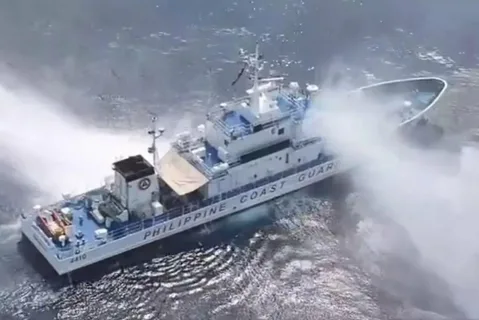
The Philippines has accused China of using water cannon on its coast guard and fisheries vessels near Scarborough Shoal for a second consecutive day, marking the third confrontation between the two countries in the South China Sea within a single week. China and Philippines news today centers on this escalating standoff, which comes just days after Beijing announced plans to designate part of the shoal as a nature reserve.
Background
China scarborough shoal disputes have simmered for over a decade, but tensions have sharply intensified in recent weeks. China has controlled access to the shoal, known in the Philippines as Bajo de Masinloc and in China as Huangyan Island, since 2012, despite the feature sitting well within the Philippines’ internationally recognized exclusive economic zone.
The latest flashpoint began after Beijing announced it was designating part of Scarborough Shoal as a national nature reserve. Manila filed a formal diplomatic protest almost immediately, and the announcement helped set the stage for the confrontations that followed just days later.
Philippines protests China’s plan for a nature reserve at a hotly disputed shoal, arguing the designation is a thinly veiled attempt to reinforce Chinese control over a feature international law recognizes as belonging within Philippine waters. A 2016 international arbitral ruling had already rejected the legal basis for China’s expansive claims in the area, though Beijing has never accepted that ruling.
Details
On Friday, the Philippine Coast Guard said Chinese vessels fired water cannon at two of its ships, the BRP Cape San Agustin and the fisheries vessel BRP Datu Paduhinog, within an hour and a half of each other during a mission near the shoal. It was the second straight day China had used water cannon against Philippine vessels in the area.
Philippine Coast Guard spokesperson Jay Tarriela said a Chinese vessel came within about seven metres of a Philippine fisheries boat, creating what he called a serious risk of collision. He said the China scarborough shoal nature reserve area remains a traditional fishing ground for Filipinos, whose rights cannot be lawfully impeded by any foreign power.
China’s coast guard offered a very different account of events. It said it had taken “control measures” against multiple Philippine vessels it accused of operating illegally in waters it considers under Chinese jurisdiction, referring to the shoal by its Chinese name, Huangyan Island.
The incident came just three days after a separate and more serious confrontation at Second Thomas Shoal, roughly 650 kilometres away, where Manila said a Filipino sailor was injured after being struck on the head with a wooden baton by a Chinese coast guard member. That earlier clash prompted both governments to summon each other’s ambassadors, with Chinese officials accusing the Philippines of deliberate provocation.
The timing has drawn particular attention because the confrontations unfolded just as Southeast Asian foreign ministers wrapped up regional meetings in Manila, attended by both Chinese Foreign Minister Wang Yi and US Secretary of State Marco Rubio.
Quotes
Tarriela said the Philippine Coast Guard strongly condemns what he described as the dangerous and unprofessional actions of the China Coast Guard, adding that the shoal has long served as a traditional fishing ground that no foreign power can lawfully block Filipinos from using.
US Secretary of State Marco Rubio, addressing the confrontations during his visit to Manila, called Beijing’s actions in the South China Sea “disturbing” and reaffirmed Washington’s support for the Philippines as a treaty ally.
China’s foreign ministry, responding separately to broader Philippines Taiwan tensions, said Manila should not use geographic proximity or the presence of Filipino migrants as justification to interfere in matters it considers China’s internal affairs.
Impact
The standoff carries weight well beyond the immediate confrontation at sea. China and Philippines news today reflects a broader pattern of near-weekly incidents that have raised concerns among regional allies about the risk of a more serious escalation involving the treaty relationship between Manila and Washington.
The dispute has also become entangled with the Philippines Taiwan question. President Ferdinand Marcos Jr. has repeatedly said the Philippines would likely be drawn into any conflict over Taiwan given its geographic proximity and the roughly 200,000 Filipino nationals living and working there, a position that has visibly irritated Beijing according to Philippines Marcos Taiwan watchers.
Regional allies have voiced growing concern. Australia’s foreign minister previously condemned similar Chinese coast guard actions as destabilizing and dangerous, while Japan and the United States have both stepped up joint patrols and statements of support for Manila in recent months.
Economically, the repeated confrontations threaten to disrupt fishing activity that coastal Filipino communities near Zambales depend on, since Scarborough Shoal has traditionally served as one of the richest fishing grounds in the region.
Conclusion
With back-to-back water cannon incidents this week and a formal protest still pending over the nature reserve designation, the Philippines and China both appear to be digging in rather than de-escalating. Manila has signaled it will not withdraw its vessels from contested waters despite repeated confrontations, while Beijing shows no indication of changing its coast guard posture around the shoal.
Given the pace of recent incidents, more confrontations at Scarborough Shoal or nearby features look likely in the coming weeks. Expect China and Philippines news today to keep making headlines as both sides continue asserting competing claims over one of the South China Sea’s most contested waters.
Frequently Asked Questions
What has China done to the Philippines?
Over the past decade, China has repeatedly used its coast guard and maritime militia to assert control over waters within the Philippines’ internationally recognized exclusive economic zone, including tactics such as water cannon strikes, vessel ramming, and blocking resupply missions to Philippine outposts like the BRP Sierra Madre at Second Thomas Shoal. China has also occupied and restricted Filipino access to Scarborough Shoal since 2012 despite a 2016 international arbitration ruling that rejected the legal basis for China’s broader claims in the South China Sea. Most recently, China announced plans to designate part of Scarborough Shoal as a nature reserve, a move the Philippines has formally protested as another attempt to entrench Chinese control over disputed territory.
Has China blocked the Scarborough Shoal?
Yes, China has effectively controlled access to Scarborough Shoal since a tense standoff in 2012, using its coast guard presence to restrict Filipino fishermen and government vessels from freely operating in the area, despite the shoal sitting within the Philippines’ exclusive economic zone under international law. While Filipino fishing boats have at times been allowed limited access to the shoal’s traditional fishing grounds, Philippine government vessels attempting to assert sovereignty or support fisheries operations have repeatedly faced water cannon attacks, dangerous manoeuvres, and blocking tactics from Chinese coast guard ships, particularly during periods of heightened tension like the current one.
Who’s stronger, the Philippines or China?
In terms of raw military capability, China possesses a vastly larger and more advanced military than the Philippines, including the world’s largest navy by number of vessels and a substantially bigger coast guard fleet, which is why China has been able to maintain a near-constant presence around contested features like Scarborough Shoal. However, the Philippines is not without significant support: it maintains a mutual defense treaty with the United States, has deepened security cooperation with Japan and Australia, and has increasingly relied on international law, including the 2016 arbitral ruling, to build diplomatic pressure against China’s claims. Any direct military conflict would overwhelmingly favor China in conventional terms, which is one reason the current standoff has remained limited to coast guard-level confrontations rather than escalating into open military engagement.