Netanyahu and Allah Ditta: One Name, Two Worlds, Different Stories
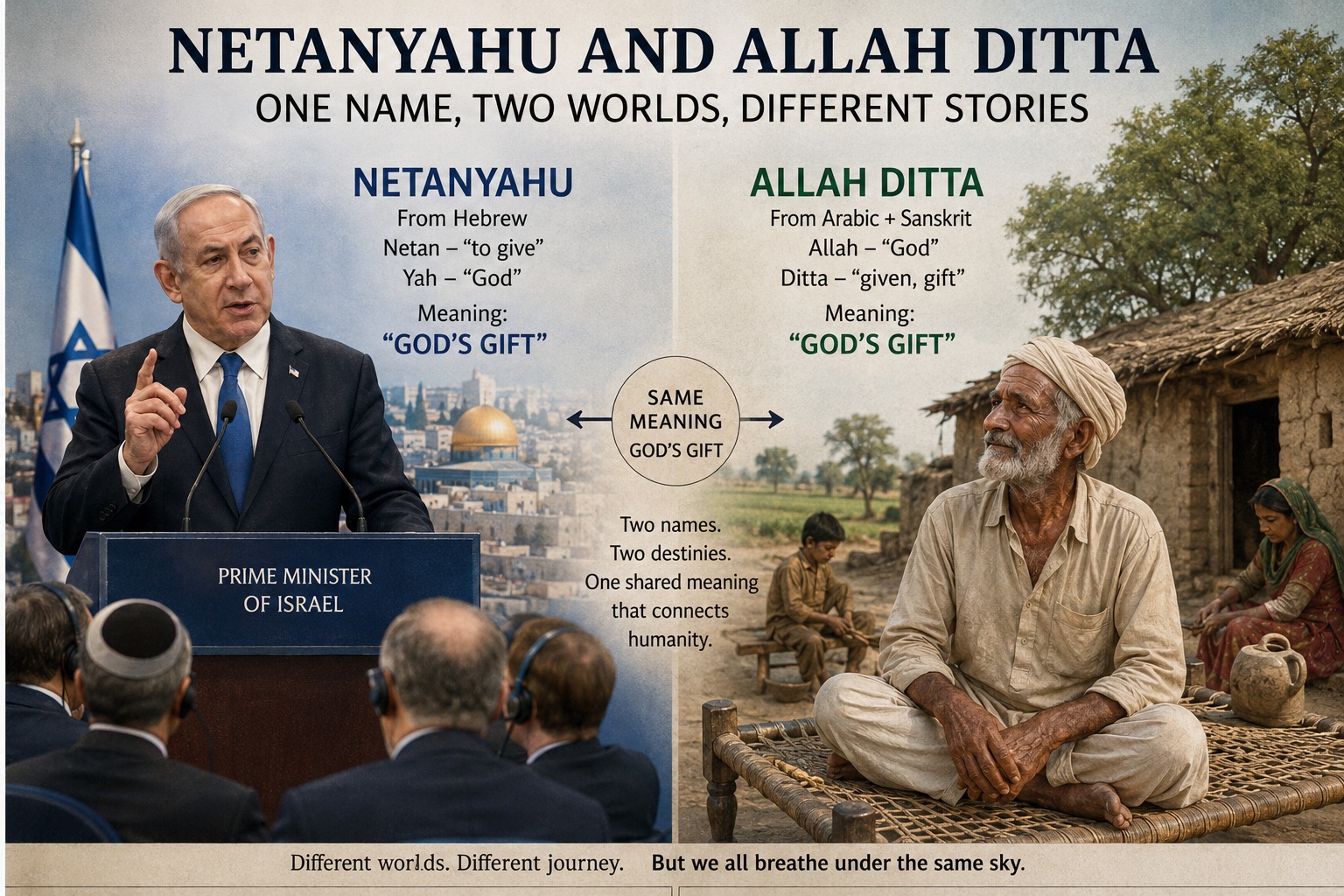
Picture the scene of a major international conference, where Israel’s Prime Minister Benjamin Netanyahu stands with his delegation ready to deliver a speech, and suddenly one of the Pakistani journalists present raises a question in a rather provocative tone: “Mr. Prime Minister, do you know that in Urdu and Punjabi your name translates to Allah Ditta?” The interpreters’ eyes widen in disbelief, they scramble to find a suitable translation for this strange sentence, caught in a whirlwind of confusion. But this is no joke, it is an open miracle of linguistics. The Hebrew word “Netan” means “to give,” and “Yah” is a name for God, thus meaning “God’s gift.” Similarly, “Allah Ditta” combines the Arabic “Allah” with “Ditta,” derived from Sanskrit, meaning “God’s offering.” Two languages, two religions, two continents, yet one shared meaning. It seems that throughout history, humans have linked their offspring to the Creator to express His glory But where this linguistic harmony astonishes us, history’s tragedy lies in the fact that these two names could have been twins not only in meaning but also in destiny, yet time placed them on entirely separate paths.
Turning the pages of history, on one side we find the Polish Jewish family Mileikowsky, who upon setting foot on Palestinian soil changed their surname to Netanyahu to strengthen their Zionist identity. This name carried with it the thunder of the Bible, the echoes of prophets, and the memory of a glorious past. Then came the moment when this very name was given to a man who became Israel’s longest-serving prime minister, whose politics grip the very arteries of the Middle East, at whose signal wars ignite and peace treaties crumble into dust. He manoeuvres between Washington and Moscow, commands attention at the United Nations, and makes his adversaries feel the might of his military power. His name is being etched onto the golden pages of history. On the other side lie the vast valleys of the Indian subcontinent, where Allah Ditta has for centuries been the name of an ordinary man. He is the farmer tending his crops, the labourer feeding his children with his sweat, the elderly man sitting on a charpoy telling tales to his grandchildren. History books contain no mention of him, he has conquered no empire, signed no treaty, attended no global summit. He simply lives his life, spending his days battling inflation, load-shedding, and the search for employment, looking up at the sky and wondering why the same God who gave him life has kept the world’s wealth and fame so far from his reach.

This contrast creates a bitter irony. Two human beings, bearing names of identical meaning, yet the chasm between them is so vast that no bridge can span it. One gift of God is part of global power politics, dropping bombs, waging diplomatic wars, and gracing the world’s media headlines. The other gift of God sits in his humble hut, worrying about his children’s education and two meals a day. The question keeps knocking at the mind: do names truly matter? Did Netanyahu become prime minister because his name is biblical, and is Allah Ditta a farmer because his name is local? Or is this merely a matter of resources, geography, and the unfair design of colonial politics, which has given one a throne and the other a footstool? If we weigh them on a linguistic scale, Netanyahu could be called Allah Ditta and Allah Ditta could be called Netanyahu, but in real life these names carry no weight. Decisions are made by power, not by names.
The ultimate irony is that Netanyahu draws upon his name as a sacred historical identity and uses it for his political survival, while Pakistan’s Allah Ditta possesses only the wealth of his hard work and patience as a blessing from his name. Both carry names with the same meaning, yet their lives are completely opposed. For one, the name is a political weapon; for the other, it is a simple mark of identity. If after reading this piece someone concludes that Netanyahu is merely a fortunate Allah Ditta, that would be an incomplete truth, because it would ignore his personal struggle, his political acumen, and the role of global circumstances. Likewise, to assume that Allah Ditta’s fate is only poverty would also be unfair, for his life contains patience, contentment, and a different kind of richness that perhaps Netanyahu does not possess.
This comparison confronts us with a deep philosophical question: is man the maker of his own destiny, or merely a captive of circumstances? Do names truly elevate anyone, or is it all about social structures, historical accidents, and the sway of international politics? Netanyahu, through his intellect, turned a small family name into a global identity, and Allah Ditta, through his labour, sustained his family. The struggle of both is worthy of respect, but their measure is different. Our mistake lies in judging everything by a global yardstick. We assume that success is only what makes headlines, and fame is only what decorates newspapers, while reality is far more expansive. A farmer’s success is his harvest, a labourer’s success is his skill, a father’s success is his children’s smiles. This is the aspect that often escapes our notice.
Dear readers, whenever you see Netanyahu on a television screen conversing with world leaders, do bring to mind an image of some elderly Punjabi man sitting on his charpoy, saying, “Well done, Allah Ditta, may the Lord’s glory be praised.” And whenever you see an Allah Ditta in a village lane immersed in his labour, think that perhaps this is the same Netanyahu whom global politics never gave a chance, or perhaps he is an even greater human being who gave meaning to his life without wealth and fame. Politics may not be able to tolerate this irony, for politics is accustomed to hiding its truths, but language – language is the voice of humanity. It does not diminish or magnify any name; it only conveys meaning. And the meaning remains exactly what it was centuries ago: God’s gift, the Creator’s blessing. This is the shared truth that connects us all, whether we call it Netanyahu or Allah Ditta, whether we dwell in the golden towers of Tel Aviv or the mud huts of Punjab. We are all inhabitants of the same earth, breathing under the same sky, and turning towards the same God. The only difference lies in the narrative we have built around ourselves. If we break that narrative, we will see a world where humanity matters more than names, where destiny is determined not by words but by deeds, and where every Allah Ditta has the right to become his own Netanyahu.