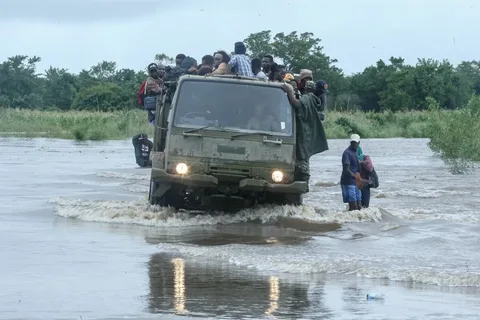
Floods in Africa today are once again dominating headlines, with Mozambique, South Africa and several Sahel nations struggling under the weight of relentless rainfall. Emergency teams are racing to reach stranded families as rivers overflow and roads disappear underwater. Aid agencies warn that the situation could worsen sharply in the coming months as a record-strength El Nino intensifies across the continent.
Summary
Africa flooding has already displaced hundreds of thousands of people since late 2025, and the crisis is far from over. Mozambique remains the worst-hit nation, with more than 650,000 people affected across seven provinces. Meanwhile, South Africa has declared national disasters twice this year, and humanitarian groups are now bracing for a fresh wave of Sahel floods driven by an intensifying El Nino pattern.
Background: How the 2025-2026 Flood Season Began
The floods in Africa 2025 season started quietly in December, when heavy rains began overwhelming rivers across the southern part of the continent. What followed was one of the most severe flooding events the region has experienced in a generation. Reservoirs filled beyond capacity, and rivers like the Limpopo and Incomati burst their banks in early 2026.
By late January, the flooding had already affected close to 800,000 people across Eswatini, Madagascar, Malawi, Mozambique, South Africa, Tanzania, Zambia and Zimbabwe. Mozambique bore the brunt of the disaster, with entire towns submerged and critical infrastructure destroyed. The scale of destruction quickly drew comparisons to the catastrophic 1997 Mozambique floods.
Latest News in Mozambique Today
Floods in Mozambique today continue to threaten communities that are still recovering from earlier damage this year. Mozambique floods 2026 today have affected more than 650,000 people, destroying homes, crops, water systems and vital infrastructure across seven provinces. With the cyclone season still active, forecasters warn that more rainfall could push river levels even higher in the coming weeks.
Hard-hit cities including Maputo, Xai-Xai and Chokwe remain under significant strain, with tens of thousands of homes damaged or destroyed. The Mozambique Red Cross, working alongside the IFRC, is evacuating at-risk communities and delivering emergency health and water sanitation support. International rescue teams from Brazil, South Africa, Portugal and the United Kingdom have also mobilized to assist local responders who remain overstretched.
Floods in South Africa Today
Floods in South Africa today have forced the government to declare a national disaster on two separate occasions this year. The first declaration came on 18 January after devastating floods struck Limpopo and Mpumalanga provinces. A second disaster was declared in May, after another round of storms swamped informal settlements across six provinces.
These repeated disasters have highlighted just how vulnerable South African communities remain to extreme weather, particularly in low-income and informal housing areas. Emergency shelters have been set up across affected provinces, though officials admit that resources remain stretched thin given the scale and frequency of these events.
Sahel Floods and the Wider Africa Flooding Crisis
Sahel floods have added another layer of urgency to an already dire situation across the continent. Localized heavy rains and flooding have been reported along the Gulf of Guinea coast, while inundation continues in the Sudd wetlands of South Sudan. At the same time, parts of East Africa have faced abnormally dry conditions, creating a complicated and uneven pattern of extreme weather across the region.
This mix of flooding in some areas and drought in others is a hallmark of the current El Nino cycle, which experts say is intensifying rapidly. The US Climate Prediction Center confirmed on July 9 that El Nino has an 81 percent chance of becoming one of the most powerful events since 1950, with peak impacts expected between October and December this year.
Details: The El Nino Factor
The International Rescue Committee (IRC) warned this week that Kenya, Uganda, Somalia, Bangladesh, Pakistan and Afghanistan are among the countries most at risk from the intensifying El Nino pattern. Kenya faces an 80 to 82 percent chance of El Nino conditions persisting through 2026, with dry conditions this summer expected to give way to a high risk of flooding and landslides later in the year.
Uganda is bracing for a similar shift, moving from drier months into a flood-prone final quarter of the year. During the last El Nino cycle, more than 413,000 people in Uganda were affected by flooding and displacement. Somalia is also on high alert, with heavy rain in the Ethiopian highlands combined with local seasonal rains threatening to raise river levels along the country’s two main waterways.
Quotes From Officials and Experts
Bob Kitchen, IRC Vice President for Emergencies, described the scale of the unfolding crisis in stark terms. He said aid organizations are watching several emergencies converge at once, and warned that the communities least equipped to absorb another shock are precisely the ones now in the crosshairs of this extreme weather pattern.
Portugal’s Secretary of State for Foreign Affairs and Cooperation, Ana Xavier, also addressed the crisis earlier this year while announcing support for Mozambique. She reaffirmed her government’s commitment to standing with Mozambican communities, even as Portugal simultaneously managed its own severe weather challenges at home.
Impact: Regional and Global Consequences
The humanitarian impact of this flooding crisis is enormous and still growing. Across Southern Africa alone, more than 2.36 million people had been affected by the end of April. Cholera outbreaks have already been reported in Malawi, Mozambique, Tanzania, Zambia and Zimbabwe, driven largely by damaged water infrastructure and reduced access to healthcare.
Beyond the immediate humanitarian toll, the flooding is also causing significant economic damage. Mozambique’s state-owned railway operator has already lost an estimated three million US dollars due to suspended services on a key flood-affected line. Damaged roads, bridges, schools and health facilities are further complicating relief efforts and slowing the region’s economic recovery.
The global response has been substantial, with the European Union, United States, Angola, Spain, Norway, Japan and neighboring African nations all sending emergency humanitarian aid. However, UNHCR has stressed that funding remains insufficient, requesting 38.2 million US dollars in 2026 alone to meet Mozambique’s rising humanitarian needs.
Conclusion: What Comes Next
Floods in Africa today are a warning sign of what may lie ahead as the current El Nino cycle strengthens through the rest of 2026. With Mozambique, South Africa and Sahel nations already stretched thin, humanitarian agencies are urging governments and donors to act early rather than waiting for disaster to strike again.
Forecasters are closely watching a critical rainfall update expected in mid-July, which will help determine funding priorities and anticipatory action across the region. Until then, millions of people across Africa remain at risk, and the coming months will likely determine whether the continent can avoid an even larger humanitarian emergency.
Frequently Asked Questions
What is causing the floods in Kenya specifically?
Kenya’s flooding risk is closely tied to the current El Nino cycle, with forecasters estimating an 80 to 82 percent chance that El Nino conditions will persist through the rest of 2026. While the country has experienced relatively dry conditions during the summer months, experts warn that this is expected to shift dramatically later in the year, bringing a high risk of both flooding and landslides. In response, the Kenyan government has already activated its national disaster response framework to prepare for the anticipated impact.
Is the flooding in Mozambique still ongoing today?
Yes, floods in Mozambique today remain an active and serious humanitarian emergency. More than 650,000 people have been affected across seven provinces, with homes, farmland, water systems and infrastructure destroyed or severely damaged. Because Mozambique’s cyclone season is still underway, forecasters warn that additional heavy rainfall could worsen conditions further in the coming weeks, putting displaced families at continued risk of disease outbreaks, food insecurity and prolonged displacement.
How is the international community responding to Africa flooding?
Several countries and organizations have stepped in to support flood-affected nations across Africa. Rescue teams from Brazil, South Africa, the United Kingdom and Portugal have been deployed to Mozambique, while the European Union, United States, Angola, Spain, Norway and Japan have all sent humanitarian aid. Despite this support, agencies like UNHCR say funding remains far below what is needed, having requested over 38 million US dollars in 2026 alone just to meet Mozambique’s rising humanitarian requirements.