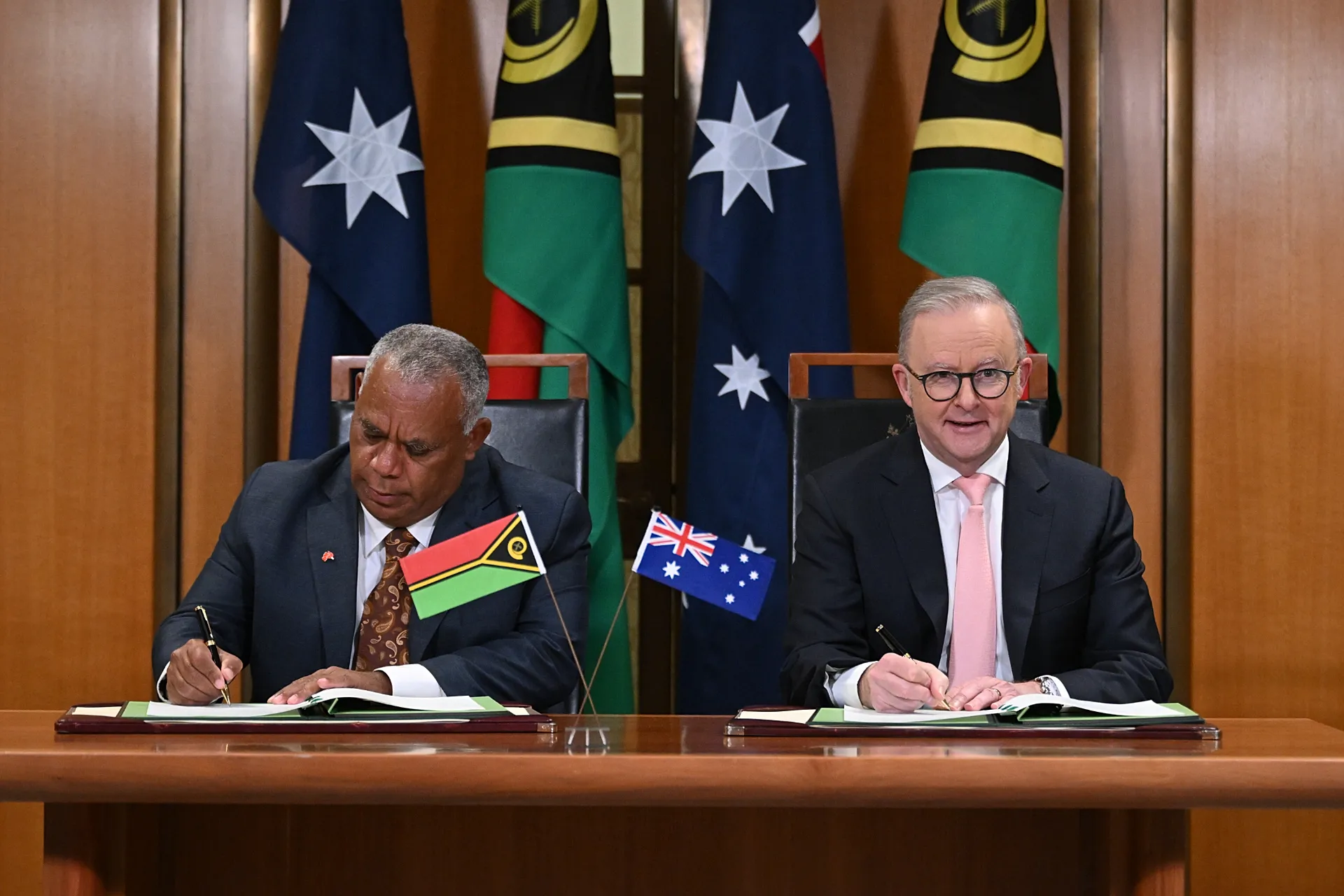
After months of negotiations, legal reviews, and political changes in Port Vila that extended the timeline considerably, Australia and Vanuatu have formally signed the Pukpuk Treaty a bilateral security agreement that both governments are describing as a partnership built on mutual respect rather than military dependency.
The name itself is telling. Pukpuk means crocodile in several Pacific languages an animal associated with strength, protection, and resilience. That framing wasn’t accidental. Both sides wanted an agreement that felt distinctly Pacific rather than something imposed from outside.
What they’ve produced is a comprehensive framework covering security cooperation, disaster response, policing, cybersecurity, maritime surveillance, border management, and economic development. And at its center sits one provision that grabbed the most international attention: Vanuatu will not permit any foreign military base on its territory without Australia’s agreement under the partnership framework.
Why This Matters and Why Now
To understand the significance of this treaty, you need to understand what’s been happening in the Pacific over the past few years.China has significantly expanded its diplomatic, economic, and security presence across Pacific Island nations. The Vanuatu-China policing agreement that emerged in recent years attracted considerable attention and concern from Australia, New Zealand, and Western allies. A Solomon Islands security agreement with China in 2022 sent alarm bells ringing across Canberra. The question of whether Pacific Island nations might host foreign military infrastructure of any kind moved from theoretical to genuinely pressing.
Australia’s response has been to intensify its own engagement across the region. Not through threatening ultimatums or Cold War-style pressure, but through what officials describe as genuine partnership offers: climate support, infrastructure investment, expanded labor mobility, disaster preparedness assistance, and bilateral security frameworks that offer practical benefits.The Pukpuk Treaty is the latest and arguably most significant expression of that strategy.
What the Treaty Actually Does
It’s worth being specific, because the Pukpuk Treaty is not a military alliance in any traditional sense.Australia is committed to supporting Vanuatu across national security cooperation, maritime surveillance, border management, cybersecurity, disaster preparedness, infrastructure resilience, police training, and economic development. These aren’t abstract commitments they address things Vanuatu actually needs help with given its geographic vulnerabilities, limited institutional capacity, and exposure to natural disasters, illegal fishing, and transnational crime.
The foreign military base provision is the headline, but the practical substance of the treaty is this package of support for Vanuatu’s own resilience and capability. Officials from both countries have been careful to frame it that way Vanuatu’s PM described it as a partnership, not dependency, and emphasized that the country’s independent foreign policy remains intact.
That matters because Vanuatu maintains diplomatic relations with China and other powers. The treaty doesn’t ask Vanuatu to choose sides. It asks Vanuatu to deepen one particular partnership while remaining free to manage its own foreign relationships.
Why It Took So Long
The delay in finalizing the agreement was real, and it reflected genuine complexity rather than diplomatic foot-dragging.Vanuatu has experienced significant political instability the country has had numerous changes of government in recent years, and successive administrations reviewed the treaty’s provisions carefully before committing. Any agreement that touches on sovereignty, foreign policy, and military access is politically sensitive in a small island nation with a strong tradition of nonalignment.
The legal review process took time. Sovereignty protections required careful drafting. Implementation details needed to be worked through practically rather than just conceptually.
The fact that it took longer than expected doesn’t diminish the outcome. Both sides ultimately arrived at provisions that Port Vila’s government could genuinely support not provisions that were simply accepted under pressure.
How This Compares to Other Pacific Security Arrangements
The Pukpuk Treaty shares structural similarities with Australia’s security arrangement with Fiji, but each agreement is tailored to the specific circumstances of the partner country.
Both the Fijian pact and the Pukpuk Treaty emphasize regional security, maritime cooperation, disaster response, police cooperation, and climate adaptation. But Vanuatu’s geographic location, its specific vulnerabilities, and the political context around its relationship with China shaped provisions that are distinct from what was agreed with Fiji.
Analysts expect Australia to continue pursuing similar bilateral agreements with other Pacific island nations. The strategy appears to be building a network of relationships that collectively strengthen regional stability without the language or structure of a formal military alliance that would alarm smaller nations wary of being caught between competing great powers.
Australia’s Broader Pacific Strategy
Prime Minister Albanese has made Pacific security a consistent priority, and the treaty fits within a broader Australian foreign policy posture that combines climate commitments, economic partnerships, and security cooperation.
At Pacific Islands Forum meetings, Australia has repeatedly emphasized its willingness to address what Pacific nations themselves identify as their most pressing security threats which, for most of them, are climate change and natural disasters, not military aggression. Illegal fishing, which strips economic resources from small island economies, is also high on the list.
The Pukpuk Treaty addresses all of these alongside more traditional security elements. Regional security specialists note that this comprehensive framing economic development alongside defense cooperation, climate resilience alongside maritime security reflects a more sophisticated approach than simply offering military presence.
What It Means for Vanuatu
For a small island nation of roughly 300,000 people spread across an archipelago exposed to cyclones, earthquakes, and volcanic activity, the practical benefits of this treaty are significant.
Enhanced disaster preparedness and emergency response capability matters enormously in a country that sits on the Pacific Ring of Fire and regularly faces destructive weather events. Cybersecurity support addresses a growing vulnerability as digital infrastructure expands. Maritime surveillance assistance helps protect fisheries that are economically vital. Police training improves domestic security capacity.
And the economic development commitments provide investment that small island economies genuinely need.The Vanuatu passport, which has attracted international attention through the country’s citizenship-by-investment program, isn’t directly affected by the security treaty. But improved border management and stronger security cooperation may strengthen international confidence in Vanuatu’s documentation systems over time.
The Geopolitical Context
This treaty doesn’t exist in a vacuum. It’s part of a broader competition for influence across the Indo-Pacific that involves Australia, the United States, New Zealand, France, China, and Japan, among others.
What makes the Pacific particularly sensitive is that the island nations in it are genuinely sovereign, genuinely independent, and genuinely capable of making their own choices about which partnerships to pursue. They’re not simply prizes to be won in a great power competition they’re countries with their own interests, identities, and priorities.
The most successful partnerships in the region, analysts consistently note, are those that recognize this reality and offer something genuinely useful rather than simply seeking to exclude a rival.
Whether the Pukpuk Treaty meets that standard from Vanuatu’s perspective, not Australia’swill become clearer as implementation begins and the commitments move from signing ceremony to actual delivery.
What Comes Next
The treaty has been signed. Now the real work starts.Joint working groups from both governments will begin coordinating projects across infrastructure, cybersecurity, policing, maritime surveillance, and disaster preparedness. Both sides have committed to regular progress reviews and to adapting cooperation as challenges evolve.
Successful implementation matters beyond the bilateral relationship. If the Pukpuk Treaty delivers visible, practical benefits for Vanuatu, it becomes a model that could encourage similar arrangements across the Pacific. If it doesn’t if the commitments remain on paper without meaningful follow-through it becomes a cautionary tale about the gap between diplomatic announcements and genuine partnership.The Pacific is watching.
FAQs
Who is responsible for Vanuatu’s security?
Vanuatu manages its own security primarily through the Vanuatu Police Force the country doesn’t maintain a standing military. Through arrangements like the Pukpuk Treaty, Australia provides assistance in disaster response, maritime surveillance, policing, border security, and emergency support. The key distinction is that this assistance strengthens Vanuatu’s own capabilities rather than substituting Australian authority for Vanuatu’s. Sovereignty and independent decision-making remain with Port Vila.
Is Vanuatu a wealthy or developing country?
Vanuatu is classified as a lower-middle-income developing country. Its economy depends on tourism, agriculture, fisheries, foreign aid, and services. Economic growth has occurred in recent years, but the country remains seriously vulnerable to natural disasters cyclones, earthquakes, and volcanic activity are genuine recurring threats and to the longer-term impacts of climate change. International partnerships like the Pukpuk Treaty are partly about building the economic and institutional resilience to manage those vulnerabilities.
What religion do people in Vanuatu practice?
Christianity is dominant, with most Vanuatuans belonging to Presbyterian, Anglican, Catholic, Seventh-day Adventist, or other Protestant denominations a legacy of extensive missionary activity in the 19th and 20th centuries. Traditional indigenous beliefs remain important in many communities and often coexist with Christian practice rather than being replaced by it. Vanuatu’s Constitution protects religious freedom, and the country’s religious landscape reflects both its colonial history and the enduring strength of its indigenous cultural traditions.