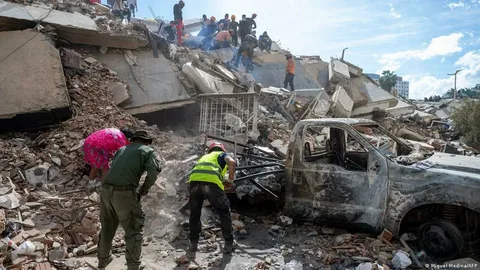
Rescue workers are still pulling through rubble. Families are camped outside collapsed buildings, watching and waiting. Temporary shelters are filling up. And in some of the hardest-hit neighborhoods, residents are asking why help didn’t arrive faster.
The earthquake that struck parts of Venezuela communities devastated, and the country is now in the difficult middle phase of a disaster past the initial shock, deep into the search for survivors, and beginning to confront the longer question of what comes next.
The Immediate Situation
The quake caused widespread structural damage across several communities. Residential buildings collapsed. Roads were blocked. Public facilities were damaged. Thousands of families were forced out of their homes in the immediate aftermath, many of them spending nights outdoors with aftershocks still possible and structural engineers not yet cleared to let them return.
Emergency crews moved quickly after the initial quake, but damaged infrastructure created real obstacles. Getting heavy equipment and rescue teams into the most severely affected neighborhoods took longer than anyone wanted. Temporary shelters schools, sports centers, community halls converted on short notice absorbed displaced families while humanitarian organizations worked to get food, clean water, blankets, and medical supplies distributed.
The situation on the ground is the kind that emergency workers describe as organized chaos: everyone is working, the needs are enormous, and the logistics are genuinely difficult.
The Search for Survivors
Every hour matters in these operations, and the teams on the ground know it.Specialized units with search dogs, listening equipment, and heavy machinery are methodically working through collapsed structures. The challenge is doing it carefully removing debris too quickly or with the wrong technique can trigger secondary collapses that endanger both rescuers and anyone still alive underneath.
Medical teams are positioned near active rescue sites, ready to provide immediate care for anyone pulled from the rubble. Hospitals in affected areas have expanded emergency capacity and are operating under significant pressure.
Officials confirm that dozens of people remain missing. The casualty figures are expected to change as search operations continue and as some areas become accessible for the first time since the quake.
Families Waiting in the Hardest Situation
There’s a particular cruelty to the waiting and the families gathered near rescue sites are living it.
Not knowing whether someone you love is trapped somewhere, whether they’re alive, whether rescue teams have reached them yet that uncertainty is its own form of suffering. Community volunteers have been working alongside official relief efforts, distributing supplies but also simply being present for people who have nowhere to go and nothing to do but wait.
Residents have been calling for greater transparency about the missing persons situation, the casualty count, and the timeline for recovery operations. That’s a reasonable ask from people in an impossible situation, and it’s something authorities will need to address directly.
Government Response: Under Scrutiny
Public frustration has been building, and it’s being expressed.
Some residents in the hardest-hit neighborhoods say emergency assistance was too slow to arrive. The response they experienced didn’t match the urgency they needed. That’s a common complaint in the immediate aftermath of major earthquakes disasters don’t wait for logistics to catch up but it’s not something authorities can simply dismiss.
Government officials have defended the timeline, saying rescue operations began immediately and resources were mobilized as fast as conditions allowed. They’ve promised continued support and announced that financial assistance and temporary housing programs will follow for displaced families.
The accountability question will continue to develop as the immediate emergency stabilizes. For now, the priority from every side is getting to survivors before it’s too late.
Aftershocks: The Ongoing Danger
Geologists monitoring Venezuela’s seismic activity are tracking what happens after the main quake — and what comes after matters almost as much as what caused it.
Aftershocks are normal following a significant seismic event. They can continue for days or weeks, and while they’re typically smaller than the main quake, they can destabilize already-damaged structures, complicate rescue operations, and deepen the fear of people who are already frightened.
Scientists are using updated seismic mapping to identify fault movement, understand which areas remain most vulnerable, and help emergency planners prioritize where resources go next. That data also feeds into engineering assessments of damaged infrastructure bridges, highways, hospitals, schools before anyone is allowed back in.
Residents are being urged to follow official emergency alerts and evacuation guidance whenever aftershock warnings are issued.
The Footballer Rumor: Set the Record Straight
Social media has been circulating claims about a Venezuelan professional footballer being among the victims or affected parties.
As of publication, there is no official confirmation of any such reports from emergency authorities or sports organizations. This is exactly the kind of rumor that spreads rapidly during disasters people searching for human-interest connections to a large-scale tragedy, posts shared without verification, speculation treated as fact.
In rapidly developing situations like this, unconfirmed social media posts cause real harm. They create false hope or false grief for families, they distract from verified information, and they can complicate official communications. Stick to official emergency agency announcements for accurate information.
Venezuela’s Seismic Reality
This earthquake didn’t happen in a vacuum. Venezuela sits near the boundary between the Caribbean Plate and the South American Plate the movement of those tectonic plates has created active fault systems across parts of the country that make seismic risk a permanent geographical reality, not an occasional anomaly.
That means preparedness isn’t optional. Seismologists are consistent on this: you cannot reliably predict when an earthquake will occur, but you can significantly reduce casualties and damage through better building standards, public preparedness, and effective emergency response systems.
For individual households, experts recommend keeping an emergency kit: water, flashlights, batteries, first-aid supplies, important documents, emergency contacts. For communities and governments, the harder work is building and enforcing construction standards that allow buildings to withstand seismic events rather than collapse under them.
What Recovery Actually Looks Like
Rescue operations will eventually wind down. The harder, longer work comes after.Engineers need to inspect thousands of buildings before reconstruction can begin a process that takes time even when resources are plentiful. Displaced families need housing, financial assistance, and support for the disruption to employment, schooling, and healthcare that disaster creates. Infrastructure that was damaged roads, power networks, telecommunications, public facilities needs to be repaired or rebuilt.
Economic losses extend well beyond immediate property damage. Local businesses that closed, workers who couldn’t reach their jobs, supply chains interrupted these ripple outward into communities that were already dealing with Venezuela’s broader economic challenges before this earthquake struck.
Recovery will require sustained coordination between government agencies, local communities, and international partners. And residents understandably are already hoping that whatever gets rebuilt will be built to better standards than what collapsed.
Regional Context
Neighboring countries across South America have been monitoring the situation and reviewing their own emergency preparedness procedures. Regional disaster agencies are exchanging technical information, and international humanitarian organizations have indicated readiness to provide additional assistance if Venezuelan authorities request it.
South America has extensive experience with major seismic events Chile’s 1960 Valdivia earthquake remains the largest ever recorded at magnitude 9.5, and the 2010 Haiti earthquake and 2011 Japan Tōhoku earthquake are among the most studied disasters in modern history. That body of experience has shaped regional and global approaches to earthquake response, and it’s available to Venezuela as it moves through this crisis.
FAQs
Is Venezuela in a seismically active zone?
Yes. Venezuela lies near the boundary between the Caribbean Plate and the South American Plate, and several active fault systems run through parts of the country. Destructive earthquakes aren’t as frequent as in some neighboring regions, but the geological risk is real and ongoing. National and international seismic monitoring networks track fault activity continuously, and scientists use that data to improve emergency response planning.
What challenges was Venezuela already facing before this earthquake?
Significant ones. Venezuela has been dealing with economic instability, inflation, shortages of essential goods, and pressure on public services for years. A major earthquake compounds all of those pre-existing challenges simultaneously damaging infrastructure that was already strained, displacing people who had limited resources to begin with, and demanding emergency response capacity that was already under pressure. Recovery in this context depends heavily on both national commitment and international support.
Where have magnitude 9.0 earthquakes occurred?
Earthquakes of that magnitude are extremely rare among the largest ever recorded. The 2011 Tōhoku earthquake in Japan reached approximately magnitude 9.0 and triggered a catastrophic tsunami. The 1960 Valdivia earthquake in Chile, at magnitude 9.5, remains the largest instrumentally recorded earthquake in history. The 1964 Alaska earthquake, at magnitude 9.2, is another example. Each of these events significantly advanced the science of earthquake preparedness and response, leaving legacies that still shape how the world approaches seismic risk today.