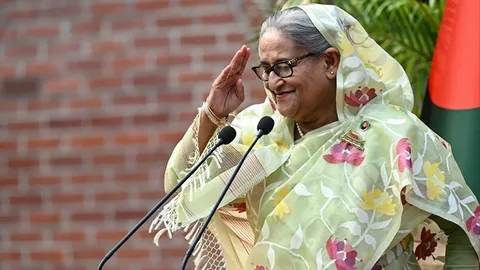
Former Bangladesh Prime Minister Sheikh Hasina has said she plans to return to Dhaka before the end of this year. No specific date, no detailed timeline just a public statement that immediately set off a wave of reaction across Bangladesh’s political landscape.
For a country still navigating the aftermath of the crisis that ended her government, the announcement lands differently depending on who you ask. Her supporters see it as the return of an experienced leader. Her critics see it as a complication Bangladesh doesn’t need right now. Political analysts see it as something that will depend heavily on factors she may not fully control.Here’s the full picture.
Why She Left in the First Place
To understand what a return would mean, you have to understand how the departure happened.What began as protests against public sector job quota policies in Bangladesh escalated, rapidly and unexpectedly, into something much larger. Demonstrations grew in scale and intensity, drawing in young people particularly university students and what became known as the Gen Z protest movement who had grievances that went well beyond the initial quota issue.
Calls for political accountability, democratic reform, and a fundamental change in how the country was being governed pushed the movement beyond what her administration could contain through normal means. As unrest intensified and security concerns mounted, Sheikh Hasina stepped down as Prime Minister and left Bangladesh.
It was one of the most significant political ruptures in the country’s recent history the end of more than a decade of continuous leadership by one of South Asia’s most recognizable political figures.
What’s Happened Since
An interim administration took over with two stated objectives: restore stability, and prepare the country for credible democratic elections.
Bangladesh has since been in a period of political transition institutional reforms, legal proceedings involving former government officials, and ongoing debates about what the country’s democratic future should look like. International observers have been watching closely, encouraging peaceful dialogue and a credible path back to elected government.
Through all of it, Sheikh Hasina has remained outside Bangladesh, making public statements but not directly participating in the domestic political process. Until now, those statements had mostly been expressions of confidence in her eventual return. This latest announcement is more direct.
Will She Actually Come Back?
That’s genuinely uncertain, and anyone who tells you otherwise is probably overstating their confidence.
Sheikh Hasina returning to Bangladesh isn’t simply a matter of booking a flight. There are legal proceedings to consider investigations involving former government officials have been underway, and questions about her own legal situation inside Bangladesh remain unresolved. There are security considerations. And there are political calculations by the interim government and other parties about what her return would mean for the country’s fragile transition period.
Political analysts are largely consistent in their view: a return is possible, but it depends on conditions that haven’t been fully established yet. What her return would look like whether she returns to active politics, faces legal proceedings, or plays some other role is equally unclear.
What’s not unclear is that the announcement itself has already changed the conversation in Bangladesh, even before anything concrete has happened.
The Sheikh Hasina Legacy: Two Very Different Stories
Few political figures in South Asia inspire such genuinely divergent assessments.The case her supporters make is substantial. During her years in office, Bangladesh experienced some of its strongest sustained economic growth. Infrastructure investment was significant bridges, highways, ports, energy projects. Digital services expanded, electricity access reached communities that previously had none, and exports from the garment sector grew considerably.
The case her critics make is equally substantial. Opposition parties and international human rights organizations raised consistent concerns about political repression, restrictions on dissent, questions about election transparency, and constraints on media freedom. The Gen Z protests which ultimately ended her government weren’t just about quota policy. They were an expression of accumulated frustration with how power had been exercised over many years.
Both of these things are true simultaneously. That’s what makes her legacy genuinely contested rather than simply a matter of political preference.
Who She Is: The Personal Details
For readers less familiar with her background Sheikh Hasina was born on September 28, 1947, making her 78 years old. She is the daughter of Sheikh Mujibur Rahman, Bangladesh’s founding leader, which means politics has been the central thread of her entire life.
She married nuclear scientist Dr. M. A. Wazed Miah in 1968. He passed away in 2009. Their two children — Sajeeb Wazed Joy and Saima Wazed have both had public profiles, though neither has stepped into formal national political roles. Sajeeb Wazed Joy has been involved in technology and digital development advisory work. Saima Wazed has built a significant international reputation in mental health advocacy and public health.
Sheikh Hasina served multiple terms as Prime Minister across different periods, making her Bangladesh’s longest-serving Prime Minister by a considerable margin.
Bangladesh’s Prime Ministers: A Brief Historical Picture
Bangladesh has had a number of Prime Ministers since independence, including Tajuddin Ahmad, Sheikh Mujibur Rahman, Muhammad Mansur Ali, Shah Azizur Rahman, Ataur Rahman Khan, Mizanur Rahman Chowdhury, Khaleda Zia, and Sheikh Hasina herself.
The country’s political history has often been marked by periods of intense rivalry particularly between the Awami League, which Sheikh Hasina led, and the Bangladesh Nationalist Party associated with Khaleda Zia. That rivalry has shaped Bangladeshi politics for decades and remains relevant to understanding the current transition period.
Why the Gen Z Protests Matter to This Story
The protests that brought down Sheikh Hasina’s government weren’t an accident, and they weren’t purely spontaneous.
They were an expression of something that had been building a generation of young Bangladeshis who grew up with rising expectations, connected to the world through digital technology, and increasingly unwilling to accept governance they viewed as unfair or unaccountable.
The quota issue that triggered the protests was real and substantive it concerned how government jobs were allocated, a significant issue in a country where public sector employment carries considerable weight. But the movement quickly became about something larger: the expectation that those in power should be genuinely answerable to the people they govern.
That shift in expectation doesn’t disappear with a change in government. Any political future for Sheikh Hasina or anyone else has to reckon with it.
What Happens Next
Bangladesh is at a point where several things are happening simultaneously: an interim government managing a transition, legal proceedings running their course, political parties positioning for future elections, and now the complicating factor of a former Prime Minister announcing her intention to return.
How all of that resolves will shape Bangladesh for years. The next elections will be a crucial test whether they are credible, competitive, and accepted by the major political forces will determine whether this transition period produces genuine democratic renewal or simply replaces one set of political problems with another.
Sheikh Hasina’s potential return adds a variable that makes every other calculation more complex. Whether that complexity serves Bangladesh’s interests or complicates them depends on how it unfolds and that’s not yet clear to anyone.
FAQs
Who is considered Bangladesh’s greatest Prime Minister?
There’s no consensus answer, and political views in Bangladesh are divided enough that agreement on this would be surprising. Sheikh Hasina’s supporters point to her economic record and length of service. Others cite Sheikh Mujibur Rahman as the founding father whose historical significance stands apart. Khaleda Zia also has a significant legacy. Ultimately, assessments depend heavily on what you value most in political leadership.
Can Sheikh Hasina actually return to Bangladesh?
She has said she intends to, and her statement is being taken seriously. But the practical path to return involves legal proceedings, security arrangements, and decisions by Bangladeshi authorities that haven’t been resolved. Analysts think a return is possible but contingent on conditions that are still developing. The political implications of her return whatever form it takes — would be significant and immediate.
What actually drove the Gen Z protests?
The immediate trigger was Bangladesh’s public sector job quota system, which many young people viewed as unfair in its allocation of government positions. But the protests grew quickly beyond that specific issue into a broader demand for political accountability, democratic reform, and a government that genuinely answers to its citizens. The scale and energy of the movement reflected frustrations that had been building for years, and it ended up reshaping Bangladesh’s political landscape in ways that will be felt for a long time.