

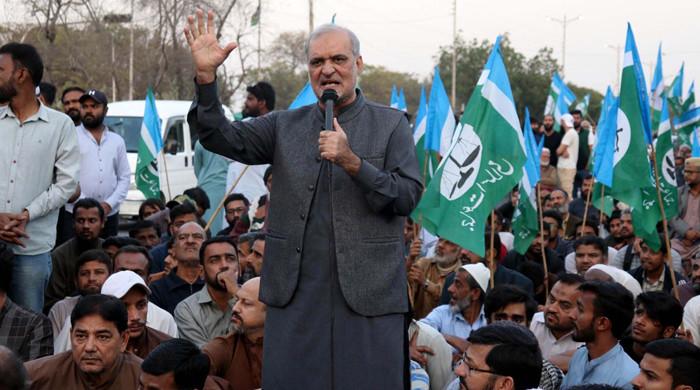

Jamaat-e-Islami (JI) has launched one of its most aggressive protest campaigns yet against soaring inflation and what it calls an unjust tax burden on ordinary Pakistanis. JI chief Hafiz Naeem ur Rehman has taken the party’s fight on two fronts staging large public demonstrations across the country and filing a constitutional petition against the petroleum levy in the Federal Constitutional Court. With a major march on Islamabad also announced, JI protests against inflation and taxes are rapidly becoming a central challenge to the government in the current political situation in Pakistan.
Background: Why Is JI Protesting?
Pakistan’s economy has been under severe strain, with rising fuel prices, inflated electricity bills, and heavy government levies squeezing millions of ordinary citizens. JI chief Hafiz Naeem ur Rehman strongly criticized the recent hike in petroleum, electricity, and gas prices, accusing the government of burdening citizens with excessive taxes and levies. He claimed that while the global market price of petrol stands at Rs271 per litre, consumers in Pakistan are being charged Rs401 per litre due to heavy taxation, including a levy of Rs117.
Hafiz Naeem said inflation continues to spiral because of flawed government policies, adding that over the past three years, Rs1.9 trillion had been collected in electricity-related taxes. Instead of offering relief to the public, he alleged, the authorities imposed additional fixed charges on electricity and gas bills.These numbers have fueled deep anger among Pakistan’s working class and middle-income households. The political challenges faced by Pakistan today are not limited to governance or political prisoners they are deeply economic, and JI has positioned itself as the voice of the financially struggling masses.
Details: JI Takes to the Streets
Addressing a large gathering at Aabpara Chowk in Islamabad, Hafiz Naeem said the movement had formally begun and could escalate into countrywide protests. The demonstration drew a significant number of participants who chanted slogans against the government and demanded immediate relief.
Hafiz Naeem said the turnout disproved claims that the public would not mobilise over rising electricity and fuel costs, adding that the protest marked the beginning of a broader campaign. He warned that failure to change course would push more people onto the streets.
Earlier, at a large protest demonstration on Multan Road, Lahore, Hafiz Naeem announced a countrywide protest movement against the recent massive increase in petroleum prices, warning of strikes and sit-ins in front of chief minister houses of all four provinces if the decision was not reversed.
He noted that millions of motorcycle users, estimated at around 25 million, were among the worst affected, while daily wage earners and students were effectively paying an additional monthly tax burden of around Rs6,000 due to rising costs. This figure has resonated powerfully with protesters in cities and small towns alike.
JI Moves to Court: Constitutional Challenge Against Petroleum Levy
Alongside the Pakistan protest today on the streets, JI took its fight into the courtroom. JI filed a constitutional petition against the government’s Petroleum Levy system and the newly introduced Climate Support Levy (CSL), arguing that both measures violate the Constitution, parliamentary supremacy, the federal system, and fundamental rights. According to the petition, the Petroleum Levy is no longer a limited regulatory surcharge and has effectively become a major source of government revenue.
The petition claimed that the levy on petrol has reached a historic high of approximately Rs117.41 per litre, accounting for nearly 43 percent of the ex-refinery price of petrol. It further stated that the government is expected to collect Rs1.47 trillion under the Petroleum Levy during fiscal year 2025-26, while total collections have already exceeded Rs6.3 trillion. According to Hafiz Naeem’s petition, the Petroleum Levy is being forcibly collected from the public without providing any specific service or benefit in return. The petition argued that the government has labeled it a “levy” merely to avoid constitutional requirements applicable to taxation.
The petition, filed through senior counsel Imran Shafeeq, challenges the petroleum levy and climate support levy framework under the Petroleum Products Ordinance, 1961, as amended through Section 3 of the Finance Act 2025, and asks the court to declare the current arrangement ultra vires, unconstitutional and in violation of fundamental rights.
This legal step marks a significant escalation in JI’s campaign moving from protest in Pakistan on the streets to a formal constitutional confrontation.
A Bigger March Is Coming
JI’s current wave of demonstrations is only the beginning. Addressing a public gathering in Lower Dir, Hafiz Naeem announced a “decisive march” towards Islamabad after Eid ul Adha to protest inflation and what he described as anti-public economic policies. He said the party was no longer interested in making superficial reforms but aimed to uproot what he described as a deeply entrenched system dominated by powerful bureaucrats, feudal lords, investors and influential mafias.
The JI chief warned that the party could also resort to a nationwide strike and wheel-jam protest if the government failed to provide relief to the masses. The threat of a shutter-down strike which would close markets, shops, and businesses across Pakistan is being taken seriously given JI’s track record of mobilizing traders and citizens in past campaigns.
Opposition Divided But Active
The JI protests against inflation and taxes are part of a broader opposition wave, even as different parties move on separate tracks. Major opposition parties are preparing protest activities against the government over inflation and governance issues, but they are moving ahead on separate tracks, underlining continuing divisions within the opposition. JUI-F and JI have declined to unite on one platform, with each announcing its own programme.JI chief Hafiz Naeem filed a constitutional petition against higher fuel prices and taxes, and also announced a nationwide protest movement beginning on May 22 against inflation. Although the timing of these protest calls overlaps, senior leaders of JUI-F and JI indicated they were not considering joining a protest front led by TTAP or PTI-backed groups.
This division in the opposition reflects one of the deeper political challenges faced by Pakistan an opposition that shares the same grievances but cannot find a unified voice.
Quotes: Hafiz Naeem Speaks Out
Hafiz Naeem said the government must immediately withdraw what he called a “brutal and unjustified” fuel price hike or face a nationwide agitation, and urged citizens to prepare for a strong protest campaign.
He maintained that the increase was not limited to fuel prices alone, but was accompanied by higher taxation, further squeezing household budgets. He also claimed the government was collecting approximately Rs700 billion in taxes from the poorer segments of society, while failing to generate even Rs10 billion from the affluent.
Criticizing the government, the JI chief said rulers were using global crises as an excuse to burden the masses, questioning why relief was not passed on to the public when international oil prices had dropped significantly in the past.
Impact: What JI’s Protest Means for Pakistan
The JI protests against inflation and taxes reflect broader political challenges faced by Pakistan that go beyond a single party or issue. The combination of fuel price hikes, electricity bill surges, and heavy government levies has created widespread discontent that cuts across partisan lines.
The current political situation in Pakistan now features multiple opposition forces PTI, JI, JUI-F, and others all pressuring the government simultaneously, even if not in a coordinated way. For the ruling coalition, managing this multi-front pressure while keeping the IMF program on track and meeting fiscal targets is an enormous challenge.
If JI follows through on its promised Islamabad march after Eid ul Adha, the protest in Pakistan could reach a scale not seen since the biggest protest mobilizations of recent years, and the government will face a serious test of its authority and public legitimacy.
Conclusion: What Comes Next
JI’s campaign is unlikely to stop at street protests and court petitions. With a nationwide strike, a march on Islamabad, and a constitutional court battle all in the pipeline, the coming weeks will be critical. The government must decide whether to engage in dialogue, offer economic relief, or risk a further escalation of protests across Pakistan.
The protest in Pakistan tomorrow and through the coming months will be shaped by whether the ruling coalition can credibly respond to the economic pain ordinary citizens are feeling every day at the fuel pump, the electricity meter, and the grocery store.
FAQs
Why is Gen Z protesting in Pakistan?
Pakistan’s Gen Z is protesting because they are the generation most directly crushed by inflation, unemployment, and rising fuel and utility costs. Many are also politically motivated, supporting opposition parties like PTI and JI that have mobilized young people around issues of economic justice, political prisoners, and what they see as an unfair system dominated by entrenched elites. Social media has made it easier for young Pakistanis to organize, spread information, and join protests in Pakistan today.
Who is Pakistan’s biggest friend?
China is widely considered Pakistan’s closest and most consistent strategic partner, with deep ties through the China-Pakistan Economic Corridor (CPEC) and strong diplomatic coordination. Saudi Arabia also plays a critical role, especially in providing financial support during economic crises. Pakistan’s relationship with the United States, while historically important, has been more complex and conditional, shaped by regional security dynamics.
Who is Pakistan currently at war with?
Pakistan is not officially at war with any country. However, it faces ongoing internal security challenges, particularly counterterrorism operations in Khyber Pakhtunkhwa and Balochistan. Tensions with Afghanistan over cross-border militant activity remain a consistent concern. Relations with India are tense, with the long-running Kashmir dispute and periodic incidents along the Line of Control. The more immediate “war” Pakistan faces today is against its own economic instability rising prices, heavy taxes, and public anger that is driving protest in Pakistan to new heights.