
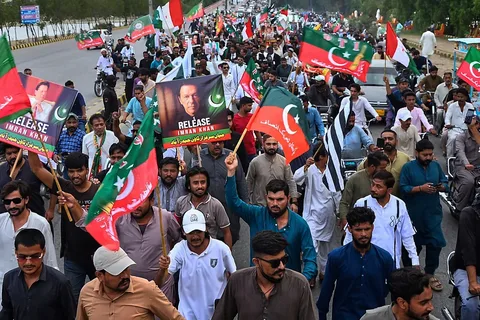

Pakistan protest today erupted across major cities as Pakistan Tehreek-e-Insaf (PTI) and the opposition alliance Tehreek Tahaffuz Ayeen-e-Pakistan (TTAP) took to the streets on Friday, May 23, 2026. The demonstrations were held in Islamabad, Lahore, and Peshawar despite Section 144 restrictions and heavy police deployments. Protesters demanded the immediate release of PTI founder Imran Khan, access to proper medical care for him in jail, and relief from Pakistan’s worsening inflation crisis.
Background: What Is Driving the Current Political Situation in Pakistan?
The current political situation in Pakistan has been deeply turbulent since 2022, when Imran Khan was removed as Prime Minister through a no-confidence vote. Khan has faced over 150 legal cases since his removal from power, and his current detention is tied to several key convictions, including the Toshakhana case, in which he was sentenced to 14 years in January 2025 for illegally selling state gifts.
Imran Khan has been imprisoned since August 2023 and is currently serving a sentence at Adiala Jail in connection with a £190 million corruption case. His continued detention has become the biggest political flashpoint in Pakistan’s recent history and a central driver of recurring protest in Pakistan.
This political crises in Pakistan has drawn in millions of ordinary citizens who are also struggling with economic hardship. The combination of Imran Khan’s imprisonment and a severe cost-of-living crisis has fueled the biggest protest movements Pakistan has seen in years.
Details: Pakistan Protest Today What Happened on May 23
PTI staged countrywide protests in Islamabad, Peshawar, and Lahore against Imran Khan’s imprisonment, inflation, and fuel price hikes, despite Section 144 restrictions and heightened police limits. This marks one of the most significant protest in Pakistan since the November 2024 march.
PTI and the opposition alliance TTAP announced the demonstrations at district headquarters across the country, with leaders citing Imran Khan’s imprisonment, rising inflation, higher petroleum prices, and other issues. The announcement had come just days earlier, outside Parliament House, after a PTI parliamentary party meeting.
PTI workers stated that Section 144 was already in place in the federal capital, but they proceeded with the protest as it was in support of their founding chairman Imran Khan and against inflation, which is severely affecting the public. Security forces were deployed in large numbers across the cities to contain the crowds.
A few days before this Pakistan protest today, several PTI leaders and workers staged a sit-in in Rawalpindi after they were denied a meeting with Imran Khan, who remains imprisoned in Adiala Jail. The Islamabad police prevented KP Chief Minister Sohail Afridi, accompanied by Khan’s sisters and several PTI workers, from proceeding towards Adiala Jail.
Imran Khan’s Health: A Central Issue Fueling Political Challenges Faced by Pakistan
One of the most urgent issues driving the current wave of protests is the health of Imran Khan behind bars. PTI has alleged that Imran Khan has suffered severe impairment to his right eye, with vision reduced to around 15 percent due to central retinal vein occlusion (CRVO), and has accused the government of criminal negligence in denying him timely medical intervention.
PTI demanded the immediate transfer of Imran Khan to Shifa International Hospital for a comprehensive and transparent medical examination, particularly of his eye condition, and called for unrestricted access for his personal physicians, including Dr. Faisal Sultan and Dr. Asim Yousaf.
While the government claims his condition is improving and manageable within the jail, his family has rejected these reports and demanded an independent evaluation. This standoff has deepened public anger and become one of the central political challenges faced by Pakistan today.
Quotes: Leaders Speak Out
Former National Assembly Speaker Asad Qaiser stated that the entire party and the people of Pakistan were deeply concerned about the health of Imran Khan and his wife, Bushra Bibi, adding that the parliamentary party had unanimously endorsed the decisions taken at the TTAP summit.
PTI Senator Azam Swati told the Senate that the former prime minister had lost sight in one eye and urged the state to ensure basic human rights for both Khan and Bushra Bibi, saying that inhumane treatment is never justified.
On the government’s side, Adviser to the Prime Minister Rana Sanaullah told the Senate that both Imran Khan and Bushra Bibi were receiving the best medical treatment available in the country, and that meetings in jail were being managed under a court-approved procedure.
TLP Protests Pakistan: Another Layer of Unrest
The political crises in Pakistan are not limited to PTI alone. In October 2025, the Islamist political party Tehreek-e-Labbaik Pakistan launched a long march from Lahore toward Islamabad in solidarity with Palestinians. Authorities imposed Section 144 in Rawalpindi, suspended mobile data services, and deployed police and Rangers. Clashes erupted and, according to reports, at least 11 TLP workers were killed during live fire and shelling by police.
The Government of Pakistan subsequently banned the TLP on October 23, 2025, citing its involvement in terrorism and violence. The TLP protests Pakistan episode added another chapter to the country’s long history of street politics and state crackdowns, underscoring how deeply divided Pakistani society has become.
Pakistan Protests Wiki: A History of Street Politics
To understand Pakistan protest today in its full context, it helps to look at recent history. Since 2022, Pakistan has seen Imran Khan ousted as PM, a nationwide protest the day after his removal, his landmark arrest in May 2023, mass arrests of PTI leaders following the May 9 riots, and eventually a second arrest in August 2023.
The November 2024 PTI protest in Islamabad’s D-Chowk saw Imran Khan issue a “final call” from his jail cell, with demands including his release, the resignation of the Shehbaz Sharif government, and the repeal of the Twenty-sixth Amendment to the Constitution of Pakistan. Independent sources reported casualties, making it one of the biggest protests in Pakistan in recent memory.
Pakistan protests wiki pages document a pattern: every major political development since 2022 has triggered a new wave of street action, government crackdowns, and Section 144 impositions.
Impact: Regional and Economic Consequences
The political crises in Pakistan are not just a domestic affair. Ongoing instability has damaged investor confidence, strained Pakistan’s economic recovery under the IMF program, and complicated its foreign relations. The PTI MNA who cycled to Parliament to protest a more than Rs14 per litre fuel price hike that pushed petrol costs above Rs416 per litre illustrated how deeply inflation pressures have hit ordinary Pakistanis.
International human rights organizations have also raised concerns about political prisoners, press freedom, and the treatment of opposition figures in Pakistan. The cycle of protest in Pakistan tomorrow and the day after remains likely as long as Imran Khan remains behind bars and economic conditions stay harsh.
Conclusion: What Comes Next?
The protest in Pakistan tomorrow and in the coming weeks is expected to intensify if PTI’s core demands remain unmet. The opposition has warned of escalating nationwide agitation. Leaders cited rising inflation, fuel price hikes, and deteriorating law and order, and warned of intensified nationwide agitation if demands remain unmet.
The current political situation in Pakistan points toward continued confrontation between the ruling coalition and a deeply mobilized opposition. Whether dialogue or further crackdowns follow will define Pakistan’s political trajectory in the months ahead. For millions of Pakistanis watching the Pakistan protest today unfold on their screens, the stakes economic, democratic, and humanitarian could not feel higher.
FAQs
Why is Gen Z protesting?
Pakistan’s Gen Z is protesting for multiple reasons. Economically, they face record youth unemployment, soaring inflation, and unaffordable fuel and food prices. Politically, many support Imran Khan, who built a strong youth following before his arrest. They are also angry about what they see as censorship of social media, suppression of dissent, and a justice system they feel operates unequally. Pakistan’s Gen Z is connected, vocal, and increasingly willing to take to the streets — making them a key force in any Pakistan protest today.
Who is Pakistan’s biggest friend? Pakistan has historically maintained close ties with China, which is considered its most consistent strategic partner through initiatives like the China-Pakistan Economic Corridor (CPEC). Saudi Arabia is also a major ally, providing financial support during economic crises. The United States has been an important but complicated partner, particularly in the context of regional security. Domestically, the question of “who is Pakistan’s friend” has itself become politically charged, with different parties accusing rivals of serving foreign interests.
Who is Pakistan currently at war with?
Pakistan is not officially at war with any country. However, it faces serious internal security challenges, including ongoing counterterrorism operations against militant groups in Khyber Pakhtunkhwa and Balochistan. Relations with neighboring Afghanistan remain tense, with frequent cross-border incidents. Pakistan and India also maintain a long-standing dispute over Kashmir, with periodic flare-ups along the Line of Control. The political crises in Pakistan have occasionally strained civil-military relations internally, but no formal state of war exists.