

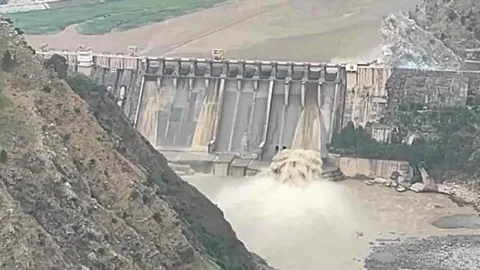

Pakistan’s Punjab province has been placed on a high flood alert following a major Chenab River water release. India has opened the spillway gates of the Salal Dam on the Chenab River, triggering an official advisory warning of dangerously rising water levels in downstream Pakistani regions. The Chenab River water release date has been set from May 21 to May 30, 2026, raising serious concerns for riverbank communities, farmers, and government agencies on both sides.
Background: Why Is India Releasing Water into Chenab River?
The Salal Dam, located on the Chenab River in Indian-administered Jammu and Kashmir, periodically requires emergency silt flushing to maintain its reservoir capacity. Silt builds up behind the dam walls and must be flushed out through the spillway gates. When India opens these gates, a massive surge of water mixed with sediment flows downstream into Pakistan.
The Chenab River is one of the most critical waterways shared between India and Pakistan. It enters Pakistan through Punjab, flows past the Marala Barrage in Sialkot district, and continues toward the Trimmu Headworks and beyond. Any large-scale water release from Indian dams directly affects Pakistani communities living along its banks. This current Chenab River water release event is significant because it spans ten consecutive days, giving water authorities little room for delayed response.
Full Details: What Is Happening on Chenab River Today
Sialkot Deputy Commissioner Saba Asghar confirmed that India has issued an important advisory regarding emergency silt flushing at the Salal Dam on the Chenab River from May 21 to May 30, 2026. The advisory warns that the water level in the Chenab River will rise by more than three metres as a direct result of this Chenab River water release.
A high alert has been issued at the Marala Barrage and its surrounding areas, particularly the Bajwat region. The DC has deployed the Punjab Enforcement and Regulatory Authority (PERA) to monitor the river continuously. All relevant departments have been directed to keep a 24-hour watch on the Chenab River water level and report any sudden increase immediately.
Barrage gates, telemetry systems, and flood safety arrangements have been ordered to remain fully operational throughout the Chenab River water release period. The canal system and water flow are being monitored on an uninterrupted basis. Citizens have been urged to avoid unnecessary visits to rivers and canals and to take all necessary precautionary measures for their safety.
The District Emergency Control Room in Sialkot has been activated. Residents seeking information or guidance during the Chenab River water release can contact the helpline at 052-9250011.
Official Quotes
Sialkot DC Saba Asghar stated:
“An important advisory has been issued by India in view of possible emergency silt flushing at the Salal Dam on the Chenab River from May 21 to May 30. In view of the rising water level, a high alert has been issued at the Marala Barrage and adjacent areas, especially Bajwat. Citizens should avoid unnecessary visits to rivers and canals and take precautionary measures.”
The DC further directed that communication between the Provincial Disaster Management Authority (PDMA), the Meteorological Department, and all district institutions be strengthened. Any sudden increase in water or grey silt-laden flow must be reported immediately to the concerned authorities.
She also ordered restrictions on the movement of people and animals along the riverbanks and riverbed of the Chenab River during this critical water release period.
Impact: What This Chenab River Water Release Means for Pakistan
The impact of today’s Chenab River water release extends well beyond Sialkot district. The Marala Barrage is the first major water control point that the Chenab River reaches after crossing into Pakistani territory. A rise of over three metres at this barrage translates into increased pressure on the entire downstream river system.
Immediate risks include:
- Flooding of agricultural lands in Sialkot, Gujranwala, and adjacent districts
- Danger to fishing communities and small settlements along the riverbanks
- Disruption to the canal irrigation network that feeds hundreds of thousands of acres of farmland in Punjab
- Risk of silt deposition damaging agricultural soil in low-lying areas
Punjab has faced devastating floods in recent years. Last August, severe flooding in the Sutlej, Ravi, and Chenab rivers forced mass evacuations across Punjab. The Flood Forecasting Division (FFD) and PDMA reported water levels nearing or exceeding critical levels at several key river sites. The combined inflow from these three rivers posed a severe threat to downstream regions including Multan and Muzaffargarh, displacing millions of residents.
This history makes the current Chenab River water release all the more alarming for disaster management agencies. The PDMA has been placed on standby, and coordination with the Meteorological Department has been intensified to track any accompanying rainfall that could compound the already rising river levels.
Regional and Strategic Significance
The Chenab River water release also carries a deeper political and strategic dimension. Relations between India and Pakistan over shared river waters have been a source of tension for decades. The Indus Waters Treaty (IWT), signed in 1960 and brokered by the World Bank, governs how the two countries share the waters of the Indus River system, including the Chenab.
Under the IWT, Pakistan has rights over the Chenab River, but India is permitted to construct certain run-of-river dams. The Salal Dam is one such structure. While operational needs like silt flushing are permissible, the downstream impact on Pakistan remains a persistent concern. Pakistan has repeatedly raised objections to the design and operations of Indian dams on treaty rivers, arguing they cause unpredictable flooding in Pakistani territory.
In a related development this month, Pakistan welcomed a Permanent Court of Arbitration (PCA) decision in the IWT proceedings, stating it affirmed limits on India’s ability to control water on rivers allocated to Pakistan. The current Chenab River water release is taking place in that context, adding a layer of diplomatic sensitivity to what is also a humanitarian concern.
Conclusion: What to Expect in Coming Days
As the Chenab River water release continues through May 30, 2026, Pakistani authorities are urging calm but demanding preparedness at every level. The PDMA, district administrations, and the Flood Forecasting Division are working together to monitor the situation hour by hour.
Residents in Sialkot, especially those in the Bajwat area near the Marala Barrage, should follow all official advisories and keep monitoring updates from the District Emergency Control Room. Farmers near the riverbanks are advised to move livestock and valuable equipment to safer ground.
The next ten days will be critical. If the Chenab River water release proceeds without additional rainfall or dam operations upstream, the situation may remain manageable. However, if monsoon rains arrive early or intensify, the risk of a larger flood emergency will grow significantly. Disaster management agencies across Punjab are watching the Chenab River water level with close attention and stand ready to respond.
Frequently Asked Questions (FAQs)
Which dam is present on Chenab River?
Several dams and barrages are located on the Chenab River. On the Indian side, the most prominent is the Salal Dam in Jammu and Kashmir, which is a run-of-river hydroelectric project. On the Pakistani side, the Marala Barrage in Sialkot and the Trimmu Headworks are among the key water control structures on the Chenab River. The Baglihar Dam is another major Indian dam on the Chenab, also located in Jammu and Kashmir.
When did the Chenab project start?
The Salal Dam project on the Chenab River was constructed in two stages. The first stage was commissioned in 1987 and the second stage in 1993. The broader development of the Chenab River system in Pakistan, including barrages and canal networks, began during the colonial era in the late 19th and early 20th centuries. The Marala Barrage was completed in 1939. In terms of modern hydropower development on the Chenab in Pakistan, planning for the Karot and other hydropower projects began in the 2000s and 2010s as part of long-term energy development programmes.
Which is the 2nd largest river in India?
The Godavari River is considered the second largest river in India by length and drainage area, after the Ganga. It flows for approximately 1,465 kilometres across central and southern India before meeting the Bay of Bengal. The Chenab River, while a major river in the Indus system, is primarily associated with the Punjab region and is classified under the western rivers allocated to Pakistan under the Indus Waters Treaty.