

America–China: Cooperation, Confrontation and the Struggle for Global Leadership That Continuously Reshaped the World Order
1949 to 1979 — Hostility, Ideological Conflict and the Beginning of Diplomatic Thaw
In 1949, when Mao Zedong announced the establishment of the People’s Republic of China, world politics entered a new phase. After the Second World War, the world had already been divided into two major blocs. On one side stood the United States and the capitalist Western system, while on the other side stood the Soviet Union and the communist bloc. The success of the communist revolution in China deeply alarmed the United States because Washington feared that if communism continued spreading across Asia, its global consequences would be dangerous. For this reason, the United States refused for many years to recognize the government in Beijing and continued to regard the government of Chiang Kai-shek in Taiwan as the legitimate representative of China. This became the foundation that pushed U.S.–China relations toward hostility, distrust and ideological confrontation from the very beginning.
The Korean War in 1950 transformed this hostility into open confrontation. The United States stood with South Korea, while China entered the battlefield in support of North Korea. The war not only claimed millions of lives but also raised the wall of hatred between America and China even higher. Washington labeled China an aggressive state, while China portrayed America as an imperialist power. During this period, the Taiwan issue also intensified. The United States signed military agreements for Taiwan’s defense and deployed naval fleets, while China viewed these actions as violations of its sovereignty. This issue remained the most dangerous flashpoint in relations between the two powers for decades.
The situation became even more complicated during the 1960s. Although the United States and China remained rivals, relations between China and the Soviet Union also began deteriorating. Border disputes and ideological disagreements emerged between the two communist powers. The United States saw this situation as a diplomatic opportunity. Washington realized that if China could be separated from the Soviet Union, the global balance of power might shift in America’s favor. Under this strategy, secret diplomatic contacts began. The world was stunned in 1971 when Henry Kissinger secretly visited China. It was the first moment when signs of thaw appeared in the Cold War hostility.
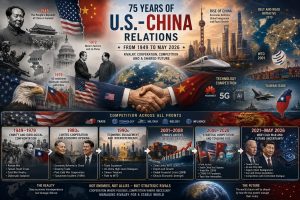
In 1972, U.S. President Richard Nixon’s historic visit to China became a major revolution in global politics. It was not merely a diplomatic meeting but the beginning of a new global balance of power. The meeting between Nixon and Mao Zedong sent a message to the world that hostilities are never permanent and that national interests can create new pathways. America was now abandoning its policy of completely isolating China. On the other hand, China also wanted closer ties with the United States to escape Soviet pressure. This meeting opened the doors for trade, diplomacy and cultural relations.
In 1979, the United States officially recognized the People’s Republic of China. This decision became a major turning point in history because it established formal diplomatic relations between the two countries. Although America maintained unofficial ties with Taiwan, the world clearly realized that China could no longer be ignored in global politics. Around the same time, Deng Xiaoping initiated economic reforms in China. He introduced a capitalist-style economic model within the communist political system. This was the step that would eventually transform China into one of the world’s largest economic powers. The United States welcomed this process because it hoped that economic openness would integrate China into the global system.
This was the era in which U.S.–China relations shifted from hostility toward reconciliation. Both countries quietly began cooperating against the Soviet Union. America provided China with opportunities in technology, trade and investment, while China started opening the doors of its economy. Yet despite this reconciliation, the fundamental differences never disappeared. Taiwan, ideological divisions and the struggle for global leadership remained in the background. These same unresolved differences would eventually become the foundation of a new Cold War.
1980 to 2008 — Economic Partnership, Global Trade and the Rise of the Chinese Giant
The 1980s marked the beginning of a new chapter in U.S.–China relations. Instead of direct hostility, both countries moved forward on the basis of cooperation, trade and shared interests in global politics. The Soviet Union still remained America’s greatest rival, and China also had serious disagreements with Moscow. As a result, a quiet strategic partnership emerged between Washington and Beijing. The United States adopted a policy of integrating China into the global economy, while China accelerated the opening of its markets. Deng Xiaoping’s economic reforms gave China a new direction. Through agricultural reforms, industrial development, foreign investment and special economic zones, China gradually transformed from a closed economy into a participant in the global market. This was the period when cities such as Shenzhen evolved from small towns into global industrial centers.
American and Western companies began investing in China because labor was cheap, regulations were flexible and the government strongly supported industrialization. For American corporations, China became a dream destination where large-scale production was possible at low cost. On the other hand, China used American investment, technology and markets to advance its economy at an astonishing speed. For the first time, the world began realizing that China was not merely another communist state but a future economic superpower.
However, relations suffered a major shock in 1989 when students and young activists gathered in Beijing’s Tiananmen Square demanding political freedom and democratic reforms. The Chinese government crushed the protests through military action. The incident was condemned throughout the world. The United States imposed sanctions on China and raised the issue of human rights internationally. This was the moment when America realized for the first time that economic reforms did not necessarily lead to political freedom. China made it clear that it could open economically while still maintaining strict communist political control.
In the 1990s, the Soviet Union collapsed and the United States emerged as the world’s sole superpower. Many American policymakers believed that China would gradually move toward a Western-style political system. Based on this assumption, America expanded trade relations with China even further. China dramatically increased its industrial production and gradually became the factory of the world. American companies invested billions of dollars, millions of jobs shifted to China and Chinese products spread throughout global markets. Cheap Chinese goods transformed the world economy. American consumers gained access to low-cost products while China accumulated massive foreign exchange reserves.
At the same time, the Taiwan issue once again became a source of tension. During political developments and elections in Taiwan in 1995 and 1996, China conducted military exercises while the United States sent naval fleets into the region. The world realized that despite expanding trade, mutual trust between the two countries remained incomplete. America became increasingly concerned about China’s growing military influence, while China believed the United States was attempting to contain its rise.
A historic breakthrough came in 2001 when China joined the World Trade Organization. This event became revolutionary in China’s economic history. After joining the WTO, Chinese exports increased explosively. American and European corporations shifted manufacturing operations to China on a massive scale. Within only a few years, China moved onto the path of becoming the world’s second-largest economy. During this era, “Made in China” became recognized throughout the world. Mobile phones, computers, clothing, toys, electronics, machinery and countless other products manufactured in Chinese factories flooded international markets.
Initially, the United States appeared to benefit from this economic relationship. American corporate profits increased, consumers gained access to cheaper goods and global trade accelerated. But gradually, a new sense of anxiety emerged inside the United States. Manufacturing jobs began disappearing because factories were relocating to China. Unemployment increased in industrial cities. American politicians started asking whether the United States had itself empowered its greatest future rival.
The 2008 global financial crisis became a major turning point in this debate. While the United States and Western economies fell into severe crisis, China remained relatively stable. Beijing supported its economy through massive stimulus packages and surprised the world. During the same period, China began investing heavily across Africa, Asia and Latin America. Ports, highways, railway projects and energy infrastructure expanded China’s global influence. For the first time, the world seriously began asking whether the twenty-first century would become a “Chinese Century” instead of an “American Century.”
This was the period when U.S.–China relations evolved beyond trade and gradually transformed into a silent struggle for global power. Although both countries remained economically dependent on one another, distrust was steadily growing internally. America increasingly realized that China was no longer merely a trading partner but its greatest future strategic rival. Meanwhile, China began believing that it was no longer a secondary power in the global system but an emerging superpower. This realization would eventually push both countries toward a new Cold War.
2009 to 2020 — Clash of Power, Technology War and the Beginning of a New Cold Conflict
After the 2008 global financial crisis, the economic and political direction of the world began to change. Although the United States still remained the dominant global power, its economy was struggling with crisis, while China emerged as a relatively stable and rapidly growing nation. After 2009, U.S.–China relations entered a new phase in which competition and distrust continued to grow alongside cooperation. The relationship was no longer limited to trade or diplomacy but was increasingly transforming into a struggle over global leadership, technology, military power and ideological influence.
During this period, China began converting its economic strength into political and military influence. Beijing launched major projects such as the Belt and Road Initiative, aimed at connecting Asia, Africa and Europe through infrastructure and trade networks linked to China. While the project became a source of development for many countries, the United States viewed it as a major challenge to its own global influence. America realized that China was no longer merely a manufacturing power but a country capable of reshaping the global order itself.
At the same time, tensions in the South China Sea intensified. China began constructing artificial islands and establishing military facilities there. The United States described these actions as violations of international maritime law and increased its naval presence in the region. This was the moment when the two powers began confronting one another more directly. Although no open war erupted, military tensions had clearly intensified.
Competition in the field of technology also accelerated dramatically. The United States began expressing security concerns regarding major Chinese technology companies. Huawei in particular became the center of a global controversy. America claimed that Chinese technology firms could be used for espionage and imposed restrictions on several Chinese companies. China described these measures as economic warfare. As a result, technology — especially 5G networks, semiconductors and data control — became the new battlefield of global politics.
When Xi Jinping came to power in 2012, China’s foreign policy became more assertive and ambitious. China introduced the concept of the “Chinese Dream,” aimed at restoring China to the center of global power. Meanwhile, America’s policy toward China also began changing. During the Obama administration, the “Pivot to Asia” strategy emerged, designed to strengthen American influence in Asia in order to balance China’s growing power.
The situation changed even further after 2016 when Donald Trump became President of the United States. Trump strongly criticized America’s trade relations with China. According to him, the United States had suffered losses from trade agreements with China, while Chinese products had weakened American industry. As a result of this policy, a trade war began between the two countries in 2018. The United States imposed heavy tariffs on Chinese products, and China responded with countermeasures. The conflict was no longer limited to tariffs alone; global supply chains also began suffering disruption.
At the same time, the technology war intensified further. Huawei was effectively pushed out of the American market. Strict restrictions were imposed on semiconductors, artificial intelligence and advanced technologies. In response, China accelerated efforts to strengthen its domestic technology sector. Gradually, the world began dividing into two technological blocs — one led by America and the other by China.
In 2020, the global COVID-19 pandemic pushed relations between the two countries into another crisis. The United States and China exchanged severe accusations over the origins and spread of the virus. America accused China of lacking transparency, while China accused the United States of politicizing the crisis. During this period, the global economy suffered heavily and major supply chain disruptions emerged. For the first time, the world realized that deteriorating relations between China and America would not affect only the two countries but the entire global system.
By 2020, it had become clear that U.S.–China relations were now driven more by rivalry and confrontation than cooperation. Although both countries remained economically dependent upon each other, trust had nearly disappeared. The Taiwan issue was intensifying again, military activity in the South China Sea was increasing and a new Cold War in technology had already begun.
This was the moment when the world started realizing that the greatest conflict of the twenty-first century would not necessarily be a traditional military war but rather an economic, technological and geopolitical struggle. America was attempting to preserve its global dominance, while China was moving toward the creation of a new world order. Developments after 2020 pointed toward an even deeper confrontation that would shape the future of the world in the years ahead.
2021 to May 2026 — New Cold War, Taiwan Crisis and the Global Race for Artificial Intelligence
After 2021, U.S.–China relations entered a new and even more complex phase in which traditional diplomacy became deeply intertwined with technology, defense, data, supply chains and global alliance politics. What had once been a conflict limited mainly to trade and tariffs gradually evolved into a struggle over the restructuring of the global order itself. The United States openly began describing China as its greatest strategic rival, while China made it clear that it would no longer accept the dominance of any other power.
With changes in American policy, the Biden administration placed alliance-building against China at the center of its strategy. In the Indo-Pacific region, the United States strengthened defense and strategic cooperation with allies such as Japan, Australia and India. The objective was to contain China’s growing influence. Meanwhile, China also expanded its regional and global partnerships. Through the Shanghai Cooperation Organization, BRICS and investments across Africa, Beijing broadened its influence. Once again, the world began dividing into blocs, although this time the divisions were driven less by ideology and more by technology and economics.
During 2022 and 2023, the Taiwan issue once again became the center of global tensions. In response to visits by American officials to Taiwan and signs of military cooperation, China reacted strongly and launched large-scale military exercises. Chinese air and naval activity increased significantly in the South China Sea and the Taiwan Strait. The United States also expanded the presence of its warships and allied forces in the region. This situation made it increasingly clear that Taiwan was no longer merely a regional issue but the most sensitive flashpoint for a possible global conflict.
At the same time, the technology war entered a decisive phase. The United States imposed strict restrictions on exports of advanced semiconductors and artificial intelligence technologies in order to slow China’s technological progress. AI, supercomputing and advanced chip manufacturing became the central battlegrounds of this competition. In response, China accelerated the development of its domestic semiconductor industry and AI models. As a result, the world gradually split into two separate digital ecosystems — one led by American technology and the other by Chinese technology.
In 2023, relations deteriorated further after an incident involving a Chinese balloon entering American airspace was declared a national security threat by the United States. The episode highlighted the deep lack of trust between the two countries. Diplomatic meetings continued, but in practical terms tensions kept increasing. At the same time, trade relations between the two nations partially declined and efforts began to reorganize global supply chains under the concepts of “decoupling” and “de-risking.”
During 2024 and 2025, the global economy moved toward a new trend. Major international companies began reducing complete dependence on China and started searching for alternative manufacturing centers. Vietnam, India, Mexico and several other countries emerged as parts of new supply chains. In response, China further strengthened its domestic market and expanded economic cooperation with BRICS nations. During this period, uncertainty in the global economy continued to grow, yet complete separation remained impossible because the United States and China were still among each other’s largest trading partners.
The high-level meeting held in May 2026 took place against this broader background, where both countries once again attempted to understand that complete confrontation was neither possible nor beneficial. Important topics discussed during the meeting included Taiwan, the situation in Iran, the global energy crisis, the race in artificial intelligence, semiconductor supply chains, tensions in the South China Sea and global trade. Although both sides agreed on cooperation and dialogue in certain areas, their fundamental differences remained unresolved.
No clear solution emerged regarding Taiwan, but both sides acknowledged that direct military confrontation must be avoided. In the field of technology, America continued trying to preserve its dominance, while China accelerated its policy of technological self-reliance. The two countries also maintained differing interests regarding Iran and the Middle East, although they partially agreed on stabilizing global energy supplies.
This entire situation makes it clear that the relationship between the United States and China is now neither complete hostility nor complete partnership but rather a form of “controlled competition.” Both countries remain economically dependent on each other while simultaneously trying to limit one another’s influence. This contradiction has become the defining reality of their relationship.
By 2026, the world had entered a new kind of Cold War in which traditional military fronts had become less important than the battlefields of technology, data, economics and global alliances. U.S.–China relations are no longer simply the story of two nations; they are shaping the future direction of the entire world. In the coming years, this confrontation may either lead to a new global balance or push the world into a far more dangerous phase through a major international crisis.