

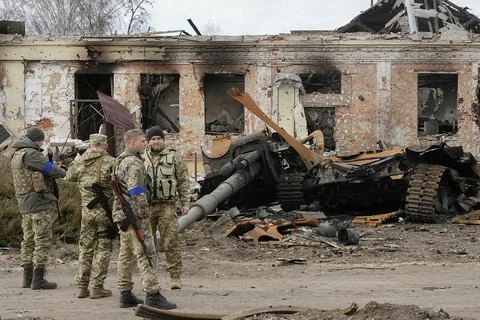

Russia’s war against Ukraine has now entered its fourth year, and the human cost on both sides continues to rise at a staggering pace. According to multiple international intelligence bodies and independent trackers, over one million Russian soldiers have been killed or wounded since February 2022. Meanwhile, civilian deaths in Ukraine from Russian attacks keep mounting, with 2025 recorded as the deadliest year for Ukrainian civilians since the war began.
Background: A War That Shows No Signs of Ending
Russia launched its full-scale invasion of Ukraine on February 24, 2022. What many expected to be a swift military campaign has stretched into years of grinding frontline combat, mass drone warfare, and large-scale missile strikes on civilian infrastructure.
Three years into the conflict, the battlefield remains largely frozen along a roughly 1,000-kilometer front line. Russia continues to make slow, incremental gains in eastern Ukraine’s Donbas region, but at an enormous cost in lives and military equipment. Peace negotiations have stalled repeatedly, with no lasting ceasefire in sight as of May 2026.
How Many Russian Soldiers Have Died in Ukraine?
Exact figures remain contested, but multiple credible sources paint a picture of catastrophic Russian military losses.
According to independent Russian outlet Mediazona and the BBC Russian service, verified Russian military deaths confirmed through obituaries, court records, and official registries have crossed 152,000 since the start of the invasion. These are only confirmed, named deaths and represent a fraction of the actual toll.
A broader estimate published by Mediazona in early 2026, based on Russia’s Probate Registry, put the figure at approximately 352,000 Russian soldiers killed through the end of 2025. This accounts for male Russian citizens aged 18 to 59 who died during the war period.
British intelligence figures are even higher. The UK Ministry of Defence estimated total Russian casualties — killed and wounded combined at over 1,118,000 by October 2025. Of those, British intelligence estimated that between 200,000 and 250,000 Russian soldiers had died in combat.
The Center for Strategic and International Studies (CSIS) noted that Russia was on track to hit the one million casualty mark in the summer of 2025, calling it “a stunning and grisly milestone” that reflects Vladimir Putin’s “blatant disregard for his soldiers.”
Russia has now suffered more fatalities in Ukraine than in all Russian and Soviet wars combined between the end of World War II and February 2022 a staggering historical comparison.
Ukraine Casualties vs Russian Casualties 2025: The Comparison
Ukraine’s losses are harder to verify, as Kyiv keeps military casualty figures largely classified for operational security reasons.
Ukrainian President Volodymyr Zelensky stated in December 2024 that approximately 43,000 Ukrainian soldiers had been killed and around 370,000 wounded. By April 2025, Zelensky revised the figure upward to around 100,000 Ukrainian soldiers killed.
Western estimates vary widely. Former U.S. SACEUR General Cavoli estimated more than 790,000 Russian soldiers killed or wounded as of April 2025. The Institute for the Study of War has consistently noted that Russian forces rely heavily on poorly trained infantry to advance, leading to disproportionately high Russian losses relative to territorial gains.
By most credible assessments, Russia has suffered battlefield casualties at a ratio of roughly 5 to 1 or higher compared to Ukrainian military losses though Ukrainian losses remain severe in absolute numbers.
Civilian Deaths in Russian Attacks on Ukraine
The toll on Ukrainian civilians has been immense and worsening throughout 2025.
The UN Human Rights Monitoring Mission in Ukraine (HRMMU) reported that since the full-scale invasion began, at least 14,534 Ukrainian civilians have been killed and over 38,000 injured — and these are only documented cases, meaning the real numbers are likely higher.
Civilian harm rose sharply in 2025, with total casualties in the first ten months of the year increasing by 40% compared to 2024. Civilian deaths rose by 17%, while civilian injuries surged by 46%. Human Rights Watch confirmed that 2025 was “the deadliest year for civilians in Ukraine since the start of Russia’s full-scale invasion.”
Short-range drone attacks have become one of the most lethal weapons against civilians. Between February 2022 and April 2025, such attacks killed at least 395 civilians and injured 2,635 more, according to HRMMU. The death toll from drones hit a record high in April 2025 alone, with 42 civilians killed and 283 injured in a single month.
The UN’s Independent Commission of Inquiry concluded in May 2025 that Russian drone attacks on civilians in Kherson Province constituted crimes against humanity of murder, noting the attacks were “widespread, systematic and conducted as part of a coordinated state policy.”
Russia’s Largest Attacks on Ukraine in May 2026
Just days before this article’s publication, Russia launched one of its most devastating aerial campaigns of the entire war.
On May 14, 2026, Russia fired over 1,560 drones and 56 missiles at Ukraine in a two-day period the largest aerial assault since the war began. The attack primarily targeted Kyiv, collapsing a nine-story residential building in the capital’s Darnytsia neighborhood. At least 24 people were killed and dozens more injured, according to Ukrainian emergency services.
The Kyiv mayor called it “the enemy’s largest-scale attack on the capital” and declared a day of mourning. European Commission President Ursula von der Leyen condemned the strikes as “another night of death and destruction” and announced a €6 billion drone support package for Ukraine.
Earlier in early May, Russian drone and missile attacks had already killed at least 27 people across five Ukrainian regions. Ukrainian energy workers and rescue personnel were among the dead after strikes on gas facilities operated by Naftogaz.
Quotes From Officials and Experts
Danielle Bell, Head of UN Human Rights Monitoring Mission in Ukraine: “Although individually less destructive than artillery or missiles, the sheer scale and increasing frequency of short-range drone attacks have made them one of the deadliest weapons in Ukraine.”
Yulia Gorbunova, Senior Ukraine Researcher at Human Rights Watch: “2025 was the deadliest year for civilians in Ukraine since the start of Russia’s full-scale invasion, while U.S.-initiated peace efforts have not brought any critical breakthroughs.”
Erik Møse, Chair of the UN Commission of Inquiry on Ukraine: “Three and a half years of armed conflict in Ukraine continue to have a devastating impact on the civilian population.”
Ukrainian President Volodymyr Zelensky described Russian strikes as “absolutely cynical, senseless terrorist strikes devoid of any military sense,” adding that “such Russian strikes on our cities and villages do not cease for a single day.”
Impact: Regional and Global Consequences
The scale of Russian losses has profound implications for Russia’s long-term military capacity, its domestic population, and geopolitical stability. With over 350,000 soldiers estimated dead and total casualties exceeding one million, Russia has drained significant portions of its pre-war military strength — a fact that NATO and Western analysts continue to monitor closely.
For Ukraine, the civilian death toll reflects a deliberate and systematic campaign against the country’s population and infrastructure. Energy strikes have left millions without heating and electricity during winter months. The destruction of hospitals, schools, and residential buildings has forced millions of Ukrainians into displacement.
Globally, the war continues to strain energy markets, disrupt grain supplies, and test the unity of Western alliances supporting Ukraine. Diplomatic efforts including those initiated by the United States in early 2026 have so far failed to produce a durable ceasefire.
Conclusion: What Comes Next
The Russia-Ukraine war shows no clear path to resolution. Casualty figures on both sides will continue to rise as long as fighting persists. International pressure for accountability including through the International Criminal Court, which Ukraine joined in January 2025 is growing, but enforcement remains limited.
Independent trackers like Mediazona, BBC Russian, and the Russian Losses in Ukraine tracker continue to document deaths one by one, providing a sobering record of the war’s human cost. As of May 2026, the numbers reflect one of the bloodiest conflicts in modern European history and the fighting continues.
FAQs
How many Russians died in WWII, including civilians?
The Soviet Union suffered approximately 26 to 27 million total deaths during World War II, making it the country with the highest death toll of any nation in the conflict. This includes an estimated 8 to 11 million military deaths and around 16 to 19 million civilian deaths from combat, famine, disease, and Nazi atrocities. The exact figure remains debated by historians.
Can two men marry in Russia?
No. Same-sex marriage is not legal in Russia. In 2020, Russia amended its constitution to explicitly define marriage as a union between a man and a woman. In 2023, Russia’s Supreme Court additionally ruled that the international LGBTQ+ movement was an “extremist organization,” further restricting LGBTQ+ rights in the country. Same-sex couples have no legal recognition or civil union status under Russian law.
How many Muslims will be in Russia in 2050?
Russia currently has one of the largest Muslim populations in Europe, estimated at 15 to 25 million roughly 10 to 17% of its population. Demographic projections, including studies from the Pew Research Center, suggest that Muslims could make up approximately 14 to 19% of Russia’s population by 2050, driven by higher birth rates in Muslim-majority regions such as Chechnya, Dagestan, and Tatarstan, as well as migration from Central Asian countries. Some projections place the Muslim share as high as one-fifth of Russia’s total population by mid-century, depending on migration trends and birth rate trajectories.