

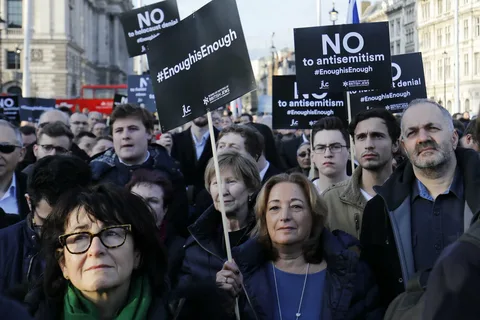

Two things can be true at once in Britain right now and the country is struggling to hold both. Antisemitic attacks are rising to levels not seen in decades. And the right to protest is being eroded faster than at any point since the 1980s. The anti-Semitism vs dissent Britain debate has reached a point where distinguishing genuine hate from legitimate political speech is becoming not just difficult but legally dangerous.
Both failures are real. Both deserve to be named.
The Golders Green Attack A Genuine Crisis
The trigger for the latest escalation in the anti-Semitism vs dissent Britain debate was the stabbing of two Jewish men in Golders Green, north London, on April 30. A 45-year-old British national of Somali origin was charged with attempted murder. Britain raised its national terrorism threat level to “severe” its second highest level the following day. Prime Minister Keir Starmer visited the scene and was booed by local Jewish residents who accused him of failing to protect their community. The group Harakat Ashab al-Yamin al-Islamiya, reportedly linked to Iran, claimed responsibility for some recent antisemitic attacks. The United Synagogue estimated security costs of around £1 million a year including one synagogue spending £20,000 a month on protection alone.
20,000 March Against Antisemitism Outside Downing Street
The response from Britain’s Jewish community was emphatic. Between 10,000 and 20,000 people gathered outside Downing Street on May 10 in a rally organised by the Campaign Against Antisemitism one of the largest such demonstrations in British history. British Chief Rabbi Ephraim Mirvis condemned social media platforms for allowing hate to spread and accused Iran of fomenting violence. United Synagogue president Saul Taylor described a national “epidemic of anti-Jewish hate” and criticised the broader anti-racism movement for failing to stand up for Jewish communities. Campaign Against Antisemitism CEO Gideon Falter coined the term “Britifada” to describe what he called an ongoing campaign of violence comparing the situation to the Palestinian Intifada.
Starmer Moves to Ban Protests And the Problems Begin
The Golders Green attack prompted Prime Minister Starmer to consider banning some pro-Palestine marches and prosecute people chanting “globalise the Intifada” a phrase he called “completely off limits” and “extreme racism.” The Metropolitan Police Commissioner told the BBC that people using the phrase were “likely to be arrested.” In March 2026, Home Secretary Shabana Mahmood had already approved a police request to ban the annual al-Quds Day pro-Palestine march the first march ban since 2012. This is where the anti-Semitism vs dissent Britain crisis becomes genuinely complicated because genuine hate and legitimate political protest are being legislatively conflated.
2,700 Peaceful Protesters Arrested Under Terror Law
The scale of the crackdown on dissent is striking. Over 2,700 people have been arrested across Britain under the Terrorism Act 2000 many simply for holding signs reading “I oppose genocide, I support Palestine Action.” Palestine Action, a direct-action group that protested at an Elbit Systems drone factory in Bristol, was proscribed as a terrorist organisation by the government in 2025. A High Court ruled that proscription unlawful in February 2026. Yet arrests continued pending the outcome of a government appeal. Human Rights Watch described the situation plainly: ordinary law, not counterterrorism legislation, should address crimes committed during direct action. By using terror law against protesters, Britain is treating civic dissent as a security threat.
The Police and Zionist Groups A Contested Relationship
The anti-Semitism vs dissent Britain debate deepened further through the trial of Ben Jamal, director of the Palestine Solidarity Campaign, and Chris Nineham of Stop the War Coalition both charged under the Public Order Act 1986 for organising a January 2025 demonstration. Evidence presented in court revealed that the Metropolitan Police had accepted recommendations from Zionist groups about protest routes. The police commander had not made any effort to consult with sections of the Jewish community that hold pro-Palestine positions. A judge refused to dismiss the case despite defence evidence that no conditions had been broken. Civil liberties organisations described the trial as the clearest sign yet of how far the space for legitimate dissent in Britain has shrunk.
The Central Problem Two Real Crises Being Conflated
The core difficulty in the anti-Semitism vs dissent Britain debate is that both sides are pointing to genuine, serious problems and the political response is making both worse. Antisemitism is real, rising, and dangerous. The Golders Green stabbing was a terrorist act. Jewish communities facing £20,000 monthly security bills are not imagining a threat. At the same time, arresting people for holding placards, banning marches not yet proven to be criminal, and using terror legislation against activists at drone factories are not solutions to antisemitism. They are responses to political pressure that erode the legal framework protecting all minorities including Jewish people from state overreach. Index on Censorship summarised the problem directly: the Jewish community needs protection, but so does the right to protest.
Where Britain Goes From Here
The antisemitism march London community held on May 10 demonstrated real public concern about a genuine problem. The Campaign Against Antisemitism, Keir Starmer, and the Metropolitan Police are not wrong that certain speech and actions at protests cross a clear legal line. But the machinery being constructed to address that problem expanded police powers, terror proscriptions, march bans, and mass arrests goes far beyond targeting genuine antisemitism. It applies to anyone willing to express political dissent in the street. Britain has spent two years allowing that machinery to be built. It will not easily be dismantled when the political moment changes.
Frequently Asked Questions
Did the British support Zionism historically?
British support for Zionism was formalised in the Balfour Declaration of 1917, in which Foreign Secretary Arthur James Balfour stated that the British government viewed “with favour the establishment in Palestine of a national home for the Jewish people.” The Declaration was the product of strategic wartime calculations, lobbying by Zionist leaders including Chaim Weizmann, and genuine sympathy among some officials for Jewish national aspirations. Britain subsequently administered Mandatory Palestine from 1920 until Israeli independence in 1948 a period marked by increasing conflict between its commitments to Jewish immigration and its obligations to the Arab population.
How do British people feel about Israel in 2026?
British public opinion on Israel has shifted significantly since October 2023. Multiple opinion polls conducted in 2025 and 2026 show majorities of British adults supporting an immediate ceasefire in Gaza, opposing arms sales to Israel, and expressing sympathy for Palestinian civilians. However, polling also shows consistent majority support for Israel’s right to exist and for addressing antisemitism seriously. The picture is not uniform younger British adults express more critical views of Israeli government policy, while older voters tend to be more supportive. The anti-Semitism vs dissent Britain debate reflects this divided public landscape, with both pro-Israel and pro-Palestine constituencies large enough to shape political behaviour.
What percentage of British Jews are Zionist?
Precise data is difficult to establish, but a 2015 survey by the Institute for Jewish Policy Research found that approximately 59% of British Jews considered themselves Zionist. A 2023 poll conducted after the October 7 Hamas attacks found higher levels of identification with Israel among British Jews, though also growing discomfort with specific Israeli government policies. A significant minority of British Jews including organisations such as Jewish Voice for Labour and Na’amod explicitly identify as anti-Zionist or non-Zionist. This internal diversity within the British Jewish community is frequently absent from the anti-Semitism vs dissent Britain public debate, which often treats the community as monolithic in its political views.