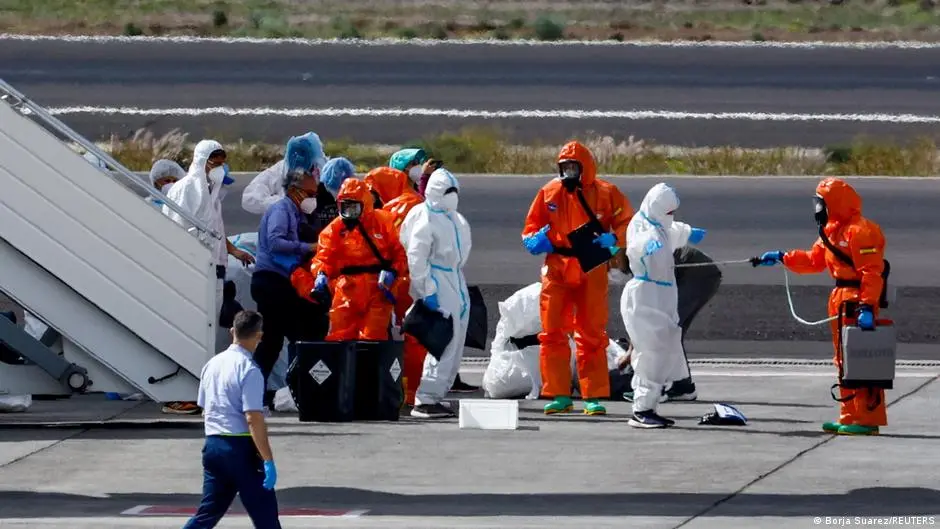
A dangerous hantavirus 2026 outbreak has been confirmed aboard the MV Hondius cruise ship, sending shockwaves across Europe and the world. The Andes hantavirus strain is at the center of the crisis, with nine confirmed hantavirus cases, at least one death, and growing fears about whether the virus has mutated. Health authorities in France, Italy, Spain, and the WHO are racing to contain the spread.
Breaking France Uncertain About Hantavirus Mutation
French Health Minister Stephanie Rist said it was not certain whether the hantavirus strain involved in the outbreak on the MV Hondius cruise ship may have mutated, although officials were “rather reassured.”
She told the National Assembly: “There are things we do not know about this virus. We do not yet have the complete sequencing of the virus, which allows us to say with certainty today, even if we are rather reassured to date, that this virus has not yet mutated.
This is a critical moment in the hantavirus 2026 outbreak. Without complete viral sequencing, no government can say with full confidence that the Andes hantavirus has not changed into a more dangerous or transmissible form. The world is watching this case with extreme attention.
What Is Hantavirus and What Are Hantavirus Symptoms?
Hantavirus is a serious viral disease that belongs to the Hantaviridae family. It is primarily known as a rodent-borne illness, though the Andes hantavirus the strain behind the hantavirus cruise ship outbreak is one of the very few strains capable of person-to-person transmission.
Hantavirus is primarily spread by rodents but can be transmitted between people in rare cases, according to the World Health Organisation. It usually begins with flu-like symptoms, such as fatigue and fever, one to eight weeks after exposure.
Common hantavirus symptoms include sudden fever, severe headaches, muscle aches especially in the thighs and back, chills, and dizziness. As the disease progresses, hantavirus symptoms can worsen dramatically. In serious cases, hantavirus symptoms escalate to shortness of breath and fluid accumulation in the lungs a condition called Hantavirus Pulmonary Syndrome (HPS), which can be fatal.
Hantavirus treatment is largely supportive. There is no approved antiviral drug specifically for hantavirus treatment. Medical teams focus on managing hantavirus symptoms, providing oxygen support, and in severe cases, using intensive care. Early hospitalization is the most effective form of hantavirus treatment known today.
The MV Hondius Hantavirus Cruise Ship What Happened
A cluster of hantavirus cases has been linked to the MV Hondius ship, which docked in Spain’s Canary Islands following a polar expedition that departed from Argentina.
The hantavirus cruise ship location the Canary Islands, a Spanish archipelago off the northwest coast of Africa is thousands of miles from where Andes hantavirus outbreaks have historically occurred. This geographic leap is one of the reasons hantavirus 2026 is drawing such global concern.
The outbreak has been linked to the Andes strain of hantavirus, with officials consulting Argentina, where an outbreak involving the same strain ended in 2019.
The MV Hondius is a polar expedition vessel that had been operating in remote South American regions exactly the kind of environment where rodents carrying Andes hantavirus are found. Passengers and crew are believed to have been exposed during the expedition before boarding the hantavirus cruise ship for the return voyage.
Hantavirus Cases How Many Are Confirmed?
The WHO has confirmed nine hantavirus cases and urged isolation of suspected cases, adding that more are expected given passenger interactions before the virus was detected. However, it said there was no sign of a wider outbreak.
The hantavirus cases now span multiple countries, as passengers from the MV Hondius hantavirus cruise ship came from across Europe. Hantavirus cruise ship deaths have been confirmed, with at least one fatality recorded in connection with the outbreak.
A woman died from hantavirus after being disembarked from a flight, and her case has triggered further hantavirus cases investigation. Italy’s top infectious diseases hospital said it would examine biological samples from a man in quarantine who had come into contact with a woman who died of hantavirus. He was briefly on the same plane as the woman who later died from the virus, and the woman was disembarked from the KLM flight before it took off from Johannesburg.
This case is particularly alarming because it suggests hantavirus cruise ship deaths are not confined to the ship itself the virus traveled with passengers onto commercial flights and into European countries.
Andes Hantavirus The Most Dangerous Strain
The Andes hantavirus is the specific strain at the center of the hantavirus 2026 outbreak. Unlike most other hantavirus strains globally, the Andes hantavirus is documented to spread from person to person not just from rodents to humans.
This makes the Andes hantavirus uniquely dangerous in outbreak settings. Most hantavirus strains found in North America and Asia require direct contact with infected rodents, their droppings, or nesting materials. The Andes hantavirus breaks that rule close contact between infected and uninfected people can be enough for transmission.
The Andes hantavirus was first identified in Argentina and Chile in the 1990s. Officials have been consulting Argentina, where an outbreak involving the Andes hantavirus strain ended in 2019. Argentina’s health authorities have direct experience managing Andes hantavirus clusters and have been sharing data with European counterparts handling the hantavirus 2026 crisis.
Looking at the hantavirus map, the Andes hantavirus has historically been concentrated in the Andes mountain region of South America particularly Argentina, Chile, Bolivia, and Paraguay. The hantavirus map now needs to be updated to reflect that the Andes hantavirus has, through a cruise ship, reached European soil for the first time in a significant cluster.
Hantavirus Map Where Is the Virus Spreading in 2026?
The hantavirus map for 2026 is more alarming than any previous year. Traditionally, the hantavirus map showed risk concentrated in the Americas particularly the southwestern United States, Canada, Argentina, and Chile for the Andes hantavirus. Parts of Europe, Korea, and China also appeared on older hantavirus maps for different strains.
The hantavirus 2026 outbreak has redrawn the hantavirus map. The MV Hondius hantavirus cruise ship location the Canary Islands placed confirmed Andes hantavirus cases in Spanish territory. Italy is now investigating hantavirus cases. France has called emergency health briefings. Germany, the Netherlands, and other EU countries are on alert because their nationals were aboard the MV Hondius.
The WHO has not declared a global health emergency over the hantavirus 2026 outbreak, but it said there was no indication that there was anything unusual about the hantavirus strain on the ship beyond its location. That reassurance, however, is conditional the full viral sequencing is not yet complete.
Expert and Official Statements What Authorities Are Saying
The WHO confirmed nine cases and urged isolation of suspected cases. It said more cases are expected given passenger interactions before the virus was detected.
France has moved quickly to brief lawmakers and the public. The French health ministry’s position, as stated by Minister Rist, is one of cautious watchfulness not panic, but not complacency either. The hantavirus 2026 outbreak is being treated as a serious but contained public health event for now.
Italy’s response has been equally serious. Italy’s Spallanzani Hospital the country’s top infectious diseases facility was awaiting biological samples from the quarantined man in order to analyse them. Spallanzani Hospital is the same facility that handled Italy’s first COVID-19 cases in 2020, signalling how seriously Rome is taking the hantavirus 2026 situation.
Global and Regional Impact Is Hantavirus the New COVID?
The hantavirus 2026 outbreak has triggered inevitable comparisons to the early days of COVID-19. Health authorities globally have been quick to push back against panic. Experts emphasize that hantavirus even the Andes hantavirus is not as transmissible as respiratory viruses like influenza or COVID-19.
However, the hantavirus cruise ship incident has exposed a real vulnerability: expedition travel to remote natural environments can bring passengers into contact with novel or dangerous pathogens. Hantavirus cases have been reported in connection with a single vessel that then distributed infected passengers across multiple continents.
The hantavirus map of risk areas may need to expand as climate change pushes rodent populations into new regions. More frequent and intense flooding which displaces rodents has historically driven spikes in hantavirus cases. The hantavirus 2026 outbreak serves as a warning about the intersection of wildlife disease, global travel, and public health preparedness.
Conclusion What Happens Next in the Hantavirus 2026 Crisis
The immediate priority for health authorities is completing the viral sequencing of the Andes hantavirus strain from the MV Hondius cruise ship. Until that is done, the mutation question remains open and with it, the question of whether standard hantavirus treatment protocols and isolation measures are sufficient.
More hantavirus cases are expected as the contact tracing expands. The hantavirus cruise ship deaths will likely rise as severe cases develop. The WHO, national health ministries, and the Spallanzani Hospital in Rome will be central to managing the next phase of the hantavirus 2026 crisis.
For ordinary people, the message is clear: hantavirus symptoms fever, fatigue, muscle pain should be taken seriously in anyone who has recently traveled to rodent-endemic environments or been in close contact with someone who has. Hantavirus treatment is most effective when started early. And the hantavirus map of risk now includes Europe in a way it never fully did before.
FAQs
Has anyone survived hantavirus?
Yes, many people have survived hantavirus, including the Andes hantavirus strain. Survival depends heavily on how quickly hantavirus symptoms are recognized and hantavirus treatment begins. Mild to moderate hantavirus cases particularly those caught before Hantavirus Pulmonary Syndrome develops have good survival outcomes. In documented Andes hantavirus outbreaks in Argentina and Chile, survival rates improved significantly with early intensive care. The 2026 hantavirus cases from the MV Hondius cruise ship include survivors currently under medical observation.
How did Gene Hackman’s wife get hantavirus?
Gene Hackman’s wife, Betsy Arakawa, died in early 2025 from hantavirus. Investigators determined she was exposed to hantavirus through rodent contact at their New Mexico home consistent with the Sin Nombre hantavirus strain common in the southwestern United States. This is the classic route of hantavirus exposure: coming into contact with infected rodent droppings, urine, or nesting material in or around a home. Her case highlighted that hantavirus cases are not limited to remote wilderness they can occur in residential areas near rodent habitats, as shown on any regional hantavirus map of the American Southwest.
Where do most people get hantavirus?
Most hantavirus cases globally occur through contact with infected rodents their droppings, urine, saliva, or nesting materials. Looking at the hantavirus map, most cases in North America involve the deer mouse in rural and semi-rural settings. In South America, the Andes hantavirus is associated with long-tailed rice rats found in forests and grasslands. People most at risk include those doing outdoor work, living in rural areas, cleaning out storage spaces where rodents nest, or as the hantavirus 2026 cruise ship case shows those on expedition travel to wilderness regions where rodent populations are dense and contact is unavoidable.