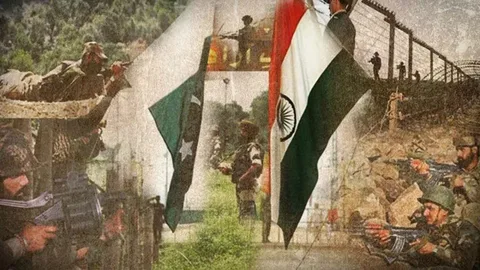
The India-Pakistan war 2026 has shaken South Asia to its core. Following India’s attack on Pakistan and Pakistan’s retaliatory strikes, a fragile ceasefire now holds but the current situation between India and Pakistan remains dangerously tense. Inside Pakistan, the political situation is equally turbulent, with the Senate erupting over terrorism in Khyber Pakhtunkhwa and accusations of Indian funding for militant groups.
India Attack on Pakistan What Triggered the War?
The India-Pakistan war 2026 did not begin without warning. Tensions had been building for months following the deadly Pahalgam attack in Indian-administered Kashmir, which New Delhi blamed on Pakistan-backed militants. India launched what it called “Operation Sindoor” a series of strikes targeting what it described as terrorist infrastructure inside Pakistan and Pakistan-administered Kashmir.
The India attack on Pakistan marked one of the most serious escalations in the India-Pakistan war list — a history of conflicts dating back to 1947. This was not a limited skirmish. Strikes hit multiple sites across Pakistan, drawing immediate and fierce condemnation from Islamabad.
Pakistan responded with its own military operations, claiming to have shot down Indian aircraft and targeting positions along the Line of Control. The India Pakistan war news today showed both sides escalating rapidly before international pressure forced a pause.
Did Pakistan Attack India? Both Sides Struck Hard
The question “did Pakistan attack India” has a clear answer: yes, Pakistan retaliated. After the India attack on Pakistan, the Pakistani military launched cross-border strikes and claimed significant damage to Indian military positions. Pakistan’s military described its response as measured, defensive, and within the bounds of international law.
The India-Pakistan war 2026 thus saw active military engagement on both sides — making it one of the most serious entries on the India-Pakistan war list since the Kargil conflict of 1999. Unlike previous standoffs, this time both sides used advanced weapons systems, drones, and precision strikes, raising fears of further escalation.
India or Pakistan who is stronger militarily? The answer is complex. India holds a significant advantage in conventional military size, defence budget, and technology. However, Pakistan’s nuclear deterrent and the geographic realities of the subcontinent make any full-scale war catastrophic for both sides. This mutual deterrence is ultimately what brought both nations to the ceasefire table.
Current Situation Between India and Pakistan Ceasefire but No Peace
The current situation between India and Pakistan is one of a ceasefire without reconciliation. International actors, including the United States, China, and the United Arab Emirates, played critical roles in brokering the pause in hostilities. The ceasefire was announced, but neither side has formally agreed to peace talks.
India Pakistan war news today reflects a deeply unsettled reality. Both militaries remain on high alert. The Line of Control continues to see violations. Trade, people-to-people contact, and diplomatic relations remain suspended.
The current situation between India and Pakistan is further complicated by domestic political pressures on both sides. India’s government faces pressure from nationalist groups demanding a tougher stance. Pakistan, meanwhile, is dealing with its own political crisis that the India-Pakistan war 2026 has temporarily overshadowed but not resolved.
Pakistan Political Situation Senate in Crisis Over Terrorism
While the India-Pakistan war 2026 dominated global headlines, inside Pakistan the political situation has reached a boiling point of its own. The Senate became a battleground this week as treasury and opposition lawmakers clashed over the rising wave of terrorism in Khyber Pakhtunkhwa.
JUI-F Senator Attaur Rehman asked whether KP had been “handed over to terrorists,” accusing the government of indifference to the province’s security situation and saying its focus on legislation was “in no way more important than the lives of the people of KP.”
This debate cuts to the heart of Pakistan’s political situation. Senator Rehman cited attacks in Lakki Marwat and Bannu, questioning why blood was being spilled while parliament focused on passing bills. His words captured the frustration of millions of Pakistanis caught between an external India-Pakistan war 2026 and an internal terrorism crisis.
India Accused of Funding Terrorism in Pakistan
Perhaps the most explosive moment in the Senate debate came when a senior government official directly linked India to terrorist attacks inside Pakistan. This dramatically tied the Pakistan political situation to the broader India-Pakistan war 2026 narrative.
Adviser to the Prime Minister on Political Affairs Rana Sanaullah claimed that “seven to eight thousand misguided people” were receiving terrorist training in Afghanistan with “funding from India and Israel” and carrying out attacks in Pakistan.
If accurate, this represents a major dimension of the India-Pakistan war 2026 that goes beyond military strikes — a proxy war fought through terrorist networks on Pakistani soil. The India attack on Pakistan, in this reading, is not just the military strikes but a sustained campaign of destabilisation through militant proxies.
Sanaullah added that there would be no compromise on Pakistan’s resolve to eliminate terrorism, and that Prime Minister Shehbaz Sharif had made it clear that Afghanistan must choose between Pakistan and terrorism.
India or Pakistan Who Is Stronger?
The India-Pakistan war 2026 has reignited the perennial debate: India or Pakistan, who is stronger? The honest answer requires looking at multiple dimensions.
In conventional military terms, India is significantly stronger. India’s defence budget is roughly eight to nine times larger than Pakistan’s. India has a larger army, a more advanced air force, and a growing naval capability. India’s missile systems, satellite intelligence, and drone technology have also advanced rapidly.
But Pakistan is not without its strengths. Pakistan’s nuclear arsenal is among the fastest-growing in the world. Its military has decades of counter-insurgency experience. And Pakistan’s geographic depth with mountains, deserts, and strategic chokepoints — makes any Indian ground invasion enormously costly.
The India-Pakistan war 2026 showed that while India can strike hard and fast, it cannot eliminate Pakistan’s retaliatory capacity. The India attack on Pakistan triggered an immediate and credible response. Both sides know that escalation beyond a certain point leads to nuclear catastrophe. That shared knowledge is, paradoxically, what keeps the subcontinent from all-out war.
India-Pakistan War List A History of Conflict
Understanding the India-Pakistan war 2026 requires context from the India-Pakistan war list. The two nations have fought four major wars: 1947 (over Kashmir partition), 1965 (Second Kashmir War), 1971 (which led to the creation of Bangladesh), and 1999 (Kargil conflict in high-altitude Kashmir).
Each entry on the India-Pakistan war list ended without final resolution of the core Kashmir dispute. The India-Pakistan war 2026 follows the same tragic pattern a crisis triggered by Kashmir, a military exchange, international intervention, and a ceasefire that resolves nothing at the root.
The current situation between India and Pakistan thus reflects not just a 2026 crisis but a 79-year-old unresolved conflict. Without a permanent political solution to Kashmir, the India-Pakistan war list will continue to grow.
Pakistan Political Situation A Nation Under Pressure From All Sides
The Pakistan political situation in May 2026 is one of extraordinary stress. Externally, the India-Pakistan war 2026 has forced a national security emergency. Internally, the country faces terrorism in KP, economic hardship, a politically imprisoned former prime minister, and a Senate divided along partisan lines.
Parliamentary Affairs Minister Tariq Fazal Chaudhry defended the government’s record, calling terrorist attacks in Bannu and Lakki Marwat “cowardly” and saying that intelligence-based operations were underway. But opposition senators were not convinced.
Rana Sanaullah urged the opposition to refrain from linking political differences with terrorist activities, and said PM Shehbaz had repeatedly invited the opposition to the dialogue table. The invitation has so far gone unaccepted.
The Pakistan political situation is further clouded by PTI’s ongoing boycott of parliament and the unresolved issue of Imran Khan’s imprisonment. With the India-Pakistan war 2026 dominating public attention, the government hopes to use national security sentiment to paper over political divisions but the Senate debate shows those cracks run deep.
Global Impact The World Watches South Asia
The India-Pakistan war 2026 is not just a regional crisis. It is a global concern. Both India and Pakistan are nuclear-armed states. Any miscalculation in the current situation between India and Pakistan could trigger consequences far beyond South Asia.
Major powers have intervened urgently. The United States called for de-escalation. China, Pakistan’s key ally, pressured both sides for restraint. Saudi Arabia and the UAE used their economic ties with both countries to push for ceasefire. The United Nations Security Council held emergency sessions.
The India Pakistan war news today shows that the ceasefire is holding but barely. Both militaries remain on hair-trigger alert. The diplomatic window to convert a ceasefire into lasting peace is narrow. If the current situation between India and Pakistan deteriorates again, the consequences for global stability oil prices, regional trade, and nuclear security would be severe.
Conclusion What Comes Next?
The India-Pakistan war 2026 has entered a new and uncertain phase. The guns are quiet for now, but the underlying causes Kashmir, cross-border terrorism, water disputes, and nationalist politics on both sides remain completely unaddressed.
For Pakistan, the path forward requires managing the current situation between India and Pakistan diplomatically while also fixing the Pakistan political situation at home. Terrorism in KP, as the Senate debate showed, is not going away. The accusation that India is funding militant groups inside Pakistan, if proven, would fundamentally reshape how the India-Pakistan war 2026 is understood by the international community.
India or Pakistan who is stronger in the long run? The nation that chooses diplomacy over destruction. The India-Pakistan war list is long enough. It is time for both sides to build something different.
FAQs
What is the national drink of Pakistan?
The national drink of Pakistan is sugarcane juice, locally known as “ganna ras.” It is widely consumed across the country, especially in Punjab and Sindh. Green tea (kahwa) is also considered a cultural staple, particularly in Khyber Pakhtunkhwa and Balochistan. Lassi a yogurt-based drink is another deeply popular beverage, especially in Punjab, and is strongly associated with Pakistani identity and cuisine.
Which city is richest in Pakistan?
Karachi is the richest city in Pakistan. It is the country’s financial capital and largest city, generating an estimated 20 to 25 percent of Pakistan’s total GDP. Karachi is home to the Pakistan Stock Exchange, the headquarters of major banks, and the country’s largest port. Lahore is the second wealthiest city, serving as the economic and cultural heart of Punjab. Despite the India-Pakistan war 2026 disrupting trade, Karachi and Lahore remain the engines of Pakistan’s economy.
Which city is called the Paris of Pakistan?
Lahore is widely called the Paris of Pakistan. The city is renowned for its Mughal-era architecture, vibrant arts scene, rich cuisine, and cultural energy. From the Badshahi Mosque and Lahore Fort to the old walled city’s bazaars, Lahore carries a beauty and historical depth that has earned it this nickname. It is also Pakistan’s fashion, music, and literary capital making it the cultural heartbeat of the nation, much like Paris is for France.