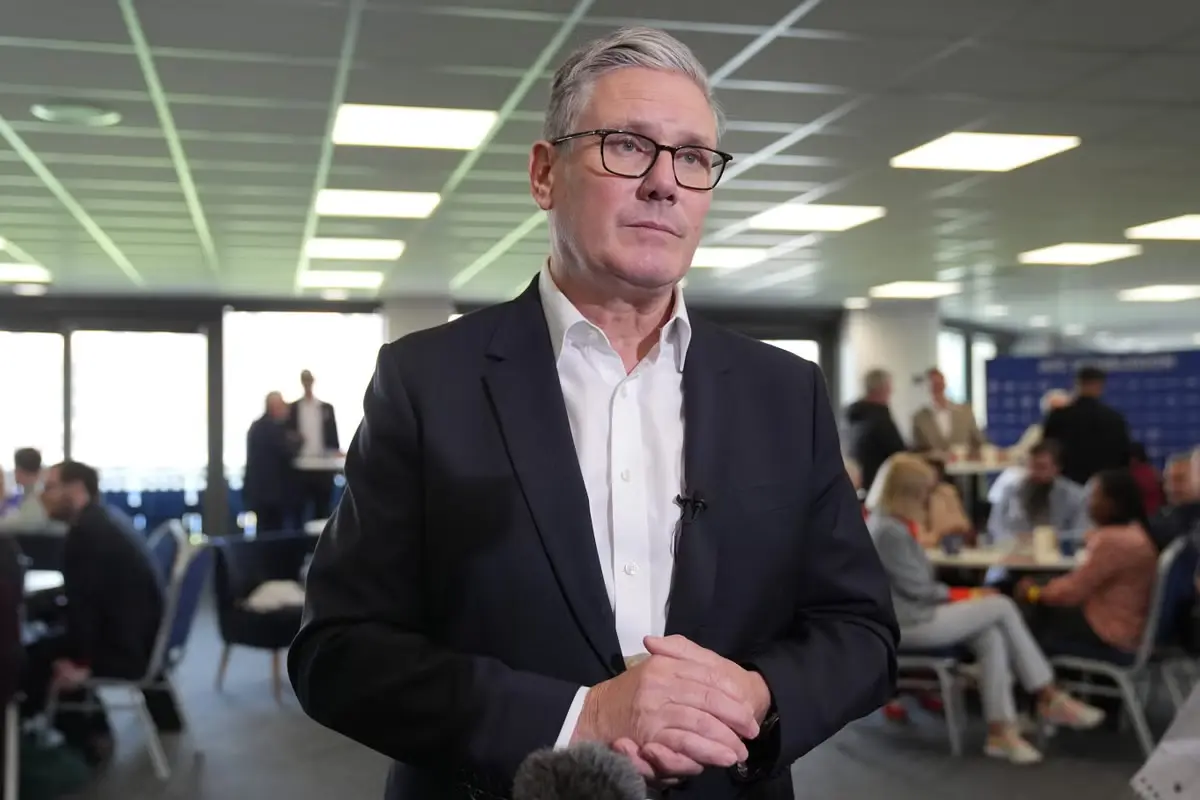
British Prime Minister Keir Starmer stood firm on Monday, vowing to prove his “doubters” wrong after Labour suffered one of its worst defeats in modern political history. The 2026 United Kingdom local elections, held on May 7, delivered a crushing blow to his party, sparking a wave of resignation calls that now number over 70 Labour MPs.
Starmer delivered a speech at the Coin Street Neighbourhood Centre in Waterloo, London, insisting he would not “walk away” from the challenges ahead. He also announced plans to nationalise what remains of British Steel, a symbolic move aimed at winning back working-class voters who have abandoned Labour for Reform UK in large numbers.
Background: A Party in Crisis After the 2026 UK Election Results
Labour swept to a landslide general election victory in July 2024, ending 14 years of Conservative rule. But within less than two years, the mood inside and outside the party has changed dramatically.
The 2026 United Kingdom local elections were the most significant test of public opinion between general elections. About 5,000 council seats across 136 English councils were up for grabs, alongside votes in the Scottish Parliament and the Welsh Senedd. The results confirmed what opinion polls had long been signalling Labour was in deep trouble.
UK Election Results 2026: What Actually Happened
The 2026 UK election results were devastating for Labour. The party lost 1,496 councillors and lost control of 38 councils across England.
Reform UK, led by Nigel Farage, surged from fewer than 100 council seats to around 1,450 seats a dramatic rise that shook British politics to its core. Even Labour strongholds in northern England crumbled. In Wigan, a former mining community Labour had controlled for over 50 years, Reform UK won every single one of the 20 seats Labour had been defending. In Salford, Labour held on to only three of its 16 defending seats.
The results were equally bad in Wales. Plaid Cymru, the pro-Welsh independence party, won the most seats across Wales meaning all three devolved regions outside England are now governed by nationalist parties.
Reform UK’s “Historic Shift” in British Politics
Nigel Farage described Reform UK’s performance in the 2026 United Kingdom local elections as a “historic shift in British politics.” He called it a “complete reshaping of British politics in every way.”
According to Sky News and the BBC, Reform UK won between 26% and 27% of the vote nationally. Most other major parties hovered between 16% and 20%. Polling expert John Curtice noted the results confirmed the fragmentation of UK politics no party holds the significant backing of the public any more.
Reform UK’s home affairs spokesperson Zia Yusuf also pointed out that if these results were replicated at a general election, Conservative leader Kemi Badenoch herself would lose her seat.
How Many Labour MPs Have Called for Starmer to Resign?
By the evening of Monday, May 11, over 70 Labour MPs had publicly called for Starmer to resign or set out a timetable for his departure a number that had been growing rapidly since the UK election results came in.
Four ministerial aides announced their resignations on Monday alone. Joe Morris, a parliamentary private secretary to Health Secretary Wes Streeting, and Tom Rutland, a PPS to Environment Secretary Emma Reynolds, both urged the Prime Minister to step down. Cabinet Office PPS Naushabah Khan and Melanie Ward, PPS to Deputy Prime Minister David Lammy, also resigned and called for new leadership.
Earlier, Labour MP Catherine West had threatened to launch an immediate leadership challenge herself, but backed down after Starmer’s speech. She said she would instead work to build support within the party for Starmer to set out a resignation timetable by September. A Survation poll for Compass found that 55% of the British public believe Starmer should step down.
What Did Keir Starmer Say Today?
In his speech, Keir Starmer acknowledged the results were difficult but framed his government as a “10-year project of renewal.” He said he was “not going to walk away” and would not “plunge the country into chaos” by resigning.
He announced plans to nationalise British Steel a significant industrial move aimed at protecting jobs in areas where working-class voters have deserted Labour for Reform UK. He pledged to prove his doubters wrong, both inside and outside the party.
The speech, however, failed to silence his critics. Conservative leader Kemi Badenoch called it “sad to watch,” adding that with so many policy resets, “even his reset button needs a reset.”
Andy Burnham The Name on Everyone’s Lips
No discussion of Starmer’s political future is complete without mentioning Andy Burnham, the Mayor of Greater Manchester.
Burnham is the most popular figure in the Labour Party by a wide margin. An Opinium poll in late 2025 gave Starmer a net approval rating of –40 compared to Burnham’s +10. In January 2026, voters believed Burnham would outperform Starmer in 12 out of 14 domestic policy categories. A YouGov poll found 34% of Britons think he would make a better Prime Minister.
However, Burnham faces a major obstacle. He is not currently a Member of Parliament, which is required to stand for the Labour leadership. In January 2026, he applied to stand as Labour’s candidate in the Gorton and Denton by-election, but was blocked by an 8–1 vote by Labour’s National Executive Committee a committee dominated by Starmer’s allies.
London Mayor Sadiq Khan has backed Burnham’s return to Parliament, saying it should happen “sooner rather than later.” But Burnham himself has yet to comment publicly on his intentions, and cancelled an event he was due to attend on Tuesday.
Angela Rayner and Other Potential Challengers
Former Deputy Prime Minister Angela Rayner, who was forced to resign last year over a breach of the ministerial code on taxation, has posted on social media that “what we are doing isn’t working, and it needs to change.” She called for “immediate action” on household costs, adding: “This may be our last chance.”
Rayner is seen as a credible contender on the left of the party. She has reportedly expressed support for Burnham returning to Westminster, potentially backing him in a leadership contest.
Other names in the frame include Home Secretary Shabana Mahmood, who notably declined to rule out interest in the top job recently.
Impact on UK Politics and What It Means
The 2026 UK election results signal more than just a bad night for Labour. They represent a profound shift in British political identity.
Reform UK has established itself as a genuine force across England, particularly in working-class communities that once formed the backbone of Labour support. The Greens have also gained ground, appealing to left-leaning urban voters who are frustrated with Labour’s direction.
Meanwhile, the fragmentation of the United Kingdom continues to deepen. Scotland, Wales, and Northern Ireland are all now governed by nationalist or separatist parties. The UK’s political map is being redrawn before our eyes.
For Starmer, the immediate danger is clear. To trigger a formal leadership contest, more than 20% of Labour MPs 81 of them must back a new candidate. With 70 already calling for change, that threshold is dangerously close.
What Happens Next for Keir Starmer?
Starmer insists he will lead Labour into the next general election, due in 2029. The party has never successfully removed a sitting Prime Minister in its 125-year history, which may offer him some short-term protection.
But the pressure is mounting. Catherine West has set an informal deadline of September for Starmer to announce a departure timetable. Multiple resignations from within the government are piling up. And with Andy Burnham circling, the question of who leads Labour into the next election is more open than it has been in years.
Starmer’s “prove the doubters wrong” speech bought him a little time. Whether it bought him enough remains to be seen.
FAQs
What did Keir Starmer do?
Keir Starmer became Prime Minister of the United Kingdom in July 2024 after leading Labour to a landslide general election victory. Since then, his government has struggled with a weak economy, low approval ratings, and a surge in support for Reform UK. After devastating 2026 local election results, he faced calls from over 70 of his own MPs to resign, but on May 11, 2026, he delivered a speech vowing to stay on and prove his critics wrong.
Why did so many UK prime ministers resign?
Several recent UK prime ministers resigned due to political crises, internal party pressure, or loss of public confidence. Boris Johnson resigned in 2022 amid a wave of scandals known as “Partygate.” Liz Truss resigned after just 45 days in office following the economic turmoil caused by her mini-budget. Rishi Sunak called a general election in 2024 that Labour won by a landslide, effectively ending his leadership. Each case reflected a breakdown of trust either within their own party or with the broader public.
Why was Rishi Sunak removed as PM?
Rishi Sunak was not forcibly removed he chose to call a general election in July 2024, which Labour won with a historic majority. His tenure was marked by internal Conservative divisions, the aftermath of the Boris Johnson era, economic pressures from rising interest rates and inflation, and declining poll numbers. After losing the election, he remained as leader of the Opposition before stepping down from that role later in 2024.