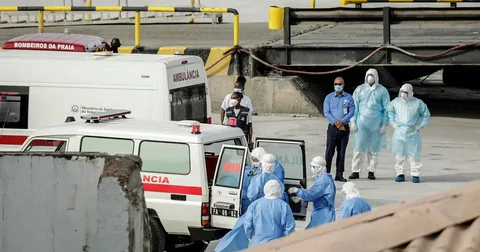
Europe’s top public health body has issued an urgent health warning today, declaring every passenger aboard the MV Hondius cruise ship a high-risk contact following a deadly hantavirus outbreak. The European Health Agency formally known as the European Centre for Disease Prevention and Control (ECDC) says all 147 people on board must undergo quarantine and daily monitoring for up to six weeks. Three people have already died.
The Health Warning Today What the EU Health Agency Said
All passengers on the cruise ship hit by a deadly hantavirus outbreak are considered high-risk contacts as a precautionary measure, the European Health Agency said ahead of the ship’s expected anchoring off the Spanish island of Tenerife.
This is among the most serious health warnings issued in Europe in recent years. The European Health Agency, known as ECDC, released the advisory as part of its rapid scientific advice framework. The health warning today affects passengers from 23 different nationalities across multiple continents.
ECDC has classified all people on board the ship and, for the purpose of disembarkation and repatriation, to be high-risk contacts. Monitoring and quarantine is required for up to six weeks 42 days with Day 0 counted from 6 May 2026.
Just as health warnings on cigarette packets are designed to alert the public before harm becomes irreversible, this health warning today from the European Health Agency is a preventive alert aimed at containing a disease that can kill within days of symptom onset.
Background What Is the Hantavirus Cruise Ship?
In April 2026, an outbreak of hantavirus infection due to the Andes virus was identified on the Dutch cruise ship MV Hondius. On 1 April 2026, the ship left Ushuaia, Argentina.
On 11 April, a passenger died on board from the virus, and his body was removed from the vessel on 24 April in Saint Helena, where his wife also disembarked. Two days later, she also died in a hospital in Johannesburg.
The outbreak escalated quickly. What began as isolated respiratory cases grew into a multi-country health crisis requiring coordinated international response. The European Health Agency, WHO, and national health bodies from the Netherlands, UK, Spain, South Africa, and others were all pulled into the response.
The ship is carrying 147 passengers and crew. As of 4 May 2026, seven cases two laboratory confirmed cases of hantavirus and five suspected cases had been identified, including three deaths, one critically ill patient, and three individuals reporting mild symptoms.
What Is the EU Warning Full Details of the ECDC Advisory
The EU warning from the European Health Agency goes further than a simple caution. It comes with specific protocols that all member states and affected countries must follow. Unlike a health warning on cigarette packets which is a passive pictorial health warning displayed on packaging this EU warning requires active intervention by governments.
High-risk contacts must self-quarantine and undergo daily symptom monitoring, and must be tested if symptomatic. Low-risk contacts must observe passive monitoring and must isolate and test if symptoms develop.
Passengers without symptoms will be repatriated for self-quarantine via specially arranged transport, not regular commercial flights, by their respective countries. This is a significant logistical undertaking involving multiple European governments simultaneously.
For flights, contact tracing applies only to probable or confirmed cases covering passengers within the same row and two rows on long flights. Healthcare and cleaning staff must use PPE, masking, and maintain one to two metres of distancing.
Where Is the Hantavirus Cruise Ship From?
The MV Hondius is a Dutch-flagged cruise ship that departed from Ushuaia, Argentina on 1 April 2026. Ushuaia is the southernmost city in Argentina, and a popular departure point for Antarctic and South Atlantic expeditions.
There were 149 people on board from 23 different nationalities, including nine EU/EEA member states: Belgium, France, Germany, Greece, Ireland, the Netherlands, Poland, Portugal, and Spain.
The ship’s journey took it through the South Atlantic, stopping at Saint Helena and Ascension Island before heading toward Cape Verde. The ship left for Tenerife on 6 May, after the Spanish Ministry of Health approved the ship’s arrival, where the passengers will be evacuated to their respective countries.
Deaths and Confirmed Cases The Full Picture
Eight people have fallen ill, including three who died a Dutch couple and a German national. Six of the eight are confirmed to have contracted the virus, with another two suspected cases, according to the WHO.
As of 8 May 2026, passengers are hospitalized in South Africa, the Netherlands, Germany, Saint Helena, Spain, and Switzerland, while the ship is on its way to Tenerife with additional medical resources and 147 individuals on board.
The spread across six countries illustrates why the European Health Agency issued its sweeping health warning today. The pictorial health warning approach used effectively on smoking warning on cigarette packages to communicate danger visually is being echoed here through public alerts issued across multiple national health systems simultaneously.
The US Centers for Disease Control and Prevention has classified the outbreak as a “level 3” emergency response, and the Dutch National Institute for Public Health has classified it as level A2 infectious disease.
Understanding Hantavirus Why This Disease Is So Dangerous
Human hantavirus infection is primarily acquired through contact with the urine, faeces, or saliva of infected rodents. It is a rare but severe disease that can be deadly.
What makes this outbreak uniquely alarming is the strain involved. ANDV Andes virus is a hantavirus primarily found in South America that causes Hantavirus Pulmonary Syndrome with a high fatality rate. Human-to-human transmission is rare but has been documented in the case of ANDV.
Illness onset is characterized by fever, gastrointestinal symptoms, rapid progression to pneumonia, acute respiratory distress syndrome, and shock. No effective antiviral treatment is available supportive care is key for a better chance of survival.
Public health experts often compare health warnings for emerging diseases to health warnings on cigarette packets or smoking warning on cigarette packages clear, urgent, and required to reach the public before more harm is done. The European Health Agency’s health warning today fits this urgent communication model.
EU Health Agency What Is the ECDC and How Does It Work?
The European Health Agency the European Centre for Disease Prevention and Control is headquartered in Stockholm, Sweden. It was established to strengthen Europe’s defenses against infectious diseases by monitoring outbreaks, issuing health warnings, and coordinating cross-border responses.
ECDC was notified on 2 May 2026 by the Netherlands via the European Union Early Warning and Response System about a cluster of unknown disease with severe respiratory symptoms on a cruise ship in the South Atlantic, operating under a Dutch flag.
The ECDC then moved quickly, issuing a rapid scientific advice the equivalent of an official health warning today within days of notification. This system mirrors how cigarette warning labels history evolved from simple text-based warnings to mandatory pictorial health warnings that governments must enforce by law. The ECDC’s role is similarly mandatory and authoritative for EU member states.
Why Is the EU Telling People to Stockpile Food Context and Clarification
There has been some public confusion between this hantavirus health warning today and separate EU civil preparedness guidance issued in recent months. The European Health Agency’s hantavirus advisory is specifically about the MV Hondius outbreak it does not involve food stockpiling instructions.
The food stockpiling guidance comes from a separate EU preparedness recommendation issued in late 2025, advising European citizens to maintain emergency supplies for at least 72 hours in case of natural disasters or major disruptions. That guidance is not linked to the hantavirus cruise ship situation.
The European Health Agency and EU institutions operate across multiple mandates. Just as smoking warning quotes remind individuals of personal risk, and smoking warning on cigarette packages carry mandatory government-enforced messages, the ECDC’s health warnings today address collective public health risk at a population level.
Global Impact A Health Crisis That Crossed Oceans
The MV Hondius hantavirus outbreak has now reached at least a dozen countries across three continents. It has triggered health warnings in the EU, UK, US, Canada, Singapore, South Africa, and Switzerland making it one of the most geographically dispersed disease alerts since COVID-19.
In the United Kingdom, the United States, and Canada, some people may have been in proximity to cases but are not showing symptoms. Contact tracing is ongoing across all these jurisdictions.
The smoking warning movie parallel is apt here this outbreak reads like a global thriller, with a cruise ship, multiple deaths, international evacuations, and a race against a 42-day quarantine clock. But the European Health Agency’s health warning today is no fiction. It is a real, active public health emergency requiring compliance from citizens and governments alike.
Conclusion What Happens Next
The MV Hondius docked at Tenerife on Sunday, May 10, 2026. Passengers are being evacuated to their home countries by specially arranged transport. The 42-day monitoring period running from May 6 to mid-June will determine whether the outbreak has been contained or whether new cases emerge in the community.
WHO currently assesses the risk to the global population from this event as low and will continue to monitor the epidemiological situation and update the risk assessment.
However, the European Health Agency’s health warning today makes clear that caution must remain high. Just as cigarette warning labels history evolved over decades to become more forceful and visual from text to pictorial health warnings the response to emerging diseases must also become faster, more coordinated, and more transparent. The MV Hondius crisis is a test of exactly that.
FAQs
What is the EU warning?
The EU warning refers to the European Health Agency’s (ECDC) rapid scientific advice issued on 9 May 2026, declaring all passengers aboard the Dutch cruise ship MV Hondius as high-risk contacts following a deadly hantavirus outbreak. The health warning today requires all passengers to undergo up to 42 days of quarantine and daily monitoring. Symptomatic passengers must be tested immediately, while asymptomatic passengers are being repatriated via specially arranged transport not commercial flights by their respective governments.
Where is the hantavirus cruise ship from?
The hantavirus cruise ship the MV Hondius is a Dutch-flagged vessel that departed from Ushuaia, Argentina on 1 April 2026. It carried 147 passengers and crew from 23 nationalities. The outbreak is believed to have begun after some passengers were exposed to the Andes virus while visiting Argentina, where the virus is endemic. The ship traveled through the South Atlantic before heading to Cape Verde and ultimately docking at Tenerife, Spain on 10 May 2026 for passenger evacuation.
Why is the EU telling people to stockpile food?
The food stockpiling advice is separate from the hantavirus health warning today. The European Health Agency’s current advisory is specifically about the MV Hondius outbreak. The food stockpiling recommendation came from broader EU civil preparedness guidance issued in 2025, advising Europeans to keep at least 72 hours’ worth of emergency supplies at home for use during natural disasters or large-scale disruptions. It is not connected to the cruise ship crisis or any specific disease outbreak.