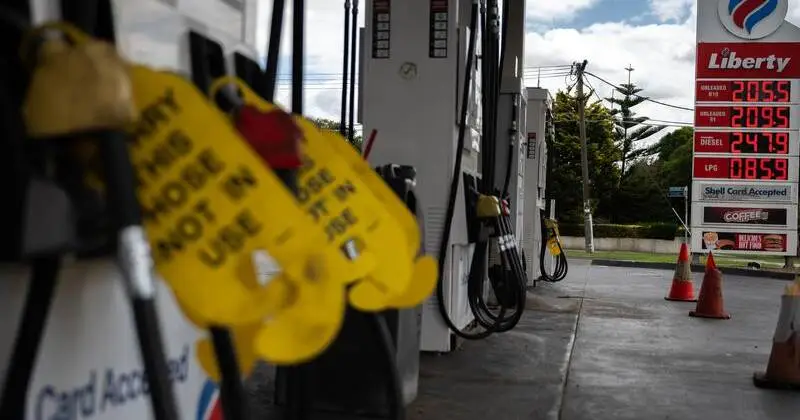
Australia is in the grip of a severe fuel crisis that has been decades in the making. With petrol prices surging, diesel running dry at hundreds of service stations, and warnings of a potential food shortage, Australians are now facing the real consequences of decades of poor energy policy decisions.
Australia imports 90 per cent of its refined fuel and holds roughly thirty days of reserves the lowest of any International Energy Agency member, against a binding obligation of at least ninety days. The Australia fuel crisis warning is no longer a distant alarm. It is a present emergency hitting homes, farms, and businesses across the country.
Background: Decades of Warning, Years of Inaction
Australia’s vulnerability to a fuel crisis did not appear overnight. It is the product of deliberate policy failures across multiple governments. In 2002, Australia held approximately 310 days of fuel reserves. By 2012, that figure had fallen below the IEA minimum and has never recovered.
A Senate inquiry conducted between 2014 and 2015 specifically flagged that counting fuel in transit as part of a strategic reserve was not energy security but rather a form of optimistic accounting. That warning went unaddressed. More than a decade later, the same structural gap remains wide open, and now Australia is paying the price.
Australia is the only member of the IEA that does not hold the mandatory 90-day fuel reserve requirement something the country has failed to meet since 2012. This is not a new failure. It is a systemic one stretching across five successive governments of both political persuasions.
Details: What Triggered the Australia Oil Crisis
The immediate trigger for the current Australia oil crisis was the closure of the Strait of Hormuz in early 2026 following escalating conflict in the Middle East. By the time Iran closed the strait in February 2026, the only surprise was that anyone was surprised. While petrol prices were surging through March, wholesale electricity prices in Australia were falling.
Australian domestic crude oil production declined from 277,000 barrels per day in 2011 to just 61,000 barrels per day in 2025, fundamentally altering the country’s energy security profile. Where Australia once had eight domestic refineries, it now operates just two. Nearly every litre of refined fuel arrives on foreign-owned vessels from Asian refineries that source crude through the same contested shipping lanes.
Over 107 fuel stations across New South Wales experienced diesel shortages as of March 2026, with independent retailers bearing the brunt of supply constraints compared to major integrated suppliers. The Australia fuel reserves situation has become impossible to ignore.
Australia Jet Fuel Crisis and Aviation Impact
The Australia jet fuel shortage has directly hit the aviation sector. In April 2026, the government announced it had received a massive shipment of 100 million litres of jet fuel and 50 million litres of diesel from Asia in an emergency procurement effort to keep airports and airlines operational. Qantas extended domestic flight cuts as the Australia jet fuel shortage restricted normal airline operations.
Diesel, however, remains the most critical fuel under pressure. Diesel powers the trucks that move freight across the country, keeps agriculture operating, supports mining and construction, and ensures emergency services can function. Without diesel, almost every supply chain in Australia grinds to a halt.
Australia Food Shortage Warning
The flow-on effects of the Australia fuel crisis have triggered serious Australia food shortage warnings. The National Farmers’ Federation is warning of food price increases of up to 50 per cent. Diesel shortages mean farmers cannot run machinery, trucks cannot deliver produce, and supply chains are fracturing at critical points.
The Minister for Agriculture, Fisheries and Forestry, Julie Collins, announced she was commissioning a National Food Supply Chain Assessment, which will advise the government on preparing for disruptions in food production and supply chains. The minister acknowledged that fuel and fertiliser supply are tightly linked to food security, and neither can be taken for granted.
Quotes: Officials and Experts Respond
Former head of the ACCC Allan Fels stated, “It is better to act sooner rather than later, given our limited reserves and the spectre of early fuel price buying, queuing and hoarding.”
The Maritime Union warned that Australia now depends on “foreign refineries, foreign-owned tankers and shipping lanes that run through contested waters,” calling the situation not just an economic issue but a national security risk.
Energy Minister Chris Bowen told reporters, “We are nowhere near that,” when pressed about whether Australia would run out of fuel, adding that minimum stock obligations remained largely intact with 80 per cent of reserves still available for future needs.
One corporate governance expert writing in The Canberra Times put the challenge plainly: “I would put a question to every board in Australia what is your organisation’s exposure to imported liquid fuel, and what is your plan to reduce it?”
Government Response: National Fuel Security Plan
On 30 March 2026, National Cabinet agreed to the National Fuel Security Plan a coordinated response to support fuel security and supply chain resilience considering the ongoing conflict in the Middle East.
Prime Minister Albanese announced that the government cut the fuel excise in half, reducing tax on every litre of petrol by 26 cents, while the heavy vehicle road user charge was cut to zero. Both measures were placed in effect for an initial three-month period.
The government also announced it would temporarily lower fuel quality standards for 60 days to allow higher-sulphur fuel to be sold, adding roughly 100 million litres to the market each month. In addition, up to 762 million litres of petrol and diesel were released from domestic reserves.
The International Energy Agency issued ten recommendations to Australia, including promoting working from home, carpooling, lowering highway speed limits, reducing air travel, and increasing public transport usage.
Who Sold EnergyAustralia? The Foreign Ownership Question
A key part of the Australia energy lockdown debate involves who controls the country’s energy infrastructure. Before electricity prices doubled over the past decade, EnergyAustralia used to be owned by Australians it was the property of the governments of New South Wales and Victoria.
EnergyAustralia is now a wholly owned subsidiary of the Hong Kong-based energy company CLP Group. Originally a state-owned enterprise of the New South Wales Government, it was acquired by CLP-owned TruEnergy in 2011. The New South Wales Government retained the distribution service under the renamed entity Ausgrid.
The profits, now privatised, flow through a tax haven in the Caribbean before reaching the CLP Group in Hong Kong an industrial empire controlled by the billionaire Kadoorie family, also known as China Light and Power Company. Critics argue that the decision to sell these assets was a fundamental mistake that has weakened Australia’s sovereign energy position.
Impact: Economic and National Security Consequences
The Australia oil crisis carries economic consequences far beyond petrol stations. Fuel and energy costs represent approximately 3 to 3.5 per cent of Australia’s CPI basket directly. However, their indirect influence through food pricing, transport, manufacturing input costs, and services is substantially larger.
Households simultaneously facing higher fuel costs, elevated grocery prices, and rising mortgage repayments have materially reduced discretionary spending. The risk of a stagflationary environment recession combined with elevated inflation is now openly discussed by economists and policymakers alike.
The Maritime Union put it bluntly: “Australia is an energy exporting nation. It is indefensible that we cannot guarantee our own fuel supply.” That statement captures the central contradiction at the heart of this crisis a nation rich in resources that cannot secure its own fuel.
Conclusion: What Happens Next?
The obvious path forward, while long, is not complicated. Australia has the resource and capability to generate the great majority of its energy domestically. Every rooftop solar installation, every battery, every electric vehicle, every wind farm permanently reduces exposure to the next shock.
Australia needs to rebuild its fuel security by increasing sovereign fuel reserves well beyond international minimum requirements and protecting and expanding domestic refining capability. The crisis of 2026 must not be allowed to pass without structural reform.
The Australia fuel crisis warning has been sounding for more than two decades. The question now is not whether Australia can hear it but whether its leaders will finally act before the next global shock arrives.
FAQs
Why is Australia having an energy crisis?
Australia is experiencing an energy crisis due to a combination of dangerously low fuel reserves, the near-total closure of domestic oil refineries, and heavy dependence on imported fuel from Middle Eastern and Asian sources. The disruption of the Strait of Hormuz in early 2026 cut off key supply routes. Australia has never met the IEA’s mandatory 90-day fuel reserve requirement since 2012, leaving the country critically exposed when global supply chains came under pressure.
What is Australia’s plan for the fuel crisis?
On 30 March 2026, National Cabinet agreed to the National Fuel Security Plan, a coordinated response to support fuel security and supply chain resilience amid the Middle East conflict. The government has halved the fuel excise, released emergency reserves, lowered fuel quality standards temporarily, secured emergency jet fuel and diesel shipments from Asia, and is extending domestic diesel stockpile infrastructure to 2030.
Who sold EnergyAustralia to China?
EnergyAustralia was originally owned by the governments of New South Wales and Victoria as a state-owned public asset. It was sold to CLP-owned TruEnergy in 2011 and is now a wholly owned subsidiary of Hong Kong-based CLP Group. While CLP Group is a Hong Kong-based company rather than a mainland Chinese state entity, it is widely referred to in the context of foreign and broadly Chinese-linked ownership of Australian energy infrastructure. The decision to privatise has drawn sustained criticism as it transferred a strategic national asset to foreign control.