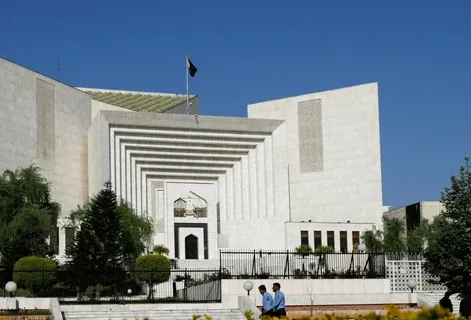
The Federal Constitutional Court (FCC) Pakistan has issued a stern warning against the growing practice of keeping judgements reserved for months without announcement. The court called this trend a serious failure to deliver justice and ordered all courts in the country to follow strict timelines for pronouncing verdicts.
The Federal Constitutional Court Pakistan has taken strong exception to the growing tendency of pronouncing judgements after keeping them reserved for a considerable time, leaving the rights of the parties in a state of uncertainty while they await the court’s opinion. This latest judgement by the FCC has sparked a national conversation about judicial accountability, case backlogs, and the state of justice delivery in Pakistan.
Background
Pakistan’s judiciary from trial courts to the Supreme Court of Pakistan has long struggled with a massive backlog of pending cases. Citizens who visit the Federal Constitutional Court Pakistan website or check the Federal Constitutional Court Pakistan Cause List often find their cases stuck in long queues with no decision in sight.
The Supreme Court of Pakistan has addressed this issue in the past. In 2015, the Supreme Court laid down that a judgement reserved by a high court should be pronounced within a period of three months (90 days). However, that ruling has rarely been followed in practice, and the FCC now finds itself repeating the same call for discipline this time with greater urgency.
Details of the FCC Judgement
Justice Aamer Farooq, who headed a two-judge FCC bench, authored the judgement while taking up an appeal by the Pakistan National Shipping Corporation against a June 2021 order of the Sindh High Court concerning post-retirement benefits.
While deciding the matter, the FCC took notice of the petitioner’s grievance that the SHC judgement was delivered 10 months after the hearing a delay it described as reflecting on the bench and amounting to a failure to administer justice expeditiously.
The court’s seven-page ruling is being seen as a landmark directive. The FCC noted that in the recent past there have been deviations from court rules and even settled practices, stressing that it is essential for everyone, including judges, to adhere to these rules and practices in order to make the dispensation of justice certain and transparent.
The FCC also expunged the concluding paragraph of the SHC judgement for being superfluous and amounting to an excess of jurisdiction, while noting that the merits of the case required no interference.
People who regularly search for the latest judgement of the Supreme Court of Pakistan or try to find a Supreme Court of Pakistan decision today in PDF format will find this ruling particularly significant, as it directly affects how quickly future decisions will be delivered across all courts.
Quotes from the Bench
Justice Farooq observed that such delay “compounds the hardship of litigants” and that such conduct on the part of the judiciary “cannot be allowed and is strictly forbidden.”
He further emphasised that “the sanctity and confidentiality of our work stand as hallmarks of judicial independence” and that “any breach thereof warrants strict action.”
The court also recalled the 2015 Supreme Court of Pakistan ruling which held that “without a judgement there is no concept of justice or a fruitful outcome of litigation,” effectively meaning the state lacks an effective justice system when verdicts are not delivered on time.
Timelines Set by the FCC
The Federal Constitutional Court Pakistan clearly reaffirmed the timelines that all courts must now follow:
It is mandatory for trial courts to pronounce judgements within 30 days of the conclusion of a trial, while high courts are expected to decide matters within 90 days of reserving them.
Since the FCC had addressed issues relating to reserved judgements and judicial conduct, a copy of the verdict is to be circulated to the high courts for strict compliance and observance.
Anyone looking for information on how to search for a Supreme Court judgement or track Federal Constitutional Court Pakistan case status can use the Federal Constitutional Court Pakistan website, which lists the Federal Constitutional Court Pakistan Cause List for upcoming hearings.
Impact: What This Means for Pakistan’s Justice System
This ruling carries deep implications for everyone who depends on the courts from ordinary citizens to large corporations. Pakistan’s judicial system is burdened with millions of pending cases, and this FCC directive is one of the most direct judicial interventions in recent years.
The court stated that it expects all courts of the country, including the FCC, the Supreme Court, and the high courts, to follow the 2015 judgement in letter and spirit, emphasising that the efficacy of any legal system depends upon the expeditious disposal of cases according to law.
People who visit the Federal Constitutional Court Pakistan website for case status updates, those following Federal Constitutional Court Pakistan jobs listings, and those tracking the Federal Constitutional Court Pakistan Cause List daily are all stakeholders in this broader question of judicial efficiency.
Hinglaj Mata Temple: Also in the News
While the Federal Constitutional Court Pakistan made headlines for judicial accountability, another story has been gaining attention in Pakistan’s news cycle the Hinglaj Mata Temple.
Hinglaj Mata Temple, also known as Hinglaj Devi or Nani Mandir, is a Hindu temple located in Hinglaj, a town on the Makran coast in the Lasbela district of Balochistan. It lies in the middle of Hingol National Park.
The three-day annual festival of the historic Hinglaj Mata temple recently concluded in remote Hingol Park in Balochistan, with an estimated over 300,000 people visiting the shrine mostly Pakistanis, along with Hindu Sindhis living in the UK, the US, and elsewhere.
The Balochistan government has decided to declare the historic Hinglaj Mata Temple a world tourism site, following a meeting between Chief Minister Sarfraz Bugti and Senator Danesh Kumar to discuss promoting minority religious tourism in the province.
Senator Kumar noted that Pakistan hosts one of the world’s largest Hindu pilgrimages at Hinglaj Mata Mandir, with around 300,000 yatris participating in the main April festival and nearly one million devotees visiting throughout the year.
Conclusion
The Federal Constitutional Court Pakistan’s strong message about delayed reserved verdicts is a wake-up call for the entire judicial system. Whether one is tracking Federal Constitutional Court Pakistan case status, browsing the Federal Constitutional Court Pakistan Cause List, checking Federal Constitutional Court Pakistan jobs, or searching for the latest judgement of the Supreme Court of Pakistan, the core message from the bench is clear justice must be swift, transparent, and consistent.
The FCC’s directive, if followed seriously by all courts, could mark a turning point in how Pakistan delivers justice to its citizens. The ball is now in the court of every judge across the country to show that justice delayed will no longer be tolerated as the norm.
Frequently Asked Questions (FAQs)
How many cases are pending in Pakistani courts?
Pakistan’s courts are burdened with millions of pending cases across all levels from district courts to the Supreme Court of Pakistan. Estimates from judicial reports suggest that several million cases are awaiting resolution at any given time, making judicial backlog one of the most pressing governance challenges in the country.
Is justice delayed, is justice denied?
Yes this is a well-established legal principle. The Federal Constitutional Court Pakistan directly referenced this concept in its latest judgement, warning that keeping verdicts reserved for months without announcing them compounds the hardship of litigants and amounts to a failure of the justice system. The FCC has now directed all courts to follow strict timelines to ensure timely delivery of verdicts.
Who are the 11 judges of the Constitutional Court?
The Federal Constitutional Court Pakistan was established under the 26th Constitutional Amendment. It is composed of judges drawn from among senior jurists and former Supreme Court justices. The court currently operates with a bench of judges including Justice Aamer Farooq, who recently authored this significant ruling on judicial delays. For the full and updated list of sitting judges, citizens can visit the Federal Constitutional Court Pakistan website directly, as judicial appointments may change over time.