

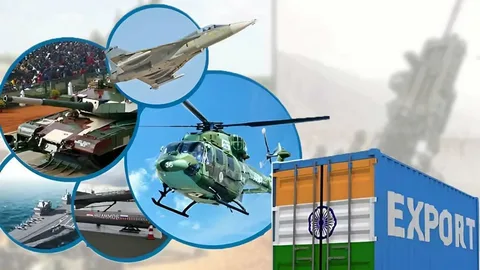

The United States has solidified its position as the world’s undisputed number one arms dealer, with defence exports reaching a historic peak. In fiscal year 2024, U.S. military equipment sales to foreign governments surged to a record $318.7 billion a 29% increase from the previous year, according to the U.S. Department of State.This milestone reflects surging global demand for American weapons, driven by geopolitical tensions, ongoing conflicts, and allied nations seeking to rapidly bolster their military capabilities.
Background: America’s Dominance in Global Arms Trade
The United States has dominated global defence exports for decades, and its lead continues to grow. The United States is by far the biggest arms dealer on Earth, responsible for 43% of all weapons exports from 2020 to 2024 transferring 7.3 times more weapons than China and 5.5 times more than Russia.
This dominance is not a recent development. The United States held a market share of over 40 percent in international arms exports between 2019 and 2023, with Russia and France following at 11 percent each.Together, these three nations contributed nearly two-thirds of all major weapons exports globally during that period.
US Arms Exports by Year: A Decade of Steady Growth
Understanding US arms exports by year reveals a consistent upward trajectory, punctuated by sharp jumps in recent years.
In fiscal year 2022, direct military sales by U.S. companies rose 48.6 percent to $153.7 billion, up from $103 billion in fiscal 2021. Meanwhile, government-arranged foreign military sales jumped 49.1 percent to $51.9 billion in 2022, compared to $34.8 billion the prior year.This made defence exports US 2022 one of the strongest years on record at that time.
Defence exports US 2021 were comparatively modest but still historically significant, with total combined sales reaching approximately $138 billion a figure that was itself a record for that era.
By FY2024, the total value of transferred defence articles and services under the Foreign Military Sales system alone reached $117.9 billion a 45.7% increase from $80.9 billion in FY2023, making it the highest-ever annual total of sales and assistance provided to U.S. allies and partners.
Then came FY2025. In FY2025, the total number for combined government-to-government Foreign Military Sales and Direct Commercial Sales reached $331.18 billion a 3.92 percent increase over the FY2024 figure of $318.70 billion.
US Arms Exports in Dollars: Where the Money Flows
The US facilitates defence exports through two primary channels. In fiscal 2024, direct military sales by U.S. companies increased to $157.5 billion, while foreign military sales arranged through the government rose to $117.9 billion from $80.9 billion the previous year.
The FY2025 figure of $104.38 billion for government-to-government Foreign Military Sales includes $75.90 billion in arms sales funded by U.S. allies and partner nations, $17.92 billion funded through the Title 22 Foreign Military Financing program, and $10.56 billion funded through Department of Defense Building Partner Capacity programs.The U.S. arms industry worth is staggering. This surge in arms exports places enormous pressure on major defence contractors to meet rising orders. Companies like Lockheed Martin, General Dynamics, and Northrop Grumman are experiencing heightened demand for products including artillery rounds, Patriot missile interceptors, and armored vehicles.
Lockheed Martin consistently ranks as the top U.S. defence contractor, with defence revenue of $64.7 billion in 2023. Boeing follows with $32.7 billion in defence revenue for the same year.
US Arms Exports by Country: Who Buys the Most?
When it comes to US arms exports by country, Saudi Arabia has historically topped the list, followed closely by key allies in the Middle East, Asia-Pacific, and Europe.
Saudi Arabia remains the single largest recipient. The U.S. supplied 74% of Saudi Arabia’s major conventional weapons between 2020 and 2024, accounting for 12% of all U.S. arms sales in that period making Saudi Arabia the U.S.’s largest customer.
Japan, Australia, and South Korea are the next major buyers. Among the top recipients of U.S. arms in 2020–24, Japan accounted for 8.8 percent of total U.S. arms exports, Australia for 6.7 percent, and South Korea for 5.3 percent.
Ukraine has rapidly become a top destination. After Saudi Arabia, Ukraine is the U.S.’s biggest arms market, receiving 9% of all U.S. conventional arms transfers between 2020 and 2024.
The Middle East as a whole absorbs a massive chunk of American weapons. According to SIPRI data, 35% of U.S. exports went to Europe and 33% to the Middle East, with Saudi Arabia alone accounting for 12% of total U.S. arms exports.
Gulf States have also signed multi-billion-dollar deals. Between fiscal years 2020–2024, the U.S. agreed Foreign Military Sales deals worth $9.11 billion with Kuwait, $4.807 billion with the UAE, $1.21 billion with Bahrain, and $675 million with Qatar.
Europe is now a rapidly growing market. European NATO countries have more than doubled their arms imports in recent years, with over 60 percent of those imports coming from the U.S.
Defence Exports US 2022 and 2021: Year-Specific Highlights
Defence exports US 2022 stood out for several key recipients. The volume of U.S. exports of major arms to Ukraine increased sharply in 2022. However, U.S. exports to Ukraine that year still fell below the levels sent to Kuwait, Saudi Arabia, Qatar, and Japan countries that received advanced new weapons like combat aircraft and air defence systems.
Defence exports US 2021 also marked a significant year in regional dynamics. The Middle East accounted for 43 percent of U.S. arms transfers during the 2017–21 period, with Saudi Arabia seeing a 106 percent increase in deliveries of major arms from the U.S.
Expert Quotes and Official Statements
The U.S. State Department has consistently defended these sales as strategic tools. The State Department emphasized that arms sales and transfers are “important U.S. foreign policy tools with potential long-term implications for regional and global security.
However, critics raise concerns about accountability. According to William Hartung of the Quincy Institute for Responsible Statecraft, the question is not just the volume of weapons delivered, but how those weapons are likely to be used and whether they promote stability or fuel conflict.
Global Impact: Reshaping the International Security Landscape
The dominance of U.S. defence exports by country has profound implications for global security. Russia’s global arms exports declined by 64% from 2020 to 2024, and China’s fell by 5.4%, whereas those of the U.S. grew by 21% during the same period.
The USA continues to be the main supplier of advanced long-range strike capabilities to many parts of the world, supplying 45 percent of all exports of long-range land-attack missiles in 2020–24, delivering them to seven states with pending deliveries to 13 more.
The U.S. arms industry worth is also being boosted by European rearmament. Trump’s push for European NATO members to boost defence spending to 5% of GDP is expected to increase demand for weapons produced by the U.S. military-industrial complex, potentially helping reduce the U.S. trade deficit
Conclusion: What Comes Next for US Defence Exports?
The trajectory of US arms exports by year shows no signs of slowing. With geopolitical tensions in Eastern Europe, the Middle East, and the Indo-Pacific all remaining elevated, demand for U.S.-made defence equipment continues to climb. The FY2025 combined sales figure of over $331 billion suggests a new normal has been established.
The U.S. currently oversees 16,098 active Foreign Military Sales cases with an open case value of over $934 billion an enormous pipeline that will fuel the U.S. arms industry worth and defence exports for years to come.
Whether through government-to-government deals or direct commercial sales, the United States remains the undisputed global leader in defence exports, shaping alliances, regional balances of power, and the future of warfare around the world.
FAQs
How much defence export from the USA?
In FY2025, total U.S. defence exports combining government Foreign Military Sales and Direct Commercial Sales reached $331.18 billion, a slight increase over the record $318.70 billion posted in FY2024.
Which country is the largest exporter of defence?
The United States is by far the world’s largest exporter of defence equipment, responsible for 43% of all global weapons exports from 2020 to 2024 transferring more than seven times the volume exported by China and more than five times that of Russia.
Who does the US export the most weapons to?
Saudi Arabia is the single largest recipient of U.S. arms, accounting for 12% of all U.S. arms sales between 2020 and 2024. Japan, Australia, South Korea, and Ukraine follow as the next major buyers of American defence equipment.