The rise of political violence in the United States did not happen overnight. Experts trace the roots of this crisis back to deepening social divisions, hyper-partisan media, and years of inflammatory political rhetoric from both sides of the aisle.
The history of political violence in the United States shows cycles of unrest from the 1960s civil rights struggles and anti-war riots to the January 6, 2021, Capitol attack. But many researchers now warn that the current moment may be even more dangerous than those previous eras.
Political violence in the United States is now at its highest level since the 1970s. In the first half of 2025 alone, there were roughly 150 recorded politically motivated attacks almost double the number recorded in the same period in 2024.
Details: What Is Happening in US Cities Today?
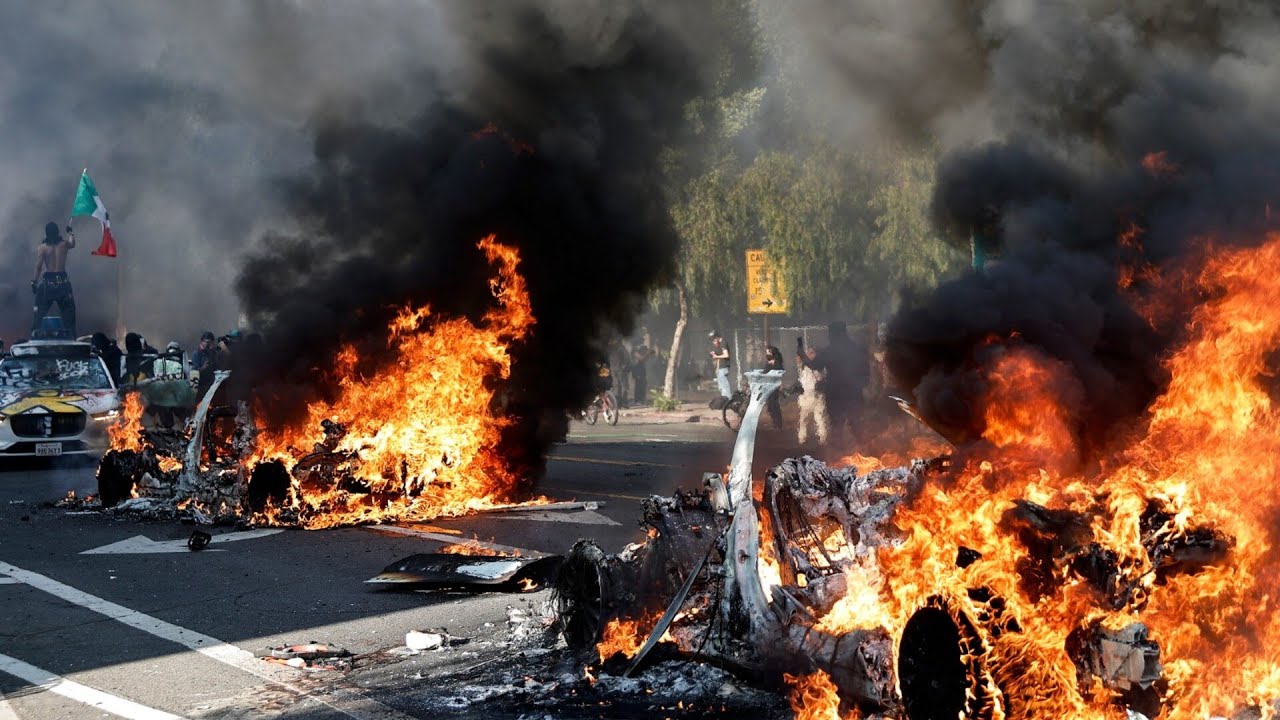
Riots in US cities and incidents of targeted political violence have occurred across multiple states. Federal enforcement actions, immigration crackdowns, and anti-government protests have all been flashpoints in the current crisis.
In cities including Minneapolis, Chicago, Los Angeles, Portland, Charlotte, and Washington, the administration deployed federal agencies and the National Guard to carry out enforcement actions. Clashes between demonstrators, ICE, and National Guard units in Los Angeles were later cited as a “model” for enforcement operations.
From January 1 through June 30, 2025, more than 520 incidents of terrorism and targeted violence occurred in the United States roughly a 40% increase compared to the same period in 2024. These incidents resulted in 96 deaths and 329 injuries across nearly every state in the country.
The political issues in the USA driving these riots include immigration enforcement, racial justice, economic inequality, and sharp disagreements over the direction of the federal government.
List of Recent Political Violence in America (2025)
Here is a summary list of recent political violence incidents that have shaken the United States:
In April 2025, there was an arson attack on Democratic Pennsylvania Governor Josh Shapiro’s residence. In May 2025, two Israeli embassy staffers were fatally shot in Washington D.C. In June 2025, an anti-Zionist fire attack occurred in Colorado. In September 2025, right-wing political activist Charlie Kirk was assassinated during a public debate in Orem, Utah.
Former Minnesota House Speaker Melissa Hortman and her husband were also fatally shot in their home in June 2025 in what the Department of Justice described as “heinous political assassinations.
In January 2026, federal immigration agents fatally shot two individuals in Minnesota in separate incidents, following a year of escalating federal immigration operations.
This list of recent political violence reflects a country where political disagreements are increasingly turning deadly.
Political Violence in the United States: Left vs Right
One of the most debated questions is whether political violence in the United States is more of a left or right problem. The data presents a complex and shifting picture.
According to the Anti-Defamation League, all 61 political killings between 2022 and 2024 were committed by right-wing extremists. However, by September 2025, a report from the Center for Strategic and International Studies noted that left-wing violence had eclipsed right-wing political violence for the first time in more than 30 years.
A May 2025 survey found that about 40 percent of Democrats supported the use of force to remove President Trump from office, while about 25 percent of Republicans supported using the military to stop protests against Trump’s agenda. Both figures more than doubled since Fall 2024.
This data shows that political violence in the United States left vs right is no longer a simple equation radicalization is spreading on both ends of the political spectrum.
Expert Quotes and Analysis
Researchers and political scientists are sounding the alarm about what they see as a structural breakdown in American civic life.
University of Chicago Professor Robert Pape stated: “We are now at a watershed moment in the United States.” He warned that America is in a “rising era of violent populism not civil war, but definitely not politics as normal.”
Many historians argue the United States is experiencing political violence not seen since the 1960s and 1970s, marked by deep social divisions, riots, bombings, and assassinations of major figures. However, experts note a key difference: today’s fragmented, algorithm-driven media landscape allows the creation of ideological echo chambers where violence can be justified, celebrated, and encouraged.
A recent study from New York University’s Stern Center found that extremist groups are systematically exploiting high-profile incidents of political violence to recruit new supporters, justify their ideologies, and call for retaliatory action.
Impact: Is the USA a Declining Power?
The rise of political violence in the United States is being watched closely by the international community. Many analysts are now asking: is the USA a declining power?
As of 2023, the United States was the only Western nation to rank among the world’s 50 most conflict-ridden countries, driven by rising political violence and far-right group proliferation.
Over time, climates of fear can lead to policy paralysis and, in extreme cases, preferences for authoritarianism as citizens trade democratic freedoms for promises of order and security.
Domestically, the U.S. Capitol Police reported a 58% rise in threats against members of Congress, and threats against local officials spiked sharply following high-profile attacks.
The political issues in the USA immigration, racial inequality, economic frustration, and political polarization are feeding a cycle of unrest that weakens institutional trust and international standing.
Conclusion: What Comes Next?
The history of political violence in the United States shows that these periods of unrest can either be managed through strong civic leadership or allowed to spiral into deeper crisis. The current trajectory, if unchecked, points toward escalation.
Aggressive federal directives, rising tensions between local and federal law enforcement, and the continued erosion of civil-military boundaries will likely create further flashpoints for confrontation and violence in 2026.
Despite the alarming trends, 70 percent of Americans continue to abhor political violence in any form, according to research by the Chicago Project on Security and Threats a reminder that the majority still rejects violence as a political tool.
The road ahead depends on whether political leaders, media figures, and ordinary citizens can step back from the brink and choose dialogue over destruction.
FAQs
What are the political issues in the USA?
The major political issues in the USA include immigration enforcement, racial justice, income inequality, gun control, abortion rights, and deep partisan divisions between Democrats and Republicans. These issues have become increasingly polarized, contributing to social unrest and riots in US cities.
What is the reason for the riots in the US?
Riots in US cities have been triggered by multiple factors police brutality, aggressive federal immigration operations, political assassinations, and growing public frustration with government policies. The rise of social media has also accelerated the spread of outrage and mobilization.
Is the USA a declining power?
This is a debated question. While the US remains the world’s largest economy and military power, the rise of political violence in the United States, institutional erosion, and deep polarization have raised concerns among political scientists and international observers about long-term democratic stability. The US being the only Western nation among the world’s 50 most conflict-ridden countries as of 2023 has added weight to these concerns.