

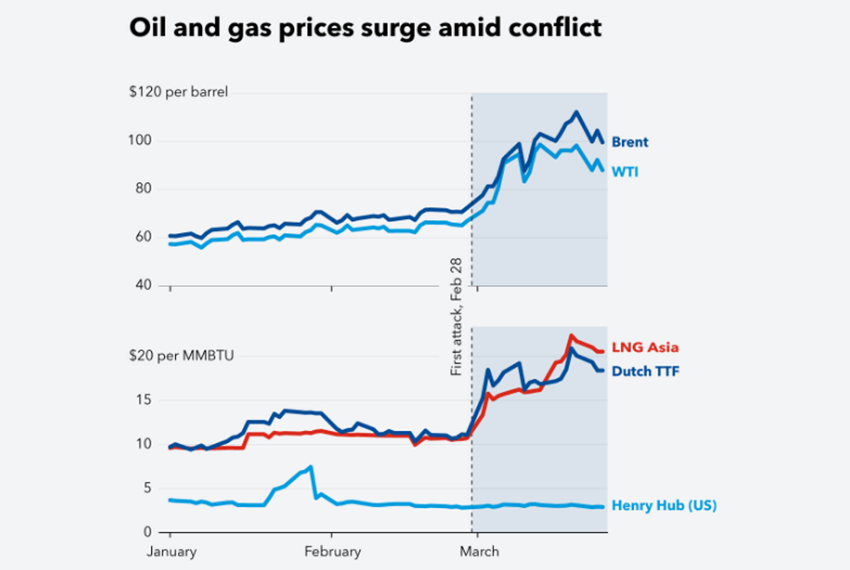

The Middle East conflict today has triggered the most severe disruption to global oil supply in recorded history. The IEA’s Executive Director has described the combined impacts as “the greatest threat to global energy security in history.”Brent crude oil futures are trading above $105 per barrel, and the oil prices forecast points to continued volatility as diplomacy between the US and Iran remains fragile.
Background: How the Middle East Conflict Started
The current crisis began on February 28, 2026, when US and Israeli forces launched strikes against Iran. In response, Iran launched strikes against Israel, regional US military bases, and targets in many nearby Arab states, including energy infrastructure.
The fallout was immediate and severe. The Strait of Hormuz the narrow waterway connecting the Persian Gulf to global shipping lanes became a flashpoint overnight. Traffic through the Strait has been essentially halted by the conflict, putting pressure on the trade of a wide range of energy products.
This chokepoint is central to understanding why the Middle East conflict impact on the global economy has been so devastating. It is not just a regional crisis it is a global one.
Details: The Oil Crisis Explained
Why Does War Affect Oil Prices?
One of the most frequently asked questions right now is: why does war affect oil prices? The answer lies in geography, supply chains, and fear.
Energy is the main transmission channel. The de facto closure of the Strait of Hormuz and damage to regional infrastructure have produced the largest disruption to the global oil market in its history, according to the IEA. For fuel-importing economies, the effect is that of a large, sudden tax on income.
When a major supply route closes, traders immediately anticipate shortages. This fear alone pushes oil prices upward even before actual shortages are felt. Crude oil is priced on global markets where perception of future supply matters as much as current supply.
Crude Oil and Brent Crude Oil Futures Today
Prices surged more than 55% since the start of the war, with Brent crude jumping from around $72 a barrel on February 27 to nearly $120 at its peak, as fears mounted over supply disruptions through the Strait of Hormuz.
As of April 26, 2026, Brent crude oil is holding above $105 per barrel, after closing at $105.33 on Friday, April 24, 2026, with the market now entering a critical phase where investors are watching whether prices will surge toward $110 or retreat as trading resumes.
Brent crude oil futures remain on a “Strong Buy” signal according to technical indicators, reflecting the market’s belief that supply constraints are far from over.
The Scale of the Supply Shock
The numbers paint a stark picture for anyone following oil news today.
Global oil supply fell by more than 10 million barrels per day in March, and the price of oil surged above $100 per barrel, while the price of refined fuels like diesel and jet fuel rose even faster, according to the IEA.
The US Energy Information Administration assessed that production shut-ins averaged 7.5 million barrels per day in March and are expected to increase to a peak of 9.1 million barrels per day in April, before gradually falling.Iraq, Saudi Arabia, Kuwait, UAE, Qatar, and Bahrain have all been affected by their inability to export through the closed waterway.
Quotes: What Experts Are Saying
The IMF, IEA, and global analysts have all weighed in on this historic oil prices crisis.
IEA Executive Director Fatih Birol stated: “The war in the Middle East is creating a major energy crisis, including the largest supply disruption in the history of the global oil market. In the absence of a swift resolution, the impacts on energy markets and economies are set to become more and more severe.”
IMF economists warned that “although the war could shape the global economy in different ways, all roads lead to higher prices and slower growth. A short conflict might send oil and gas prices soaring before markets adjust, while a long one could keep energy expensive and strain countries.”
Goldman Sachs has said the risk of a global economic downturn over the next 12 months has risen to 30%, driven by the surge in oil prices.
Middle East Conflict Impact on Global Economy
The Middle East conflict impact on the global economy is being felt across every continent, from fuel prices at petrol stations to food costs in supermarkets.
United States and Europe
California’s gasoline prices surged above $5 per gallon during the second week of March 2026 amid the US conflict with Iran.Inflation fears have returned, and interest rate cuts expected earlier in 2026 are now in serious doubt.
In the UK, Brent crude oil rose from around $70 a barrel before the conflict to temporary peaks of over $100 a barrel. UK wholesale natural gas prices also rose by roughly 75% between late February and late March 2026.Forecasts for UK GDP growth in 2026 have been sharply cut by major institutions.
Asia and Developing Countries
Large energy importers in Asia and Europe are bearing the brunt of higher fuel and input costs, as about 25 to 30 percent of global oil and 20 percent of liquefied natural gas pass through the Strait of Hormuz, feeding demand not only in Asia but also in parts of Europe.Low-income countries are especially at risk of food insecurity, as higher food and fertilizer prices compound already tight financial conditions.This is where the Middle East conflict impact on the global economy hits hardest not in boardrooms, but in kitchens.
Shipping and Supply Chains
The crisis extends well beyond crude oil. Around 150 ships had dropped anchor in the Strait of Hormuz, including those carrying oil and natural gas. Several ports suspended operations in the Middle East after drone strikes, with Jebel Ali port in Dubai one of the world’s busiest container ports temporarily suspended after a fire.
Oil Prices Forecast: What Comes Next?
The oil prices forecast from the world’s most authoritative energy bodies is sobering.
The US Energy Information Administration now expects Brent crude oil prices to peak at $115 per barrel in Q2 2026 before gradually falling to an average of $88 per barrel in Q4 2026. Even in 2027, prices are expected to average $76 per barrel about $23 higher than previously forecast.Analysts forecast Brent crude oil futures to trade between $103 and $112 per barrel in the near term, with a strong chance of testing $110 if geopolitical risks intensify or supply disruptions worsen.
The key variable is diplomacy. Reports indicate that Iranian and US envoys are expected in Pakistan, raising cautious hopes that stalled US-Iran talks could resume and eventually lead to the reopening of the Strait of Hormuz. However, Iran has signaled a more guarded stance.
Which Country Is No. 1 in Oil?
Despite the crisis, the global hierarchy of crude oil production is worth understanding.
The US was the world’s largest producer of crude oil in 2025, producing 13.58 million barrels per day, comfortably ahead of Russia at 9.87 million barrels per day and Saudi Arabia at 9.51 million barrels per day.
Saudi Arabia, Iraq, Iran, the UAE, and Kuwait all landed in the top 10, which helps explain why Middle Eastern supply continues to play an outsized role in global oil balances, even with the US holding the top spot individually.The concentration of so many major producers in one geopolitically fragile region is precisely why this Middle East conflict today has caused such a massive oil news shock.
Conclusion: A Turning Point for Global Energy
The Middle East conflict impact on the global economy is real, immediate, and far from over. Brent crude oil futures above $105 reflect not just the current disruption — they reflect deep uncertainty about when supply can normalize. Every day the Strait of Hormuz remains constrained, the global economy bleeds through higher oil prices, faster inflation, and slower growth.
The crisis highlights the growing impact of geoeconomic tensions on global energy systems and broader economic stability.For consumers, businesses, and governments alike, the oil prices forecast for the months ahead will remain one of the most closely watched economic indicators in the world.
FAQs
Will Middle East conflict affect oil prices?
Yes, directly and severely. Brent crude jumped from around $72 per barrel before the conflict to nearly $120 at its peak a surge of more than 55% driven by fears of supply disruptions through the Strait of Hormuz.Oil prices remain elevated above $105 today as the conflict continues.
What is the oil crisis in the Middle East?
The current Middle East conflict today involves US-Israeli military action against Iran, which triggered Iranian retaliation targeting energy infrastructure and effectively closing the Strait of Hormuz. Around 20% of global oil and 20% of liquefied natural gas normally transit through the Strait of Hormuz, making its closure a catastrophic event for global crude oil supply.It has been described as the largest supply disruption in the history of the global oil market.
Which country is No. 1 in oil?
As of 2026, the United States holds its position as the undisputed number one largest oil-producing country in the world, outpacing traditional powerhouses like Saudi Arabia and Russia by a margin that continues to widen. However, Saudi Arabia remains the world’s largest exporter of oil, possessing around 15–17% of the world’s petroleum reserves.The distinction between production and export is important especially during a crisis where export routes are blocked.