For over 80 years, Japan kept its weapons at home. That policy ended on April 21, 2026. In the most significant overhaul of Japan arms export rules since World War II, Prime Minister Sanae Takaichi’s cabinet scrapped the ban on selling lethal weapons overseas — opening the door to exports of fighter jets, warships, missiles, and combat drones.
The decision marks a fundamental shift in Japan arms export principles that shaped the country’s identity as a pacifist nation — and signals how rapidly Tokyo’s security calculus has changed.
What Changed on April 21, 2026
The Japanese government approved a comprehensive revision of its framework governing defense equipment transfers, formally allowing the export of lethal military systems under defined conditions. The revisions modify the implementation guidelines of Japan’s Three Principles on Transfer of Defense Equipment and Technology, replacing earlier categorical limits with a broader classification system. The changes scrap rules that had limited Japan arms export rules to five non-combat categories — rescue, transport, warning, surveillance, and minesweeping. Defense equipment will now be divided simply into “weapons” and “non-weapons” based on lethal capability.
The History of the Japan Arms Export Ban
The roots of the Japan arms export ban go back to the aftermath of World War II. Japan’s restrictive defense export posture has its origins in the 1967 Three Principles on Arms Exports, which prohibited transfers to communist bloc countries, states under UN embargo, and nations involved in conflict. Over time, these rules evolved into a near-total ban, effectively isolating Japan’s defense industry from global markets. A more significant shift came in 2014, when the administration of Shinzo Abe replaced the original framework with the “Three Principles on Transfer of Defense Equipment and Technology,” allowing the transfer of five categories of non-lethal equipment and signaling a shift from prohibition to conditional permission.
Three Principles on Transfer of Defense Equipment — What They Are
The Three Principles on Transfer of Defense Equipment and Technology have been Japan’s core framework for arms exports since 2014. Set out on April 1, 2014, the Three Principles replaced the previous Three Principles on Arms Exports and established clear rules on overseas transfers — prohibiting exports that violate international treaties, UN Security Council resolutions, or go to countries involved in active conflict. The 2026 revision builds on this framework rather than replacing it entirely — maintaining strict screening procedures, controls on third-party transfers, and oversight by Japan’s National Security Council, while removing the categorical ban on lethal systems. The Three Principles on arms exports still exist in spirit, but their practical effect is now fundamentally different.
What Japan Can Now Ex
The scope of the new Japan arms export rules is broad. Japanese newspapers reported that the changes encompass fighter jets, missiles, and warships — with Japan having recently signed an agreement to build upgraded Mogami-class frigates for Australia. The new policy clears the final hurdles for arms sales including Japanese-developed warships, combat drones, and other weapons. Australia has already signed a deal for three Mitsubishi Heavy Industries frigates, and New Zealand has also shown interest. The Philippines is seeking to buy used destroyers, and 30 NATO representatives visited Japan last week to discuss deeper ties.
Japan Import Policy and the Regional Context
The revised Japan import policy on defense is driven by hard strategic realities. Wars in Ukraine and the Middle East are straining US weapons production, expanding opportunities for Japan. US allies in Europe and Asia are also looking to diversify defense suppliers as Washington’s security commitments look less certain under President Trump.Prime Minister Takaichi framed the change directly: “No single country can now protect its own peace and security alone.” She cited a deteriorating security environment, while promising that Japan’s 80-year history as a pacifist nation remains unchanged in principle. The revision also reflects Japan’s push to raise defense spending to 2% of GDP.
China Pushes Back, Allies Welcome the Move
Not everyone is pleased with the new Japan arms export principles. China vowed to resist what it called Japan’s “reckless” militarisation. “The international community, including China, will remain highly vigilant on this, and firmly resist Japan’s reckless new-style militarisation,” China’s Foreign Ministry spokesman said at a press conference. Japan’s allies, however, reacted positively. The US Ambassador to Japan called the move a “historic step” that will help enhance defense capabilities between allies. Australia welcomed Tokyo’s new policy as a deepening of their defense partnership, and the Philippines said it would give Manila access to defense articles of the highest quality.
Opposition at Home
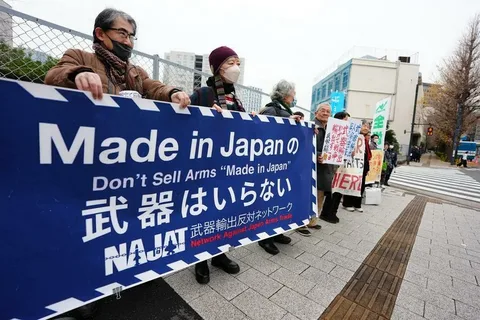
The shift in Japan arms export rules has not gone unchallenged domestically. Opponents at home say the change violates Japan’s pacifist constitution and will increase global tensions and threaten the safety of the Japanese people. Protesters gathered outside the National Diet building with flags reading “No War” and signs calling for the protection of Article 9 of Japan’s constitution — which renounces war and has been the legal basis for the country’s pacifist stance since 1947. The debate over how far Japan can go under Article 9 without formally amending it remains unresolved.
Frequently Asked Questions
Japan arms export ban — has it been fully lifted?
Not entirely. The categorical Japan arms export ban on lethal weapons has been scrapped, but the core Three Principles on Transfer of Defense Equipment and Technology remain in place. All exports still require case-by-case approval, strict end-use conditions, and a ban on transfers to countries involved in active conflict — with limited exceptions for special circumstances.
Three Principles on Transfer of Defense Equipment and Technology — what are they?
Established in 2014 under PM Shinzo Abe, the Three Principles on Transfer of Defense Equipment and Technology replaced the original 1967 arms export ban. They set out three conditions under which transfers are prohibited: when they violate international treaties, when they breach UN Security Council resolutions, and when equipment goes to a country in active conflict. The 2026 revision updated the implementation guidelines within this framework rather than replacing the principles themselves.
Japan arms exports — which countries are likely to buy Japanese weapons?
Following the update to Japan arms export rules, Australia has already signed a deal for Mogami-class frigates. The Philippines is pursuing used destroyers, New Zealand has shown interest in frigates, and 30 NATO representatives visited Tokyo to discuss procurement options. Poland and several Southeast Asian nations are also reportedly in early discussions, making Japan one of the most watched new entrants in the global defense market.