
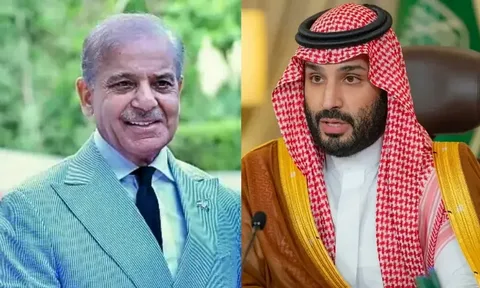

Prime Minister Shehbaz Sharif flew to Jeddah on March 12, 2026, for urgent talks with Saudi Crown Prince Mohammed bin Salman — praising the Kingdom’s restraint in not joining the US-Israeli military campaign against Iran and pressing the case for immediate Iran war de-escalation through diplomatic channels. The Iran war de-escalation message delivered by PM Shehbaz in Jeddah reflects Pakistan’s increasingly active role as a bridge-builder in the Middle East crisis — a country with deep ties to both the Islamic world and Western-aligned powers, urgently seeking to prevent the Iran war from expanding into a broader regional conflict. The Iran war de-escalation visit came as Trump and Iran war news cycles showed no sign of the conflict cooling — with the US maintaining military pressure, Iran’s new Supreme Leader Mojtaba Khamenei hardening his rhetoric, and the question of who is winning the Iran war producing very different answers depending on whether you measure tactical military success or strategic geopolitical outcome.
Background: Why Is Pakistan Pushing Iran War De-Escalation?
The Iran war de-escalation effort by Pakistan is rooted in the country’s unique geopolitical position — a nuclear-armed Muslim nation with close ties to both Saudi Arabia and Iran, strategic importance to both China and the United States, and an economy severely impacted by the oil price surge and supply chain disruptions that the Iran war has generated.
Pakistan shares a 909-kilometre border with Iran — the second longest international border Iran shares with any neighbour. The Iran war de-escalation imperative for Pakistan is therefore not abstract diplomacy — any further escalation of the Iran war toward Pakistani territory, Pakistani shipping routes, or the Pakistani diaspora communities in Gulf states directly threatens Pakistan’s national security and economic stability.
Pakistan imports approximately 60 percent of its refined petroleum through Gulf maritime routes that the Iran war has disrupted — pushing petrol prices to Rs321 per litre, the highest since September 2023, and threatening the country’s pharma supply chains and export logistics simultaneously. The Iran war de-escalation effort is therefore also an economic necessity — Pakistan cannot absorb a prolonged conflict that continues to push oil prices above $100 per barrel without severe macroeconomic consequences.
Pakistan’s role as a potential Iran war de-escalation mediator is strengthened by its historical relationships. Pakistan has maintained formal diplomatic relations with Iran throughout the revolution, the sanctions era, and the nuclear standoff — while simultaneously being one of Saudi Arabia’s closest Muslim allies. This dual relationship gives Pakistan a bridge-building credibility that few countries possess — and makes the Iran war de-escalation diplomatic role a natural one for Islamabad.
Details: Iran War De-Escalation — PM Shehbaz Saudi Visit Full Story
Iran War De-Escalation — What PM Shehbaz Said in Jeddah
PM Shehbaz arrived in Jeddah for a working visit that Pakistani officials described as focused entirely on Iran war de-escalation and regional stability. In meetings with Crown Prince Mohammed bin Salman, PM Shehbaz conveyed Pakistan’s deep concern about the Iran war’s consequences for the Muslim world, the global economy, and the security of Pakistan’s own citizens and interests.
PM Shehbaz publicly praised Saudi Arabia’s restraint — explicitly acknowledging that the Kingdom had not joined the US-Israeli military campaign against Iran despite its complex and historically adversarial relationship with Tehran. The Iran war de-escalation significance of Saudi Arabia’s non-participation is substantial — Saudi Arabia possessing the financial resources, the military infrastructure, and the regional influence to have joined the conflict if it chose to, and its decision not to do so is one of the most important stabilising factors in the current Iran war de-escalation environment.
PM Shehbaz pressed the Iran war de-escalation case on multiple fronts — arguing that a negotiated end to the conflict was in the interests of every Muslim country, that the humanitarian impact of the Iran war on Iranian civilians was unacceptable, and that the economic consequences of the conflict for oil-importing developing nations including Pakistan required urgent international attention.
Iran War De-Escalation — Saudi Arabia’s Position
Saudi Arabia’s restraint in the Iran war is a product of careful strategic calculation rather than any residual sympathy for Tehran. The Iran war de-escalation posture of the Kingdom reflects Crown Prince Mohammed bin Salman’s assessment that Saudi Arabia’s interests are best served by maintaining its current position as an indispensable regional mediator — neither joining the US-Israeli campaign nor publicly opposing it, but positioning Riyadh as a potential facilitator of any eventual Iran war de-escalation process.
Saudi Arabia’s economy — still heavily dependent on oil revenues — has actually benefited financially from the Iran war oil price surge. Brent crude above $100 per barrel fills Saudi Arabia’s sovereign wealth funds at a rate that lower oil prices cannot match. But Saudi Arabia’s Vision 2030 economic diversification strategy requires regional stability — and a prolonged Iran war that disrupts Gulf trade, flight routes, and investor confidence directly threatens the transformation that MBS has staked his legacy on.
The Iran war de-escalation diplomatic space that Saudi Arabia occupies — not a party to the conflict, maintaining channels to all sides including Iran’s new Mojtaba Khamenei-led government, and respected by Washington as a critical Gulf ally — makes the Kingdom the most important potential Iran war de-escalation facilitator in the region.
Trump and Iran War News — The US Position on De-Escalation
The Trump and Iran war news cycle in March 2026 shows an administration that is simultaneously claiming victory and refusing to define what victory looks like in terms that would enable Iran war de-escalation. Trump and Iran war news has featured repeated presidential statements claiming that Iran’s nuclear programme has been eliminated — a claim that intelligence assessments and independent verification efforts cannot confirm — alongside statements that regime change is desirable but not the current policy.
The Trump and Iran war news of internal administration disagreement has complicated Iran war de-escalation efforts. Vice President JD Vance and Defence Secretary Pete Hegseth have stated that the US goal is Iran’s nuclear programme — not regime change. Trump’s own statements have oscillated between endorsing Iran war de-escalation through a nuclear deal and demanding regime change under the MIGA — Make Iran Great Again — hashtag.
The Trump and Iran war news of no coherent exit strategy has made Iran war de-escalation diplomacy extremely difficult — because potential mediators including Pakistan, Saudi Arabia, Oman, and Qatar cannot negotiate an Iran war de-escalation framework when the US position on what would constitute an acceptable outcome changes from week to week.
Iran War 15 Point Plan — What Pakistan Is Proposing
Pakistan has been quietly circulating an Iran war 15 point plan for de-escalation through diplomatic back channels — a framework that Pakistan’s foreign policy officials describe as a structured pathway from active conflict to negotiated settlement. The Iran war 15 point plan reportedly covers an immediate ceasefire under UN monitoring, the release of sanctions pressure in exchange for Iranian nuclear commitments, international guarantees for Iran’s territorial integrity under new leadership, humanitarian access to war-affected Iranian civilian populations, and a regional security framework involving Saudi Arabia, the UAE, Turkey, and other Gulf states.
The Iran war 15 point plan Pakistan is proposing has been shared with the OIC Secretary General, the UN Secretary General’s office, and Saudi, Turkish, and Qatari diplomatic counterparts — with Pakistan seeking to build a coalition of Muslim-majority nations that can collectively approach Washington with a credible Iran war de-escalation roadmap that the Trump administration can present domestically as a victory rather than a retreat.
Who Is Winning the Iran War — The Complex Answer
The who is winning the Iran war question produces different answers depending on the analytical framework. From a narrow military perspective, the US-Israel coalition is winning the Iran war — Iran’s nuclear facilities have been damaged, military infrastructure has been degraded, and Supreme Leader Khamenei is dead. But from a strategic perspective, the who is winning the Iran war question is far less clear.
Iran is winning the Iran war in the sense that its institutional structures — particularly the Revolutionary Guard — have survived, its new Supreme Leader Mojtaba Khamenei has consolidated power, and the military conflict has generated a nationalist rally-around-the-flag effect that may actually strengthen the regime’s domestic legitimacy. The US is winning the Iran war tactically while potentially creating the conditions for strategic failure — as the Iraqi precedent so clearly demonstrated.
Who is winning the Iran war is also shaped by regional consequences — the oil price surge that the Iran war has produced has strengthened Russia, Saudi Arabia, and other producers while devastating import-dependent countries including Pakistan, Bangladesh, Sri Lanka, and most of sub-Saharan Africa. The who is winning the Iran war question therefore has no clean answer — which is precisely why Iran war de-escalation is so difficult to achieve when neither side can claim the clean victory that would justify negotiated settlement.
Iran War De-Escalation — Pakistan’s Broader Diplomatic Campaign
PM Shehbaz’s Jeddah visit is one component of a broader Iran war de-escalation diplomatic campaign that Pakistan has been conducting since the conflict began. Pakistan called an emergency session of the OIC Ministerial Council in the first week of March — issuing a joint statement calling for Iran war de-escalation that was signed by 52 of the 57 OIC member states. Pakistan has separately engaged Turkey’s President Erdogan, Qatar’s Emir Tamim, and Jordan’s King Abdullah on Iran war de-escalation — building a coalition of Muslim-majority nations willing to collectively press Washington for a negotiated settlement.
Pakistan has also used its relationship with China to advance the Iran war de-escalation agenda — with Chinese Foreign Minister Wang Yi calling PM Shehbaz to express support for Pakistan’s mediation role and coordinating messaging to the UN Security Council where China has repeatedly called for immediate Iran war de-escalation.
Quotes
PM Shehbaz Sharif, in Jeddah, on the Iran war de-escalation imperative: “Saudi Arabia’s restraint and wisdom during this crisis is commendable and must be recognised. Pakistan urges all parties to step back from the brink of catastrophe. The Iran war de-escalation is not just a regional necessity — it is a global one. Every day this conflict continues, the Muslim world pays a price we cannot afford.”
PM Shehbaz Sharif, on Pakistan’s Iran war de-escalation role: “Pakistan is uniquely positioned to be a bridge-builder in this crisis. We have longstanding relationships with all parties — Iran, Saudi Arabia, the Gulf states, China, and the United States. We will use every diplomatic channel available to advance Iran war de-escalation and protect the interests of the Muslim world.”
Saudi Crown Prince Mohammed bin Salman, on Saudi Arabia’s position toward Iran war de-escalation: “Saudi Arabia supports a peaceful, negotiated resolution to the current conflict. We have maintained our restraint deliberately — because we believe that Iran war de-escalation through dialogue is the only path that protects regional stability and the prosperity of all our peoples.”
Pakistan Foreign Minister, on the Iran war 15 point plan: “Pakistan has proposed a structured roadmap for Iran war de-escalation that addresses the security concerns of all parties while providing Iran’s new leadership with a pathway to international reintegration. We are sharing this Iran war de-escalation framework with all relevant capitals.”
OIC Secretary General, on Muslim nations’ Iran war de-escalation position: “The OIC stands united in calling for immediate Iran war de-escalation and the protection of Iranian civilians. Fifty-two member states have endorsed the Islamabad Declaration calling for dialogue, ceasefire, and a negotiated resolution to the Iran war.”
CSIS analyst, on who is winning the Iran war: “The who is winning the Iran war question has no clean answer. The US has achieved tactical military objectives. But the strategic landscape — Iranian regime survival, Gulf destabilisation, oil price shock, and the absence of any exit strategy — suggests the Iran war de-escalation is more urgent for Washington than official statements acknowledge.”
Impact: What Pakistan’s Iran War De-Escalation Push Means
For Pakistan’s Regional Role
PM Shehbaz’s Iran war de-escalation diplomacy elevates Pakistan’s regional standing — confirming Islamabad as an active peacemaker rather than a passive observer in one of the most consequential conflicts of the 21st century. Pakistan’s Iran war de-escalation role is also domestically important — demonstrating to Pakistani citizens that their government is actively working to end a conflict that is directly raising their fuel prices, threatening their medicine supplies, and disrupting the Gulf employment market that sustains millions of Pakistani families.
For Saudi-Pakistan Relations
PM Shehbaz’s Iran war de-escalation visit to Jeddah strengthens the Saudi-Pakistan relationship — with Pakistan providing diplomatic cover for Saudi Arabia’s restraint while Saudi Arabia’s financial support for Pakistan’s economy remains a critical pillar of Islamabad’s external account management. The Iran war de-escalation alignment between Riyadh and Islamabad serves both countries’ interests in maintaining regional stability while avoiding direct military entanglement.
For Trump and Iran War News and the Diplomatic Track
Pakistan’s Iran war de-escalation initiative adds to a growing body of Trump and Iran war news that shows significant international pressure on Washington to define its endgame. The Trump and Iran war news coverage of Pakistan’s 15-point plan, Saudi Arabia’s restraint, and the OIC’s unified position creates diplomatic context that the administration cannot indefinitely ignore — particularly as the economic consequences of the Iran war compound through oil prices, supply chain disruption, and financial market volatility.
For Who Is Winning the Iran War in the Long Term
The who is winning the Iran war question will ultimately be determined not by battlefield outcomes but by diplomatic ones. The Iran war de-escalation framework that Pakistan is building — through Saudi Arabia, the OIC, China, and the UN — is designed to create the conditions under which a negotiated settlement becomes more attractive to Washington than continued military engagement. Whether Pakistan’s Iran war de-escalation diplomacy succeeds in shifting the Trump and Iran war news cycle toward dialogue remains to be seen.
Conclusion
PM Shehbaz’s Jeddah visit is Pakistan doing what its geography, history, and relationships uniquely position it to do — standing at the intersection of the Muslim world and global power politics, pressing urgently for Iran war de-escalation while praising the restraint of a Saudi Arabia that has wisely chosen not to add fuel to an already blazing fire.
The Iran war de-escalation challenge is immense. Trump and Iran war news shows an administration that has not defined its endgame. Who is winning the Iran war depends on what victory is supposed to look like — and no one has agreed on that. The Iran war 15 point plan Pakistan is circulating will not end the conflict alone — but it demonstrates that diplomatic alternatives exist, that Muslim nations are unified in demanding dialogue, and that Pakistan’s bridge-builder role has never been more urgently needed.
The Iran war de-escalation may not happen this week or this month. But the Jeddah meeting — and the Saudi restraint that PM Shehbaz rightly praised — ensures that when the moment for dialogue arrives, the diplomatic architecture will be in place to seize it.
FAQs
Does China depend on Iran for oil?
China is Iran’s largest trading partner and the primary buyer of Iranian oil. Chinese purchases account for roughly 90 percent of Iran’s exported oil, providing tens of billions of dollars in annual revenue that supports Iran’s government budget and military activities.
Could the world survive without oil?
Without oil, we would face a world as far outside our ordinary experience as it is possible to get, observes Johansen, and sees no adequate alternatives to fossil fuels. Eliminating air, sea and long-distance road freight means that goods could be neither bought nor sold on any scale.
Can girls wear shorts in Iran?
The Iranian dress codes requires women to have their legs covered down until the ankles and wear loose tunics or coats that cover their lower waist and have long sleeves. Against the common myth, skinny pants and leggings are very common in Iran.