The Economic and Visual Challenge of 5G: Will Pakistan’s Cities Become a Forest of Towers?
Pakistan’s journey with mobile technology began in the early 1990s with the launch of 2G, and today we stand at the threshold of 5G. This journey has been remarkably rapid from a technological standpoint, but along the way, certain questions have emerged that are not merely about speed and coverage, but about economics, urban planning, and visual aesthetics. As a common citizen, observer, and columnist, I have raised several points, and it is in light of these questions that I am writing this column. This article expresses a curiosity: will the arrival of 5G turn Pakistan’s cities into a forest of towers, and is this even economically viable? Alongside this, we will also examine how the government, regulators, and companies are coping with this challenge.
Every generation of mobile network has its own technological and economic background. In the world, 2G arrived in 1991 in Finland, 3G in 2001 in Japan, 4G in 2009 in Sweden and Norway, and 5G in 2019 in the United States, South Korea, and Europe. In Pakistan, 2G arrived around 1992, while 3G and 4G were officially launched on April 23, 2014, after an auction, and these services became commercially available from May 2014. 5G was launched in June 2026, when PTA conducted a spectrum auction and all four operators started services in major cities. This historical background shows that Pakistan has always adopted new technology, but the economic and social implications of its implementation were never deeply examined.
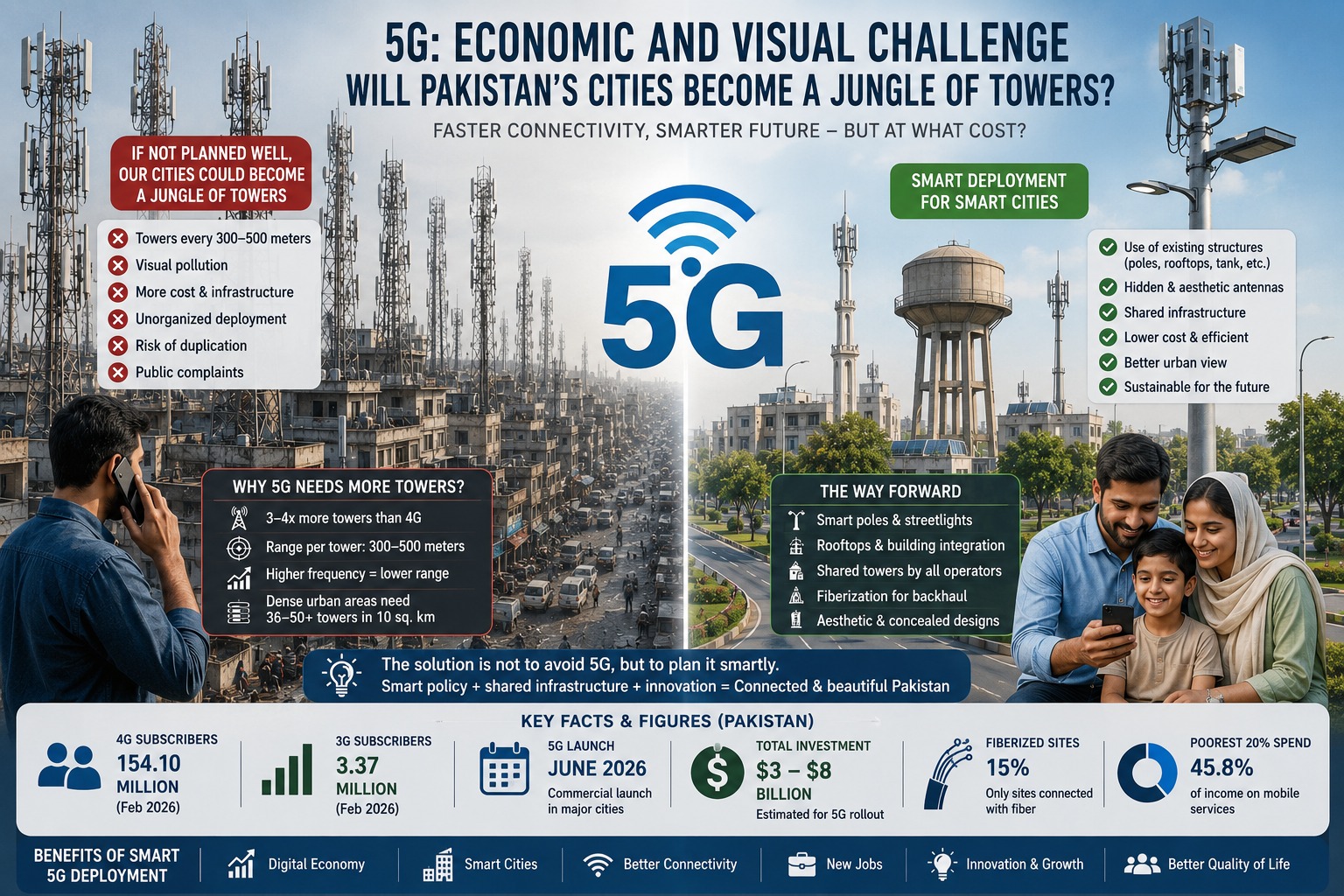
When we talk about the usage of 3G and 4G, according to PTA’s data for February 2026, Pakistan had approximately 154.10 million 4G subscribers, while 3G subscribers had dwindled to just 3.37 million. These figures clearly show how rapidly 4G grew and left 3G behind. Jazz completely shut down its 3G service, while other operators are also migrating their 3G subscribers to 4G. Regarding provincial distribution, Punjab and Sindh have the highest number of 4G coverage and subscribers, Khyber Pakhtunkhwa has 77% household internet access, while in Balochistan, coverage is being expanded through the Universal Service Fund. This disparity shows that access to technology is not just about income, but is also tied to geography and infrastructure.
Analyzing mobile and internet usage by income, according to a study, the poorest 20% of Pakistan’s population spends 45.8% of its total income on mobile services, while the richest 20% spends only 5.1%. These figures are astonishing and show just how important and expensive mobile services are for the poor. Similarly, there is an urban-rural divide, where 81% of urban residents have internet access compared to 62% in rural areas. Gender disparity is also significant, with 69% of men owning a mobile phone while only 31% of women do. These figures make it clear that the benefits of a modern technology like 5G will only be available to a specific segment of society, unless the government provides subsidies or other measures.
Now let’s turn to 5G infrastructure. The range and distance of 2G, 3G, 4G, and 5G towers depend on the frequency being used. 2G operates on 900 MHz and 1800 MHz, with a range of up to 50-70 kilometers. 3G uses 2100 MHz, which has a shorter range, with tower spacing in urban areas ranging from a few hundred meters to a couple of kilometers. 4G operates on 1800 MHz, 2100 MHz, 2300 MHz, and 2600 MHz, with a range shorter than 2G and tower spacing of 500 meters to 1.5 kilometers in urban areas. 5G operates on 3300 MHz, 3500 MHz, and higher frequencies, which have a significantly shorter range, with tower spacing of just 300 to 500 meters in urban areas. If lower frequencies like 700 MHz were used, the range could be greater, but in Pakistan, the 3500 MHz band was initially prioritized. This means that 5G will require 3 to 4 times more towers than 4G. If we calculate, in an area of 10 square kilometers (3.6 x 3.6 KM), if the tower range is 1.5 kilometers (best case), only 2 towers would be required; if the range is 0.8 kilometers (average case), 5 towers would be needed; and if the range is 0.3 kilometers (dense urban areas), 36 to 50 towers would be required. This calculation shows that dense urban areas will require a very large number of towers for 5G.
Now the question is: can Pakistan’s cities bear these towers?
Will these cities remain cities of buildings or become cities of towers?
An important point here is that in developed countries, new large towers are not being erected for 5G; instead, existing structures like electric poles, streetlights, chimneys, water tanks, and building rooftops are being used. These devices are specially designed to blend into the environment and remain inconspicuous. This is called antenna concealment. But in Pakistan, this practice is not yet common. Here, most 5G towers look just like the 2G, 3G, and 4G towers did. The main reason is that the model of telecom companies and tower companies in Pakistan is not yet fully developed. By 2025, only 20% of towers were owned by tower companies, while 80% were still owned by mobile companies. In contrast, globally, the trend of tower companies has been around for two decades, where multiple companies rent and use a single tower, reducing costs and improving the cityscape. Some changes are happening in Pakistan recently. Jazz sold its 10,500 towers to Engro Corporation to use them as a neutral infrastructure provider. This is a positive step, but even if all companies share a single tower, the limited range of 5G means a tower will still be needed every 300-500 meters. So the number of towers will still be very high, whether shared or not. And if these towers are not concealed, they will ruin the city’s landscape. This issue is not just visual but also economic. Replacing old antennas with new ones for 5G is a huge financial challenge. In Pakistan, each company may have to spend $150 to $200 million annually on infrastructure. In addition, fiberization costs $10,000 to $20,000 per site, and only 15% of sites in Pakistan are fiber-connected. The total deployment cost is estimated at $3 to $8 billion. All this at a time when the average monthly revenue per user (ARPU) in Pakistan is just $1.10, compared to the global average of $8.20. This means companies cannot charge subscribers more to recover such huge capital, nor is the government reducing taxes. Therefore, companies say that under current conditions, 5G deployment is “not a business case.”
Now the question is: can companies still make a profit in urban areas under these conditions? Urban areas have higher population density, more enterprise users, and better infrastructure, so the prospects are greater, but low ARPU and heavy investment make profitability difficult. Companies will try to generate revenue through new business models like private 5G networks, IoT connectivity, and edge computing, but these are long-term strategies.
The issue of 5G access in rural areas is even more complex. Although PTA has planned to gradually expand 5G from urban to rural areas, this requires the use of lower frequencies like 700 MHz, spectrum sharing, and Universal Service Fund projects. However, obstacles like lack of fiber, right-of-way issues, and electricity unavailability remain. For companies, making a profit in rural areas is almost impossible, so the government will either have to provide subsidies or compel companies to provide service there as well.

Now let’s turn to the important question: is there any legal restriction on concealing 5G towers in Pakistan? The PTA’s 5G license agreement does not include any clause about antenna concealment. The license terms focus on spectrum allocation, network deployment numbers (1000 new sites annually, of which 200 on new locations), coverage initiation, quality of service (minimum 50 Mbps download speed), and fiberization. There is no mention of aesthetics or device concealment. This means companies are not legally bound to conceal their equipment.
Another important aspect is the Telecom Amendment Bill 2026. This bill was actually introduced to speed up the process of laying fiber optic networks and other telecom infrastructure for telecom companies. Its purpose is to simplify right-of-way laws so that the infrastructure required for modern technology like 5G (fiber cables) can be laid quickly. A clause (Section 27B) in this bill sparked intense controversy, which proposed a fine of up to 50 million rupees for obstructing the process. This raised concerns that this clause could give companies access to private property without consent.
After this controversy, the government made it clear that no telecom equipment (tower or antenna) can be installed on any private property or building without the owner’s written consent. Federal Minister for Law, Azam Nazeer Tarar, assured that the government has no intention of seizing private property or installing towers without permission. He also said that further clarifications would be added to the bill to legally protect property rights. But the bill does not include any clause about antenna concealment, because this bill deals with property access, not aesthetics.
An important question arises here: when the government knows that 5G towers can disfigure the cityscape, why doesn’t it include this in the bill right now? There could be several reasons. The first is that the government’s primary priority is to clear the legal path for fiber deployment and tower installation. Until this fundamental legal issue is resolved, adding extra clauses related to aesthetics could create complications. The second reason is that telecom companies are already expressing concern over the heavy cost of 5G deployment, and making expensive “concealment” technology mandatory would be an additional burden for them. The third reason is that this bill was poorly drafted and passed in the National Assembly without thorough scrutiny, so the clauses included in it were not fully deliberated, and non-fundamental aspects like concealment were overlooked.
But does this mean that Pakistan will never have a law on antenna concealment? No, it does not. In the future, local governments (municipalities) can create their own bylaws for tower installation, keeping in mind the beauty of cities, which could include conditions for device concealment. Also, as technology spreads and the effects on urban landscapes become clear, Parliament could pass a separate law or amendment in the future to regulate this aspect.
Now the question is: if there is no law, will cities become cities of towers?
The answer is in two parts. In the short term, since there is no legal restriction, companies will install towers easily and cheaply, and the cityscape may be affected. But in the long term, as public awareness grows and pressure mounts on the government, some measures will surely be taken to address this issue. Additionally, international companies operating in Pakistan may use antenna concealment technology according to their global standards, which could put pressure on other companies as well.
Another important point is how the coverage gaps in 5G will be filled. Due to 5G’s short range, areas without coverage will emerge between existing 4G towers. For this, PTA has formulated a phased policy, which mandates at least 1000 new sites annually, with 20% of them in new locations. In addition, there are infrastructure and spectrum sharing policies so that companies can use each other’s towers and reduce costs. But all these are long-term plans and their implementation will take several years.
In conclusion, I would say that 5G is a reality and has arrived in Pakistan. But the challenges it brings are not just technical but also economic, social, and visual. The abundance of towers, their placement, the issue of their concealment, the cost-profit ratio, the urban-rural divide, and the lack of a legal framework — these are all aspects that require urgent attention. If the government, regulator, and companies do not jointly solve these problems, Pakistan’s cities will not remain cities of buildings but will become forests of towers. And this forest will not only be visually unpleasant but could also become an economic burden. I hope this article will be helpful in understanding all the aspects associated with 5G deployment. This is not just a technological advancement but a social, economic, and legal challenge that we have to face collectively. If we make wise decisions, 5G can become an opportunity for Pakistan; otherwise, it will remain a major challenge. My analysis is from the perspective of a common citizen who wants to welcome this new technology while keeping in mind the beauty of his city, his financial capacity, and his needs, but is also aware of its potential drawbacks.
—
****** Fact Box: Technical Facts about 5G******
- 2G operates on 900 MHz and 1800 MHz, with a range of 50 to 70 kilometers.
- 3G uses 2100 MHz frequency, with a range of a few hundred meters to a couple of kilometers in urban areas.
- 4G operates on 1800 MHz, 2100 MHz, 2300 MHz, and 2600 MHz bands, with a range of 500 meters to 1.5 kilometers.
- 5G operates on 3300 MHz, 3500 MHz, and higher frequencies, with a range of only 300 to 500 meters.
- 5G requires 3 to 4 times more towers than 4G.
- In an area of 10 square kilometers (3.6 x 3.6 KM) in dense urban areas, 36 to 50 towers may be required for 5G coverage.
- The total cost of 5G deployment is estimated at $3 to $8 billion.
- In Pakistan, average monthly revenue per user (ARPU) is only $1.10, while the global average is $8.20.
- Only 15% of cell sites in Pakistan are fiber-connected, while 5G requires 60-80% fiberization.
- The 5G license terms do not include any clause for antenna concealment; they focus on network deployment and quality of service.