

Surah Al-Qari’ah: Cosmic Collision, Analysis of Natural Laws, and the Ultimate Manifestation of the Moral Scale – Qur’anic Perspective on the End of the Universe
Humankind has always pondered the fate of the universe. Ancient civilizations presented their concepts of creation and annihilation in their own ways. Greek philosophy considered the universe eternal. Hinduism described the cyclical creation and destruction of the cosmos. Modern science introduced the Big Bang theory, demonstrating that the universe had a beginning. If there is a beginning, logically there will also be an end. But what will be the nature of that end? This question has been the subject of inquiry in philosophy, physics, and theology alike. Surah Al-Qari’ah in the Qur’an provides an answer not merely as a scientific hypothesis but as an absolute declaration. The term Al-Qari’ah itself conveys intensity, collision, and explosion. In Arabic, the root Q-R-‘ implies striking something with force. Even knocking on a door derives from this root. Thus, Al-Qari’ah signifies the event that will strike the cosmic threshold decisively. It is not a gradual unraveling but a decisive blow.
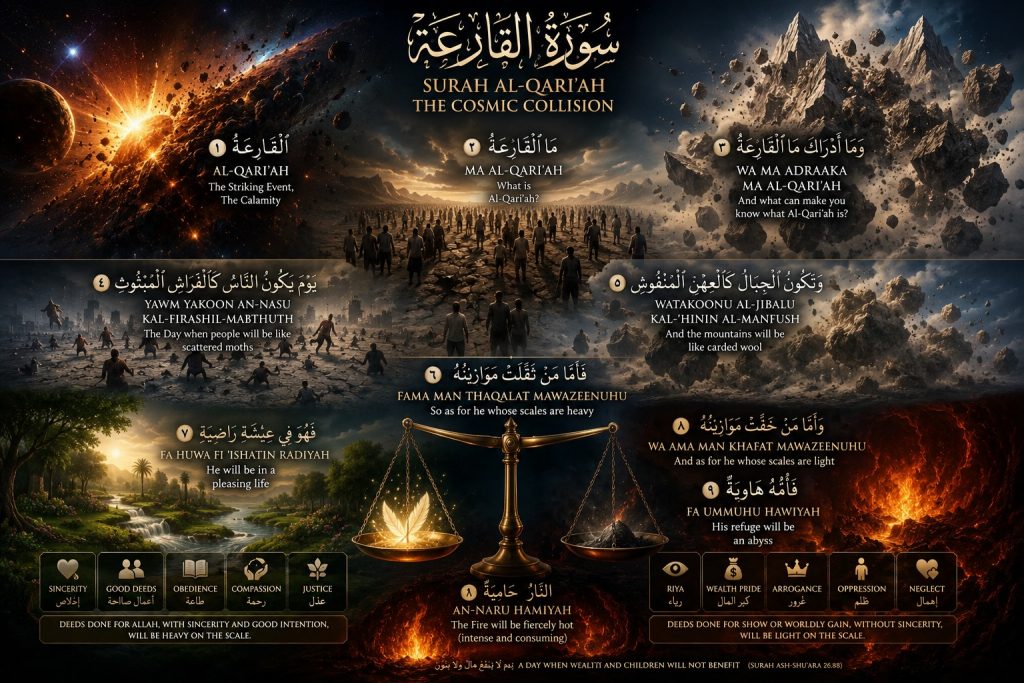
The Surah begins with three consecutive statements: Al-Qari’ah, Ma Al-Qari’ah, Wa Ma Adraaka Ma Al-Qari’ah. This repetition is not only for literary elegance but also delivers a mental jolt. When the human mind confronts an unknown reality, it questions. The Qur’an itself generates the question and then addresses it: Do you know what Al-Qari’ah is? This style indicates that the event transcends human comprehension.
The phonetic structure of Al-Qari’ah is noteworthy. The articulation of Qaf, Ra, ‘Ayn produces a strong vibration in the throat and tongue, echoing an explosive resonance. The Qur’an’s phonetics are harmonized with meaning, a stylistic feature also observed in Surah Az-Zalzalah and Surah Al-Haqqah, where word selection creates an auditory intensity reflecting the event’s gravity.
In modern physics, the concept of singularity exists. At the center of a black hole, natural laws cease to operate in their conventional form. The definitions of time and space change. Similarly, the initial moment of the Big Bang is termed a singularity, where our current equations fail. Al-Qari’ah can be described as an existential singularity; however, there is a fundamental distinction: scientific singularities are impersonal, whereas Al-Qari’ah is a conscious and moral event.
Scientific theories propose several potential ends of the universe: the Big Crunch, in which gravity collapses the universe; Heat Death, where energy disperses leaving no useful work; or the Big Rip, where dark energy tears everything apart. These are all speculative scenarios. Al-Qari’ah, however, is a certainty, not a probability. Here lies a fundamental difference: modern science perceives the universe’s end as a mere physical process, whereas the Qur’an presents it as the beginning of accountability, an end imbued with purpose. It is a declaration that history is not meaningless, and every action is recorded and judged.
Human civilization has long been proud of its power. It has split the atom, explored planets, and developed artificial intelligence. Yet, Al-Qari’ah reminds us that all these are temporary. The universe’s system is beyond human control. On the day of the final command, neither science, power, nor wealth will avail.
Al-Qari’ah is essentially a term that awakens consciousness. It makes humanity aware of its limitations. What we perceive as permanence—the mountains, oceans, stars—will all face annihilation. This realization fosters humility and directs humans toward moral responsibility. Al-Qari’ah is not merely a cosmic disaster but an existential revolution, a moment when the supremacy of natural laws will end and moral law will prevail. This is the first layer of understanding the Surah, the foundational point of its comprehension.
Surah Al-Qari’ah: “The Day When People Will Be Like Scattered Moths” – Human Psychology and Social Collapse: The Surah proceeds to depict a highly visual scene: Yawm Yakoon An-Nasu Kal-Firashil-Mabthuth. This is the day when people will scatter like moths. This metaphor is not mere literary elegance but a profound psychological depiction of human condition. The Qur’an does not compare them to organized flocks of birds or powerful animals, but to moths—fragile, drawn to light, often perishing in the flame. The term Mabthuth indicates an extreme state of dispersion, scattered and unorganized, like particles spread in all directions after an explosion. On that day, human social order will similarly fragment. Today, humans live in structured societies: state systems, judiciary, military, financial institutions—all pillars of collective order. Al-Qari’ah declares that on that day, these structures will be meaningless.
Modern sociology refers to social collapse when societies face extreme crises, and institutions fail. Law becomes weak, and individuals focus on personal survival. Yet the Day of Judgment goes far beyond, being a cosmic collapse, where every pillar of human order crumbles. Psychologically, it is a complete disorientation. A person’s identity is multi-layered: national, familial, professional, and religious. On that day, all layers dissolve, and each individual stands alone with responsibility for his actions.
Elsewhere, the Qur’an states that brothers will flee from one another, and parents from their children. Each person will be preoccupied with his own fate: Nafsin Nafsin.
The moth metaphor contains another layer: the moth mistakes light for salvation, yet it is the cause of its destruction. Similarly, worldly achievements—wealth, fame, power, pleasures—may seem beneficial, but on the Day of Judgment, if they were instruments of oppression or pride, they will harm the possessor.
Modern psychology also notes that extreme fear impairs decision-making. Excess adrenaline paralyzes rational thought. The Qur’an’s imagery illustrates this extreme fear, disorientation, and chaos on that day, where every individual moves in an aimless pattern.

This scene reminds us that worldly stability is temporary. Great empires have fallen. Powerful rulers have vanished. But the Day of Judgment surpasses all prior collapses. Partial decline is nothing compared to total annihilation.
There is a profound moral lesson here: when an individual is integrated into social order, he may feel his strength comes from his group, tribe, or nation. When standing alone, he realizes that true asset is his actions, not his lineage, collective, or army. Al-Qari’ah reduces human pride, showing that even self-proclaimed masters of the earth will be helpless moths. This metaphor teaches humility and moral responsibility.
Al-Qari’ah will not only shake physical creation but also human psychology and social structures. It is a day that dissolves collective pride and returns each individual to his true station as a responsible being accountable for his deeds.
Surah Al-Qari’ah: The Disintegration of Mountains, the Nature of Matter, and the Establishment of the Moral Scale
Following the depiction of scattered humanity, Allah Almighty describes the state of the mountains: Watakoonu Al-Jibalu Kal-‘Hinin Al-Manfush. Mountains, symbols of strength, stability, and weight, will be reduced on that day to light, fluffy, and dispersed entities. This description is profoundly eloquent. Today, even the hardest mountains—impervious to nuclear explosions—will dissolve at a divine command.
Modern physics explains that matter is composed of atoms. Each atom contains a nucleus made of protons and neutrons, held together by strong nuclear forces. Chemical bonds connect atoms into molecules. Gravity binds matter to the Earth. If all these forces are nullified, matter loses its structure. The Qur’an alludes to this very reality: even mountains will lose solidity. The term Al-‘Hinin Al-Manfush is rich in meaning; Al-‘Hn refers to colored wool. The Qur’an thus conveys not only a loss of weight but also a change in color and structure. Mountains that are today indestructible will float through the atmosphere like cotton, a cosmic vision beyond human imagination.
After this, Allah draws attention to the weight of human deeds. Fama Man Thaqalat Mawazeenuhu Fa Huwa Fi ‘Ishatin Radiyah, Wa Ama Man Khafat Mawazeenuhu Fa Ummuhu Hawiyah. The word Mawazin is plural, indicating a multi-dimensional and precise system for evaluating human deeds. In the worldly sense, we measure actions quantitatively: prayers performed, fasts observed, charity given. Yet, in the Hereafter, the measure will be qualitative as well as quantitative, accounting for intention and sincerity.
The Qur’an presents two extremes in this moral scale. The person whose deeds are heavy will enjoy pleasure, satisfaction, and spiritual tranquility (‘Ishah Radiyah), beyond the reach of death, disease, or grief. Those whose deeds are light will fall into Hawiyah. The term Hawiyah derives from Hawiyy, implying a fall from great height to extreme depth. Here, Hell is symbolized as a womb, which nurtures in comfort, but in Hawiyah, the only refuge is fire. This is an intensely painful irony, representing the consequences of moral insufficiency.
The concept of Nar Hamiyah is equally significant. This is fire at its extreme, independent of oxygen, capable of reducing all matter to its elemental state. Science confirms that when matter reaches extreme temperatures, it loses its structure. Al-Qari’ah’s fire will consume not just the body but also the soul, the ultimate thermal energy.
This Surah emphasizes that the ultimate purpose of the universe is the accountability of deeds and moral justice. All natural phenomena—the mountains, oceans, stars, and human technological achievements—are temporary. True reality lies in the weight of actions. A human being, without a connection to his Lord, is no more than a directionless moth. Al-Qari’ah represents the intersection of physics and ethics: human pride, material permanence, and technological prowess will vanish; only the scale of deeds will remain. From this, we understand that the Qur’an not only warns about the Day of Judgment but also provides practical guidance: we must cultivate sincerity in our actions, and ensure our moral scale is heavy to achieve ‘Ishah Radiyah.
Surah Al-Qari’ah: Detailed Examination of Deeds, Ethical Standards, and Human Destiny: The concept of weighing deeds in Surah Al-Qari’ah is presented with remarkable precision and philosophical depth. Fama Man Thaqalat Mawazeenuhu Fa Huwa Fi ‘Ishatin Radiyah—here, Mawazin (scales) are not physical or financial instruments, but a multi-layered system assessing the ethical, spiritual, and social dimensions of human actions. Its plural form indicates that multiple scales will measure different facets of deeds.
In this life, we often measure deeds by numbers or quantity: how many prayers, fasts, or acts of charity. The Qur’an clarifies that the true weight of actions is determined by quality and intention. A person performing thousands of acts for show or hypocrisy will find their weight light, ineffective on the divine scale. Conversely, even a small act, performed with sincerity, will carry significant weight and tilt the balance.
This idea conveys a crucial message to human consciousness and moral psychology: actions should never be for show or superficial recognition. Each deed must be filled with sincerity, intention, and purpose, for this is the measure Allah uses to weigh deeds in the Hereafter. The Qur’an likens this system to a digital or multi-dimensional scale, demonstrating that every action has consequences and an ethical weight.
The Qur’an also warns of the severe fate for those with light deeds: Wa Ama Man Khafat Mawazeenuhu Fa Ummuhu Hawiyah. Hawiyah signifies an irretrievable abyss. The womb-like metaphor highlights the painful irony: a mother’s embrace nurtures and protects, but falling into Hawiyah is analogous to descending into a consuming, inescapable fire, delivering a profound lesson through stark imagery.
The concept of Nar Hamiyah underscores the extremity of this fire. It is self-sustaining, independent of oxygen, and capable of dissolving all matter, including the soul. Science affirms that at extreme heat, matter disintegrates, losing its atomic and molecular cohesion. On the Day of Judgment, this fire will burn both body and spirit.
The Surah thus establishes moral justice above natural laws. Mountains may dissolve, human societies may fragment, but the scales of deeds will remain intact. This is the intersection of physics and ethics, where all displays of human pride and material power are nullified, leaving only moral weight. Al-Qari’ah reminds humanity of its limitations and the omnipotence of the Creator. The real purpose of life lies in deeds’ quality, sincerity, and ethical integrity. Worldly wealth, power, or fame will not carry weight on the Day of Judgment. True weight lies in sincerity, devotion, sacrifice, and good intention. Only those whose deeds are heavy will enjoy ‘Ishah Radiyah, while those with light deeds will face Hawiyah. This is the path to moral, spiritual, and practical guidance in life.
Surah Al-Qari’ah: Examples of Deeds, Moral Effects, and Human Destiny in the Hereafter : The concluding verses of Surah Al-Qari’ah provide a detailed depiction of the weight of deeds and their consequences. Allah makes it clear that whoever’s deeds are heavy will enjoy ‘Ishah Radiyah, and whoever’s deeds are light will fall into Hawiyah. Here, “heavy deeds” do not merely refer to quantity but also to quality and sincerity. A person may perform a thousand prayers, but if done for show or hypocrisy, their weight on the divine scale will be light. Conversely, a single act, performed with full sincerity and devotion, will be heavy and tip the scale.
This concept carries profound philosophical and moral significance. In worldly life, we often evaluate deeds through numerical measures: frequency of prayer, fasting, or charity. Yet the Qur’an clarifies that the true weight of actions depends on intention, quality, and purpose. This teaches human consciousness that outward acts alone have no intrinsic value; sincerity and purity of intention are paramount.
Allah illustrates the extreme consequence for those whose deeds are light with the term Hawiyah, an irreversible depth where one will experience the consequences of moral inadequacy. The imagery of falling into a womb-like structure highlights the irony: whereas a mother provides protection and comfort, falling into Hawiyah is analogous to being cast into an inescapable fire, a profound and painful lesson.
The concept of Nar Hamiyah is emphasized to evoke the extreme intensity of this fire. Unlike ordinary fire, it does not depend on oxygen and consumes all matter, both physical and spiritual. Modern science acknowledges that at extreme temperatures, matter loses its structure, a phenomenon mirrored in the Qur’anic depiction. On the Day of Judgment, this fire will burn both the body and the soul, leaving no escape.
The Surah teaches that the measure of deeds and moral accountability transcends worldly systems, human power, and material wealth. Mountains may dissolve, societies may collapse, and the natural order may be disrupted, but the scales of deeds will remain firm. This intersection of physical, ethical, and spiritual principles highlights that only moral weight truly defines human destiny.
Al-Qari’ah conveys a vital ethical lesson: human life’s real purpose lies in developing sincerity, ethical integrity, and moral responsibility. Worldly power, wealth, and status have no effect on the Day of Judgment. Only deeds performed with intention, devotion, and virtue will tip the scale, bringing one to ‘Ishah Radiyah. Light, insincere actions will lead to Hawiyah. The Qur’an thus blends moral philosophy with practical guidance, emphasizing the necessity of building ethical and spiritual weight in this life.
Surah Al-Qari’ah: Physical, Cosmological, and Theological Dimensions : The depictions in Surah Al-Qari’ah are not limited to human deeds or morality; they extend to the disintegration of the cosmos and the annulment of natural laws. Allah explains that on the Day of Judgment, mountains will become like cotton, humans will scatter like moths, and the scales of deeds will determine ultimate outcomes. These scenes surpass physical and cosmological limits as understood by human science.
Today, physics explains matter, gravity, nuclear forces, and energy principles. Yet on that day, all these laws will be suspended by divine command. Mountains, the most solid formations, will float in the air; atomic bonds will be broken; the connection between gravity and matter will cease. This is the cosmic hammer of God’s decree, ending every balance in creation.
For the human mind, this vision is incomprehensible. We track star movements, understand the Earth’s gravity, manipulate atomic structures in laboratories, and harness nuclear energy. Yet Al-Qari’ah transcends all these human capabilities. The breakdown of atomic and nuclear structures is far beyond human power. The Qur’an integrates physics, chemistry, and cosmology with a theological narrative, showing that divine power supersedes all natural laws.
The Surah also communicates that the true essence of the universe is not in observable phenomena but in human deeds. Today, humanity takes pride in technology and science—computers, large hadron colliders, nuclear energy. But on the Day of Judgment, all these will become meaningless. Only the weight of deeds will matter. This is the ultimate power shaping human destiny.
Thus, the Surah points to the convergence of cosmic disintegration and the establishment of moral justice. When physical laws collapse, mountains dissolve, and social structures disband, the scales of deeds remain. Here, physics and metaphysics, science and ethics, come together to make humanity aware of its limits and the omnipotence of God.
Al-Qari’ah reminds humans that real life’s purpose lies in cultivating sincerity, moral integrity, and ethical deeds. Worldly wealth, authority, and fame carry no weight in the divine scales. The true criterion is intention and sincerity. Whoever’s deeds are heavy will enjoy ‘Ishah Radiyah; whoever’s deeds are light will fall into Hawiyah. This Surah delivers a comprehensive vision integrating physical, cosmological, and ethical dimensions, illustrating that the ultimate human state, the moral scale of deeds, and ethical standards determine destiny on the Day of Judgment. It reminds humanity that divine power and moral accountability supersede all worldly power, providing not only a warning but also a practical guide for life.