
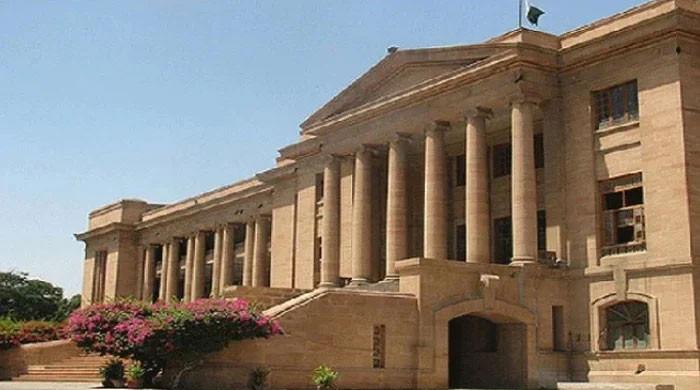

The High Court of Sindh issued a significant directive, asking the Chief Secretary of Sindh to formally report on steps taken to enforce the anti-defacement law. The case was initiated through a petition highlighting rampant violations of the Prevention of Defacement of Property Act (PDPA) 2013. Citizens and legal observers can follow all developments through the Sindh High Court Case Search portal and the official Sindh High Court Portal.
Background
The Sindh High Court issued notices to the Sindh government, the Karachi mayor, and other relevant authorities in a petition seeking strict enforcement of the law against defacement of public property.
The petition was filed by Advocate Tariq Mansoor, who drew the court’s attention to the increasing defacement of government buildings, parks, playgrounds, roads, and utility service poles. He said the problem had worsened in recent years through wall chalking, posters, banners, hoardings, and advertisements.
The matter is now listed in the Sindh High Court Case List and accessible through the Sindh High Court Portal. Citizens who wish to track case updates can use the Sindh High Court Case Search by name feature available on the official website.
Details of the Case
The petitioner cited the chief secretary, local government secretary, Karachi mayor and commissioner, inspector general of police, and prosecutor general as respondents. He argued that the Prevention of Defacement of Property Act was enacted in 2013 but had yet to be implemented in its true spirit.
Advocate Mansoor submitted that the law required the establishment of an anti-property defacement task force, which had not been constituted even after nearly 12 years. As a result, he said, defacement of public and private property continued unchecked across the city.
He further argued that the issue was linked not only to the right to life under Article 9 of the Constitution but also to several other constitutional provisions, and that defacement negatively affected public spaces, urban aesthetics, and citizens’ quality of life.
The Sindh High Court directed all respondents to submit their replies, and the Chief Secretary has been specifically asked to provide a comprehensive enforcement report. This order is part of the court’s broader effort to ensure accountability through its case management system. Sindh High Court judgments in this matter will be made available as PDF downloads through the official Sindh High Court Portal.
About the Chief Secretary of Sindh
The current chief secretary of Sindh is Syed Asif Hyder Shah, who has been in office since March 2024.
Asif Hyder Shah is a Pakistan Administrative Service officer in BS-22. He was previously posted as federal secretary in the Ministry of Climate Change and Environmental Coordination. He joined civil services in 1993 and has served on various important assignments, including as commissioner of Hyderabad and Karachi divisions.
A civil engineer by profession, Mr. Shah also holds an MBA degree from the Institute of Business Administration, Karachi, and a master’s degree from Harvard University, with fellowships from both Harvard and Stanford universities.
As the highest-ranking civil servant in the province, it is now his responsibility to respond to the High Court of Sindh’s directive and present a credible compliance roadmap.
The Sindh High Court: Structure and Reach
The High Court of Sindh is one of Pakistan’s most active superior courts. It operates from its principal seat in Karachi and maintains circuit benches at Hyderabad, Larkana, Mirpurkhas, and Sukkur. Citizens from upper Sindh can access the Sukkur High Court Cause List and the High Court Sukkur Cause List PDF from the official portal to track hearing schedules.
The High Court of Sindh continues to modernize its case management, with regular updates and notifications including transfers and postings of judicial officers, commercial litigation corridors, and the creation of new judicial oversight cells for reporting and addressing external influences.
The court’s digital infrastructure allows litigants to conduct a Sindh High Court Case Search by name and download Sindh High Court judgments in PDF format, making the justice system more accessible to ordinary citizens.
Pending Cases: A National Challenge
The Sindh High Court directive comes at a time when Pakistan’s courts are struggling under a massive backlog.
As of December 31, 2024, a total of 2,362,135 cases were pending across Pakistan’s courts. A staggering 83 percent of these 1,955,758 cases are stuck in the district judiciary, while the remaining 17 percent are spread across superior courts.
In Sindh specifically, 142,435 cases remained unresolved by year-end 2024. The courts there registered 221,330 new filings and resolved 214,471 during that period.
At the Supreme Court level, for the first time in almost ten years the upward trend in case pendency has been reversed. The total number of pending cases, which had reached 60,446 in early 2024, declined to 56,169 by October 2025.
This broader context makes the Sindh High Court’s proactive stance on public interest litigation including the anti-defacement case all the more significant.
Quotes
Advocate Tariq Mansoor, the petitioner, argued before the Sindh High Court that the Prevention of Defacement of Property Act has remained a dead letter for over a decade. He stressed that without the formation of the mandatory anti-defacement task force and proper enforcement, public spaces across Karachi and the rest of Sindh would continue to deteriorate.
Legal observers note that the High Court of Sindh has increasingly taken suo motu or petition-based notice of urban governance failures, signaling the judiciary’s willingness to hold the executive accountable for non-enforcement of existing laws.
Impact
The court’s order carries significance well beyond the immediate issue of wall chalking and illegal banners. If the Chief Secretary files a meaningful compliance report and the court follows through with concrete directives, this case could set a precedent for how Sindh enforces its environmental and urban management laws.
The case also highlights the role of the Sindh High Court Portal as a transparency tool. Citizens, lawyers, and journalists can use the Sindh High Court Case Search and the Sindh High Court Case List to monitor proceedings in real time. Those in northern Sindh can refer to the Sukkur High Court Cause List and the High Court Sukkur Cause List PDF for regional updates.
Furthermore, this case draws attention to Article 9 of the Constitution the right to life as a basis for urban quality-of-life claims, potentially widening the scope of public interest litigation in Pakistan.
Conclusion
The High Court of Sindh’s directive to the Chief Secretary marks another chapter in the court’s ongoing efforts to enforce laws that have long been neglected. With the Sindh High Court Case Search system, Sindh High Court judgments PDF availability, and the Sindh High Court Portal all now more accessible than ever, citizens have the tools to stay informed about this and hundreds of other active cases.
The next hearing will be closely watched. Whether the Chief Secretary of Sindh submits a substantive compliance report or faces further judicial pressure will determine how seriously the provincial government treats the Prevention of Defacement of Property Act going forward. In a city like Karachi, where public spaces have long suffered from illegal advertising and wall chalking, this case could finally bring meaningful change.
FAQs
Who is the new chief secretary of Sindh?
The current chief secretary of Sindh is Syed Asif Hyder Shah, who has been in office since March 2024.He is a Grade-22 Pakistan Administrative Service officer and previously served as federal secretary in the Ministry of Climate Change.
How many high courts are there in Sindh?
There is one High Court in Sindh the High Court of Sindh with its principal seat in Karachi. It has four circuit benches located in Hyderabad, Larkana, Mirpurkhas, and Sukkur. The Sukkur bench is commonly referred to in the Sukkur High Court Cause List and High Court Sukkur Cause List PDF resources available online.
How many cases are pending in Pakistan courts?
As of December 31, 2024, a total of 2,362,135 cases were pending across Pakistan. The vast majority 83 percent are in the district judiciary, while the remaining 17 percent are in superior courts including high courts and the Supreme Court.