Israel has continued striking Lebanon even after a ceasefire was announced, raising urgent questions about peace in the region. Israeli attacks have killed five people in southern Lebanon, including a journalist, Lebanon’s National News Agency reported, further straining a fragile ceasefire.The international community is watching closely as Lebanon and Israel inch toward fresh talks while bombs continue to fall.
Background: The Lebanon-Israel War 2026
The Lebanon-Israel war 2026 did not begin in a vacuum. Tensions between Israel and Hezbollah have simmered for decades, but the current round of hostilities exploded dramatically this year.
After a year of fighting, Israel invaded southern Lebanon in October 2024, pulling out after a US-brokered ceasefire at the end of November, but not before killing Hezbollah’s leader, Hassan Nasrallah. Between November 2024 and March 2026, several ceasefire violations occurred, with Israel launching near-daily attacks into Lebanon.
Hezbollah launched strikes against Israel after the 7 October 2023 attacks, which it said was in solidarity with Palestinians following the beginning of Israeli bombing of the Gaza Strip.That solidarity stance dragged Lebanon into a broader regional conflict it did not start and is now paying a devastating price for.
Why Did Israel Attack Lebanon?
Many readers are asking: why did Israel attack Lebanon in the first place, and why does it continue to do so even after a ceasefire? The answer is layered.
Israeli Prime Minister Benjamin Netanyahu said he is open to talks with the Lebanese government to “focus on the disarmament of Hezbollah and the establishing of peaceful relations between Israel and Lebanon,” but shot down the possibility of a ceasefire prior to negotiations.
Israel insists its strikes target Hezbollah military infrastructure. But critics and international bodies strongly disagree with that framing. In a 10-minute onslaught on 8 April 2026, Israeli forces struck more than 150 locations simultaneously across Lebanon, killing at least 303 persons and wounding 1,150 others. Many strikes hit densely populated residential neighbourhoods and commercial areas in central Beirut.
Lebanon called the 8 April attacks “Black Wednesday” and accused Israel of carrying out a massacre. Local observers said the attacks were not targeted and occurred in civilian areas of Lebanon, including in Beirut, where hospitals were flooded by casualties.
Did Israel Bomb Lebanon Yesterday? What Happened on April 22, 2026?
Yes and the Lebanon strike today is among the most chilling since the fragile truce began. An initial Israeli strike hit a car in at-Tiri, a village in south Lebanon, killing two people inside. Israel’s military said it struck two vehicles in southern Lebanon that departed from a military structure used by Hezbollah.
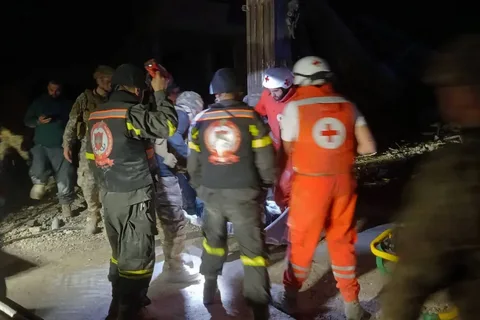
What happened next shocked press freedom groups worldwide. A later air strike hit a building in the same village, wounding a journalist who was trapped under rubble. Amal Khalil, who worked for the local media outlet Al Akhbar, was later found dead at the scene, her employer confirmed.
Amal Khalil and photographer Zeinab Faraj had gone to the site of an earlier Israeli drone strike on a car. For several hours, the Red Cross and rescue workers tried to reach the two journalists. They were unable to do that for a long time due to continued Israeli attacks in the area.
Lebanon’s prime minister accused Israel of war crimes after the airstrike killed Khalil and seriously wounded Faraj. Khalil is the fourth media worker slain by Israel in Lebanon since March.
Has Lebanon Attacked Israel?
Yes and the exchange of fire is ongoing. Has Lebanon attacked Israel? Absolutely, through Hezbollah. The Lebanese armed group said it attacked an Israeli artillery position in southern Lebanon with a drone, in response to what it said was an Israeli violation of the ceasefire. The Israeli military said it had intercepted “a hostile aircraft” launched by Hezbollah towards Israeli soldiers in southern Lebanon
Hezbollah leader Naim Qassem reportedly vowed to continue fighting Israel “until the last breath,” according to a statement read out on the militant group’s Al Manar TV.The group has made clear it will not sit idle while Israeli strikes continue inside Lebanese territory.
On 21 April, Israeli forces said that Hezbollah violated the ceasefire by launching rockets at an Israeli position in Rab Thalathin and a drone into northern Israel. Israel said it hit the rocket launcher in response.
Lebanon 100 Strikes: How Many Times Has Israel Struck Lebanon?
The scale of Israeli operations in Lebanon is staggering. The “Lebanon 100 strikes” figure is not an exaggeration it describes just one day’s bombardment. The Israel Defense Forces dubbed the 8 April attacks “Operation Eternal Darkness,” which included airstrikes and artillery shelling, and said it only hit “terror targets” belonging to Hezbollah claiming 100 airstrikes in densely populated areas.
According to the Government of Lebanon, since 2 March, the Israeli army has killed more than 2,000 people in Lebanon, including health workers and journalists, and injured 6,588 others.The human toll continues to climb with each passing day.
Between October 2023 and November 2024 alone, Israeli attacks killed more than 4,000 people in Lebanon, including 736 women, 222 health and rescue workers, and 248 children, according to the Lebanese Health Ministry.
Quotes: What Officials and Experts Are Saying
The world has not been silent. Condemnations have poured in from across the globe.
The Israeli actions were condemned by Lebanon, Australia, Bangladesh, Belgium, Brazil, Canada, China, Colombia, Egypt, France, Indonesia, Iran, Ireland, Iraq, Italy, Jordan, Kuwait, Malaysia, Norway, Oman, Qatar, Russia, Spain, Turkey, the United Arab Emirates, and the United Nations.
British Prime Minister Keir Starmer called the attacks “wrong,” and Spain called on the European Union to suspend the 1995 Association Agreement with Israel due to the “intolerable violation of international law.”
The Committee to Protect Journalists said: “CPJ holds Israeli forces responsible for the endangerment of Amal Khalil’s life and the injuries Zeinab Faraj sustained after the targeted strike on their location.”
Lebanese President Joseph Aoun said “contacts are underway to extend the ceasefire period,” signaling that diplomacy has not completely collapsed.
Impact: Regional and Global Consequences
The Lebanon-Israel war 2026 is not just a bilateral conflict. It is reshaping alliances, humanitarian corridors, and international law in real time.
The creation of a military boundary similar to the “Yellow Line” in Gaza is casting doubt on the ceasefire agreement. Lebanon and Hezbollah have rejected the move as an occupation of sovereign territory that violates the very premise of a ceasefire.
The strikes caused severe environmental damage by releasing toxic air pollutants and greenhouse gas emissions, contaminating water systems, and destroying ecosystems through fires, debris, and chemical residues.
Press freedom is also under severe attack. According to the Committee to Protect Journalists, Israel was responsible for two-thirds of all journalist and media worker killings in 2025. With Amal Khalil now added to that list in 2026, the targeting of reporters in active war zones is becoming one of the defining moral crises of this conflict.
Also in the News: Hinglaj Mata Temple
In a separate but significant development, the Hinglaj Mata Temple has recently been in the news for a much more hopeful reason. The Balochistan government has decided to declare the historic Hinglaj Mata Temple, located in Lasbela district, as a world tourism site. Chief Minister Sarfraz Bugti said the temple stands as a symbol of the province’s rich heritage, history, and tolerance.
The Hinglaj Mata Temple is a Hindu temple in Hinglaj, a town on the Makran coast in the Lasbela district of Balochistan, lying in the middle of the Hingol National Park and considered one of the 51 Shakti Peethas in Hinduism.This declaration is being welcomed as a step toward religious inclusivity and heritage preservation in Pakistan.
Conclusion: What Comes Next?
The latest attacks come on the eve of planned talks in Washington between Lebanese and Israeli ambassadors, as Lebanese President Joseph Aoun said Beirut would seek an extension of the 10-day, US-mediated ceasefire.
The ceasefire took effect on 16–17 April 2026, following continued exchanges of fire in the hours leading up to its implementation. Israeli officials stated that forces would remain deployed inside southern Lebanon during the truce.
Whether that truce holds or collapses entirely now depends on fragile diplomacy, civilian survival, and whether the international community can translate its condemnations into concrete pressure. For now, bombs are still falling. And journalists like Amal Khalil are still dying.
FAQs
Who won the Lebanon vs. Israel war?
The Lebanon-Israel war 2026 is ongoing as of April 2026. No side has declared victory. More than 2,400 people have been killed in Lebanon since Israel launched its offensive, while Hezbollah continues rocket and drone attacks into Israeli territory.A 10-day ceasefire is in place but extremely fragile, with violations reported by both sides.
How many rockets did Iran fire into Israel?
Iran’s direct rocket involvement is linked to the broader 2026 Iran war. Hostilities between Hezbollah and Israel reignited on March 2 after Israel killed Iran’s Supreme Leader Ali Khamenei.Iran has backed Hezbollah throughout the conflict, supplying weapons and support, though exact rocket counts from Iran directly into Israel are still being assessed by international monitors.
Why did Israel first attack Lebanon?
Hezbollah launched strikes against Israel after the 7 October 2023 attacks, which it said was in solidarity with Palestinians. After a year of cross-border fighting, Israel invaded southern Lebanon in October 2024.Israel stated its goal was to push Hezbollah away from the border and prevent further rocket attacks on northern Israeli communities. The conflict has since spiraled into a full-scale war in 2026.