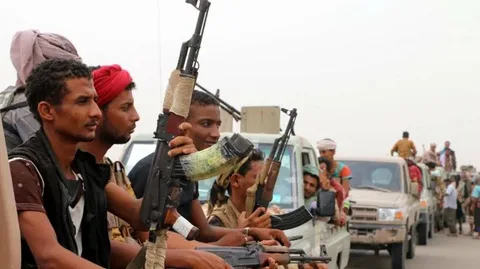
At least 15 Yemeni government troops were killed and dozens wounded in fierce fighting near the port city of Hodeidah this weekend. The clashes mark one of the deadliest single incidents in the Hodeidah conflict in recent years. The attack unfolded in the Hays district, south of Hodeidah, and comes amid rising Saudi Houthi conflict tensions across the wider region.
The renewed violence has reignited fears that the long-running Yemen Saudi conflict, largely frozen since a 2022 UN-brokered truce, could spiral into a fresh and more dangerous phase.
Background
The Hodeidah conflict is not new. It traces back to 2015, when the Iran-backed Houthi movement seized the Yemeni capital Sanaa and forced the internationally recognized government into exile. Saudi Arabia, alongside the UAE and a coalition of allied states, intervened militarily to restore the ousted government.
Since then, Hodeidah has remained one of the most contested cities in the entire war. It sits on Yemen’s western Red Sea coast and serves as the main entry point for food, fuel, and humanitarian aid into northern Yemen. Control over this port has always carried enormous strategic weight for both sides of the Saudi Houthi conflict.
A 2022 UN-negotiated truce mostly froze the front lines between Houthi forces and the Saudi-backed government. For years afterward, sporadic skirmishes replaced full-scale battles. But recent months have seen a noticeable uptick in hostility, driven partly by wider regional shifts tied to the broader history of Yemen conflict dynamics.
Details of the Latest Attack
According to military officials aligned with Yemen’s internationally recognized government, the assault began late on Friday night in the Jabal Dubas area of the Hays district, south of Hodeidah. Houthi fighters reportedly used snipers, drones, and mortar fire in a coordinated night assault.
Officials said the rebels briefly overran pro-government positions before a counterattack at dawn on Saturday managed to reclaim the territory. Fighting lasted several hours and, according to officers on the ground, this was described as one of the deadliest single Houthi attacks in years.
Government sources confirmed at least 15 troops killed and more than 20 wounded. Officials also noted that Houthi ranks suffered casualties during the exchange, though exact figures were not disclosed. The 13th Infantry Brigade of the First Division was reportedly involved in repelling the advance.
This latest flare-up in the Hodeidah conflict did not occur in isolation. It came just days after a separate and highly charged incident involving Saudi Arabia, Iran, and the Houthi movement, which has further strained the fragile calm across the region.
The Iranian Flight Incident
On Friday, Houthi military spokesman Yahya Saree announced that the group had confronted Saudi warplanes attempting to block an Iranian civilian aircraft from landing at Sanaa International Airport. The Houthis claimed the plane was carrying more than 200 stranded, wounded, and sick passengers.
Saree stated that Houthi air defenses launched surface-to-air missiles, forcing the Saudi aircraft to withdraw. The plane later landed successfully, marking the first publicly confirmed Iranian civilian flight into Sanaa in roughly a decade.
The aircraft was reportedly carrying a Houthi delegation traveling to Tehran to attend funeral proceedings for Iran’s former supreme leader. This detail places the incident within the broader fallout of the 2026 Iran war, which began in February after Israeli and American strikes targeted Iranian leadership and military infrastructure.
Official Statements and Quotes
Houthi spokesman Yahya Saree issued a stern warning following the airspace incident. He stated that any repeat violation of Yemeni airspace “will be met with a comprehensive response targeting its airports and vital interests on land and sea.”
A senior officer with pro-government forces, speaking anonymously because he was not authorized to brief media, described the Hays district assault as among the most severe attacks the region has witnessed in years. He noted that sniper fire accounted for the majority of the casualties before drone and mortar strikes followed.
The Saudi-led coalition also responded firmly. Coalition spokesperson Major-General Turki al-Maliki dismissed the Houthi threats as an attempt to shift attention away from internal struggles facing the movement. He added that the coalition would respond with “unprecedented determination and force” to any attempt to target Saudi Arabia or violate Yemen’s sovereignty.
Yemen’s Presidential Leadership Council separately condemned the Iranian flight into Houthi-controlled Sanaa, describing it as a breach of Yemeni sovereignty and a challenge to United Nations Security Council resolutions.
Regional and Global Impact
The combined effect of the Hodeidah conflict escalation and the Saudi Houthi conflict over Yemeni airspace has placed the wider region on alert. Analysts following the history of Yemen conflict developments warn that any collapse of the 2022 truce could reignite large-scale fighting after years of relative calm.
Shipping companies operating through the Red Sea and the Bab al-Mandeb Strait are watching closely. The Houthis have previously targeted commercial vessels in this corridor, and renewed hostilities could once again disrupt global trade routes that many international carriers had only recently resumed using.
Saudi Arabia’s coalition statement specifically flagged Yemeni infrastructure, including the ports of Hodeidah, Ras Isa, and as-Salif, along with Sanaa International Airport, as potential targets should tensions continue rising. This signals that both the UAE and Yemen theatre and the wider Gulf security architecture could be drawn deeper into the standoff.
For ordinary Yemenis, the stakes remain devastatingly high. The country continues to face one of the world’s most severe humanitarian crises, with millions still dependent on aid flowing through contested ports like Hodeidah.
Conclusion
The latest bloodshed in the Hodeidah conflict, paired with the tense standoff over Iranian flights into Sanaa, suggests the Yemen Saudi conflict may be entering a more volatile chapter. While the 2022 truce technically remains in place, the frequency and intensity of recent clashes raise serious doubts about its durability.
Observers tracking the Saudi Houthi conflict will be watching closely for any coalition military response, further Houthi statements, or renewed UN mediation efforts in the coming days. For now, both sides appear to be testing the limits of restraint, and any miscalculation could carry consequences far beyond Yemen’s borders.
Frequently Asked Questions
What are the Houthis fighting for?
The Houthis, formally known as Ansar Allah, say they are fighting against what they call foreign interference and a Saudi-led blockade of Yemen. They originally rose up demanding lower fuel prices and a more representative government, later expanding their goals to include control of Yemen and opposition to Saudi and Western influence in the region.
Is Abdul Malik Al Houthi a Shia or Sunni?
Abdul Malik al-Houthi is a Shia Muslim and follows the Zaidi branch of Shia Islam, which has a long historical presence in northern Yemen. He leads the Houthi movement, which draws much of its support from Zaidi communities.
Is Houthi stronger than Hezbollah?
Most defense analysts consider Hezbollah to be significantly more powerful than the Houthis in terms of trained manpower, advanced weaponry, and battlefield experience, given its decades of conflict and extensive Iranian support. However, the Houthis have demonstrated notable capability in missile and drone warfare, particularly in strikes against Saudi Arabia and Red Sea shipping.