
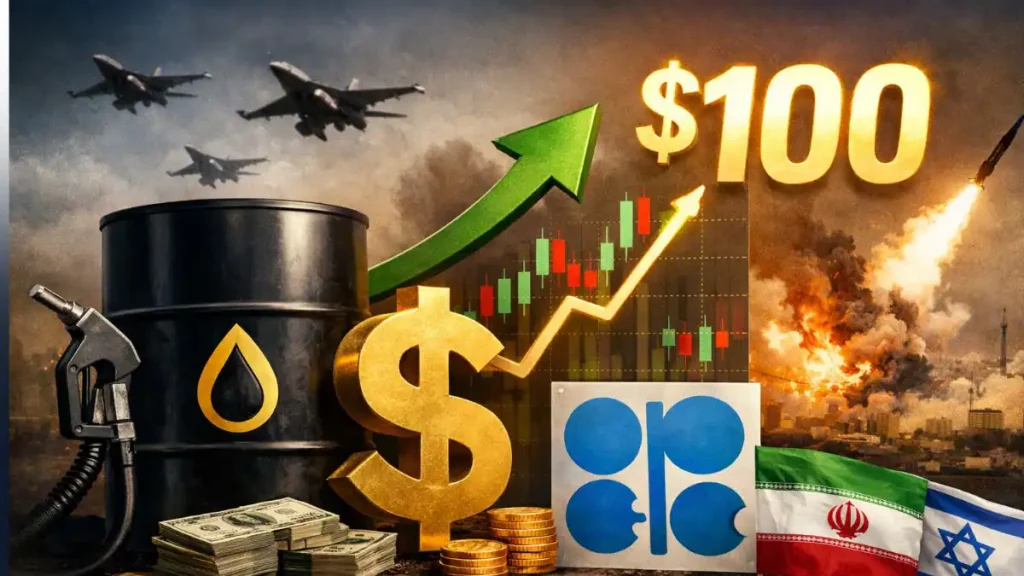

The global oil price spike 2026 did not happen overnight. It was set in motion by military action in the Middle East on February 28, when the United States and Israel launched joint strikes on Iran.
Crude oil and petroleum product prices increased significantly in the first quarter of 2026, particularly following military action in the Middle East on February 28 and the subsequent de facto closure of the Strait of Hormuz.
Brent crude oil began the year at just $61 per barrel but finished the first quarter at $118 per barrel the largest quarterly price increase on an inflation-adjusted basis in recorded history.This historic oil price chart movement caught traders, governments, and consumers completely off guard.
Global Oil Price Spike 2026 Live: Where Prices Stand Now
Anyone tracking the global oil price spike 2026 live will have seen a turbulent few weeks. Prices have jumped sharply, pulled back briefly, and then surged again as diplomatic efforts faltered.
Brent crude rose to $101.82 per barrel on April 13, 2026 up 6.95% from the previous day and is up 56.93% compared to the same time last year.
WTI crude oil rose to $104.23 per barrel on April 13, 2026 up 7.93% from the previous day and is up 69.40% compared to the same time last year.
By April 9, Brent crude had already reached $100.99 per barrel $35 above its price just one year earlier.
The global oil price spike 2026 graph tells a clear story: prices have more than doubled from their early-year lows in just a few months.
What Is Driving the Oil Price Chart Higher?
The oil price chart in 2026 shows one dominant driver the Strait of Hormuz. This narrow waterway handles roughly 20% of global oil supply, and its closure has caused chaos.
Global oil markets are in a period of heightened volatility and uncertainty due to the de facto closure of the Strait of Hormuz, a major world oil transit chokepoint. The strait has been effectively closed to shipping traffic since military action began on February 28.
The Brent crude oil spot price averaged $103 per barrel in March $32 per barrel higher than in February and daily Brent crude oil prices reached almost $128 per barrel on April 2.
Countries including Iraq, Saudi Arabia, and the UAE shut in oil production in response to disrupted navigation through the strait. Attacks on energy infrastructure and the threat of additional attacks also pushed crude oil prices higher.Every spike visible on the global oil price spike 2026 chart corresponds to a fresh escalation in the conflict or a breakdown in ceasefire talks.
Islamabad Talks Fail: Prices Surge Again
A brief ceasefire raised hopes and brought prices down temporarily. But those hopes faded fast.
Talks held in Pakistan failed to produce an agreement, with the US accusing Tehran of refusing to curb its nuclear ambitions, while Iran reportedly sought control of the strait, war reparations, a broader regional ceasefire, and access to frozen overseas assets.
The key shipping route has effectively remained closed since the conflict began, driving sharp gains in oil and gas prices and raising concerns about inflationary pressures and weaker global growth.
The global oil price spike 2026 live data reflects this directly prices jumped over 7% on April 13 alone, following the collapse of diplomatic progress.
Global Oil Price Spike 2026 Prediction: What Analysts Say
The global oil price spike 2026 prediction varies widely depending on how long the Strait of Hormuz remains disrupted. Here is where major institutions stand:
Most analysts predict that oil prices will rise to between $111.54 and $137.30 by the end of 2026. According to more conservative forecasts, prices could settle around $83.29 per barrel.
Goldman Sachs raised its Brent and WTI crude oil price forecasts for the fourth quarter of 2026, assuming 21 days of low Strait of Hormuz oil flows at 10% of normal levels, followed by a 30-day gradual recovery.
Brent oil is projected to remain above $95 per barrel in the next two months, before potentially falling below $80 in Q3 2026 and around $70 by year end, according to the latest EIA STEO models.The global oil price spike 2026 graph shows just how difficult it is to predict the next move the oil price chart has defied multiple forecasts already this year.
Expert Quotes: Could Oil Hit $200?
The possibility of $200 oil once dismissed as extreme is now being taken seriously by analysts watching the Brent crude oil price closely.
Wood Mackenzie analysts said Brent could soon hit $150 and that $200 was not “outside the realms of possibility” in 2026. Iran also invoked the prospect of $200 oil, warning through a military spokesperson that the world should “get ready” for such a spike.
Energy expert Adi Imsirovic of the University of Oxford told Al Jazeera that oil at $200 a barrel “would be a major handbrake to the world economy,” and that if flows through the Strait of Hormuz were materially disrupted for a sustained period, prices well above $100, even approaching $200, are plausible.
Prediction markets currently assign around a 14% probability of oil hitting $200 before July 2026, while Wall Street analysts outline it as an extreme tail-risk scenario rather than a base-case forecast.
Global and Regional Impact of the Oil Price Spike
The global oil price spike 2026 is not just a number on an oil price chart. It is reshaping economies, household budgets, and energy policies worldwide.
The International Monetary Fund estimates that every 10 percent rise in oil prices, sustained over a year, corresponds with a 0.4 percent increase in global inflation and a 0.15 percent reduction in economic growth.
The EIA has also revised its assumptions for global oil demand downward, with reductions occurring primarily in Asia, which is more reliant on crude oil supplies from the Middle East. Countries across South Asia including Pakistan, India, and Bangladesh are facing surging import bills and inflationary pressure. Pakistan, already hosting the US-Iran peace talks in Islamabad, is navigating a delicate balance between diplomatic opportunity and economic strain from high Brent crude oil prices.
The benchmarks have retreated from peaks above $110–$118 seen earlier in 2026, but remain significantly higher than early-year levels around $60–$70, with analysts offering mixed forecasts depending on how quickly diplomatic resolution occurs.
Conclusion: What the Oil Price Chart Says About What’s Next
The global oil price spike 2026 prediction remains deeply uncertain. The oil price chart points in two possible directions a sharp decline if the Strait of Hormuz reopens fully, or a further surge if conflict escalates.
The prediction market for WTI crude oil’s peak price in 2026 has repriced significantly, shifting probability away from moderately high outcomes toward extreme tail-risk scenarios above $200 per barrel reflecting the deep conflict between a potential supply glut and acute geopolitical risks.
Fitch Ratings raised its 2026 annual average oil price forecast, assuming the Strait of Hormuz remains effectively closed for about a month before oil prices fall to the mid-$60s in the second half of 2026.
Traders, governments, and consumers are watching the global oil price spike 2026 live data with close attention. The next few weeks and the outcome of any renewed diplomatic efforts will determine whether the oil price chart stabilizes or delivers another shock to the world economy.
FAQs
Will oil reach $200 a barrel?
It is possible but not considered the most likely outcome. According to Al Jazeera, analysts at Wood Mackenzie have stated that $200 oil is not “outside the realms of possibility” if the Strait of Hormuz remains closed for an extended period. However, prediction markets currently place the probability at around 14%. Most mainstream forecasts for the global oil price spike 2026 prediction put the ceiling between $130 and $150 under severe disruption scenarios.
Will oil prices rise again?
Yes, according to current global oil price spike 2026 live data and analyst forecasts, oil prices remain elevated and vulnerable to fresh spikes. Any breakdown in US-Iran diplomacy, new attacks on energy infrastructure, or prolonged Strait of Hormuz disruptions could push the Brent crude oil price significantly higher. The EIA expects production shut-ins to peak in April 2026 before gradually easing.
Is oil a good investment for 2026?
Oil remains a high-risk, high-reward asset in 2026. The global oil price spike 2026 graph shows extraordinary volatility prices have more than doubled from early-year lows. For short-term traders, the oil price chart offers significant opportunities but also severe downside risk if a ceasefire is finalized and the Strait of Hormuz reopens. Long-term investors should note that many analysts, including J.P. Morgan, expect prices to fall significantly by the second half of 2026 as supply recovers. Always consult a qualified financial advisor before making investment decisions.