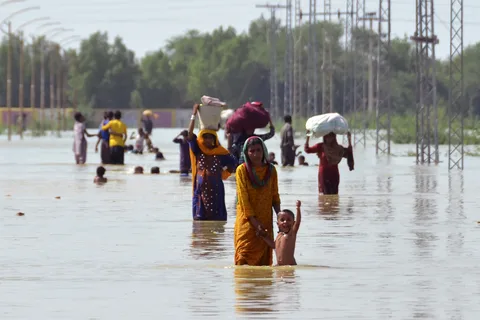
The 2025 Pakistan floods were triggered by heavy pre-monsoon rains beginning in June and continuing through September, affecting Khyber Pakhtunkhwa, Punjab, Sindh, Balochistan, and Azad Kashmir.Over a thousand lives were lost, millions were displaced, and a fierce national debate erupted not just about the floods, but about who is responsible, who failed, and what Pakistan must do next. From the Kalabagh Dam controversy to India’s suspension of the Indus Waters Treaty, flood management in Pakistan has become the defining political issue of the year.
Background: A Country Built on Vulnerable Ground
Pakistan is one of the world’s most flood-prone nations, and its vulnerability has grown dramatically in recent decades. The country sits at the confluence of monsoon rains, Himalayan glacial melt, and transboundary river systems shared with India and Afghanistan. Every year, the same cycle repeats: rains come, rivers overflow, communities are destroyed, and officials scramble to respond.
According to figures compiled by the National Disaster Management Authority (NDMA), the 2025 floods claimed at least 1,000 lives and affected nearly seven million people across the country. Punjab was the hardest hit, followed by Khyber Pakhtunkhwa and parts of Gilgit-Baltistan, where crops spread over hundreds of acres were lost, homes were washed away, and entire communities were displaced.
This is not a new crisis it is a crisis that has been building for decades, shaped by poor governance, interprovincial disputes, and inadequate infrastructure. The flood management dispute in Pakistan is as much a political failure as a natural one.
The Kalabagh Dam: Pakistan’s Most Explosive Water Dispute
No single issue captures Pakistan’s flood management dispute more sharply than the Kalabagh Dam debate. The Kalabagh Dam, proposed in 1984 on the Indus River in Punjab’s Mianwali district, is designed to generate 3,600 megawatts of electricity, irrigate farmland, and store water to help manage floods. But the $10 billion project has never moved forward because of fierce opposition from Sindh and KP, where leaders fear it would divert water southward, submerge districts like Nowshera, and displace thousands of families.
As Pakistan reeled from floods that killed at least 43 people and displaced more than 1.3 million in Punjab, a surprise call by Khyber Pakhtunkhwa Chief Minister Ali Amin Gandapur to build the long-stalled Kalabagh Dam reignited one of the country’s fiercest water disputes.
The dam debate is at the heart of Pakistan’s flood management dispute case study. Proponents argue it would store billions of gallons of floodwater and reduce downstream damage. Critics counter that it would harm agricultural land in Sindh, flood areas in KP, and displace indigenous communities with no clear resolution in sight for over four decades.
The India-Pakistan Water War: A New Dimension
The flood management dispute in Pakistan took a dangerous international turn in 2025. On April 23, India formally placed the Indus Waters Treaty in abeyance following the Pahalgam attack. The immediate consequence was not the physical diversion of river flows, but the suspension of hydrological data sharing an essential pillar for flood forecasting, reservoir operations, and irrigation planning in downstream Pakistan.
Federal Minister Ahsan Iqbal accused New Delhi of deliberately releasing excess water from dams without timely warnings, stating that “India has started using water as a weapon and has caused wide-scale flooding in Punjab,” citing releases into the Ravi, Sutlej, and Chenab rivers, all of which originate in Indian territory and flow into Pakistan.
Intense rainfall in Indian Punjab caused the Ravi, Chenab, and Sutlej to overflow, which led to India releasing excess water into these rivers into Pakistani Punjab, causing severe flooding. Multiple breaches had to be made to protect the Qadirabad, Suleimanki, and Khanki headworks from flood flows of up to one million cusecs.
Experts, however, urge caution. The sheer volume of water during an intense monsoon often exceeds any single dam or barrage’s capacity. Controlled releases have become a necessary, if dangerous, part of flood management on both sides of the border.The blame game, analysts warn, can serve short-term political purposes especially after the military conflict of May 2025.
Institutional Failures: Why Flood Management Keeps Failing
A major flood management essay on Pakistan cannot ignore the systemic institutional failures that worsen every disaster. At the federal level, the NDMA released its 2025 Monsoon Infrastructure Guidelines, instructing all provinces to inspect dams, drainage systems, and urban flood barriers. Yet a recent policy analysis published in Water Policy revealed that many District Disaster Management Authorities remain inactive or under-resourced until emergencies strike, operating without sustainable budgets, trained personnel, or effective plans.
Hazard zoning laws are poorly enforced, allowing illegal construction in flood-prone zones. Early warning systems remain outdated and ineffective, often failing to reach vulnerable populations in time, and especially in local languages.
This represents the core tragedy of flood management in Pakistan: year after year, the same gaps are identified, the same recommendations are made, and the same communities suffer the consequences.
Quotes: What Officials and Experts Are Saying
“You can’t engineer your way out of climate change with a single mega-dam,” said environmental planner Saira Rehman. “What Pakistan needs is zoning to stop construction on floodplains, stronger embankments, and restoring wetlands that absorb excess water.”
“We need consensus first on Kalabagh Dam,” said Nadeem Afzal Chan, information secretary of the PPP. “There are provincial resolutions against the project. At a time when Pakistan is busy with flood rehabilitation, we should not lose focus.”
Pakistan’s Climate Change Minister stated that “the devastation extends far beyond agriculture and livelihoods,” adding that “we’ve seen an alarming increase in the number, pattern, and erratic nature of floods over the past 10 to 15 years.”
Effects of Floods in Pakistan 2025: A Catastrophic Toll
The effects of flood in Pakistan 2025 have been catastrophic across every sector of life. Since June 26, 2025, floods from cloudbursts, glacial lake outbursts, and swollen rivers have claimed more than 1,000 lives, injured nearly 1,100 people, damaged over 12,500 houses, and washed away nearly 240 bridges. Over 6,500 livestock have died.
The WHO reported that 120 health facilities were damaged, 239 bridges were destroyed, and 671 km of roads were rendered impassable, disrupting emergency services and humanitarian aid delivery.
The economic impact was severe, with flood-related disruptions shaving an estimated 0.5 percent off national GDP. Floodwaters also mobilised sewage, industrial effluents, and agro-chemicals, contaminating drinking water sources and triggering post-flood disease outbreaks.
The flood crisis hit women and girls hardest. Floods damaged walls and doors, leaving many homes unsafe. Lack of privacy, safe toilets, and secure shelters put women and girls in daily danger. Pregnant and breastfeeding women struggled to access nutrition and medical care.
Pakistan’s Response and International Support
Pakistan has not been entirely passive. At COP29, Pakistan launched its flagship Recharge Pakistan initiative, aimed at restoring wetlands, hill torrents, and forest landscapes to act as natural buffers against monsoon flooding. Supported by $4.4 million in international funding, the program is expected to benefit over 62 million people
In urban centres like Karachi, architects and city planners are piloting “sponge city” concepts including permeable pavements, stormwater gardens, and rainwater harvesting wells. Pakistan also secured $400 million in funding from the World Bank and Asian Development Bank for flood reconstruction.
The European Union pledged Rs350 million in aid, alongside contributions from various NGOs and humanitarian organizations.
Flood in Pakistan: Essay in 150 Words (Summary Block)
Pakistan faces annual floods that kill thousands and displace millions. In 2025, the crisis worsened due to heavy monsoon rains, glacial lake outbursts, and cross-border water releases from India. Over 1,000 people died, seven million were affected, and critical infrastructure was destroyed. The flood management dispute in Pakistan remains unresolved the Kalabagh Dam debate continues, provincial coordination is weak, and early warning systems fail vulnerable communities. India’s suspension of the Indus Waters Treaty removed vital flood forecasting data, deepening downstream risk in Pakistan. Climate change is accelerating these disasters, yet Pakistan contributes less than 1% of global emissions. Without urgent reform stronger institutions, enforced zoning laws, and interprovincial water cooperation Pakistan will continue to face recurring catastrophes every monsoon season. International support and climate justice are essential if Pakistan is to break this cycle of destruction.
Conclusion: What Must Change
The overarching lesson was stark: floods in Pakistan are no longer rare disasters they are annual certainties, shaped as much by political failure as by rainfall. The flood management dispute in Pakistan whether it is the Kalabagh Dam, the Indus Waters Treaty, interprovincial water-sharing, or underfunded disaster authorities will not be resolved through emergency relief alone.
Pakistan needs long-term structural reforms: enforced floodplain zoning, modern early warning systems, institutional capacity at district level, and a genuine interprovincial consensus on water infrastructure. The international community must also recognize that Pakistan’s flood crisis is a climate justice issue a country bearing the consequences of emissions it barely produces.
Until these changes are made, the next flood season will bring the same headlines, the same losses, and the same unresolved disputes.
FAQs
What are the solutions to flood management in Pakistan?
Effective solutions include building and upgrading dams and reservoirs, enforcing floodplain zoning laws to stop illegal construction, modernising early warning systems, restoring wetlands and natural buffers, improving interprovincial water coordination, strengthening district-level disaster authorities, and investing in climate-resilient infrastructure such as sponge city designs and permeable pavements.
What are the 7 principles of disaster management?
The seven principles of disaster management are: (1) Comprehensiveness covering all hazards and all phases; (2) Progressive anticipating future disasters; (3) Risk-Driven using risk assessment as a foundation; (4) Integrated uniting all organisations and levels of government; (5) Collaborative building partnerships; (6) Coordinated aligning the goals of all stakeholders; and (7) Flexible adapting to changing situations. These principles guide bodies like Pakistan’s NDMA in planning and response.
What are the 5 points of disaster management?
The five key phases of disaster management are: (1) Prevention reducing the likelihood of a disaster; (2) Mitigation minimising the impact if a disaster occurs; (3) Preparedness planning, training, and readying systems before a disaster; (4) Response immediate action during and after a disaster to save lives; and (5) Recovery rebuilding communities and restoring services after the disaster. Pakistan’s National Disaster Management Act of 2010 is built around these phases.