Shifting Global Chessboard, Great Powers’ Bargaining, and the Future of European Defense
Mian Iftikhar Ahmad
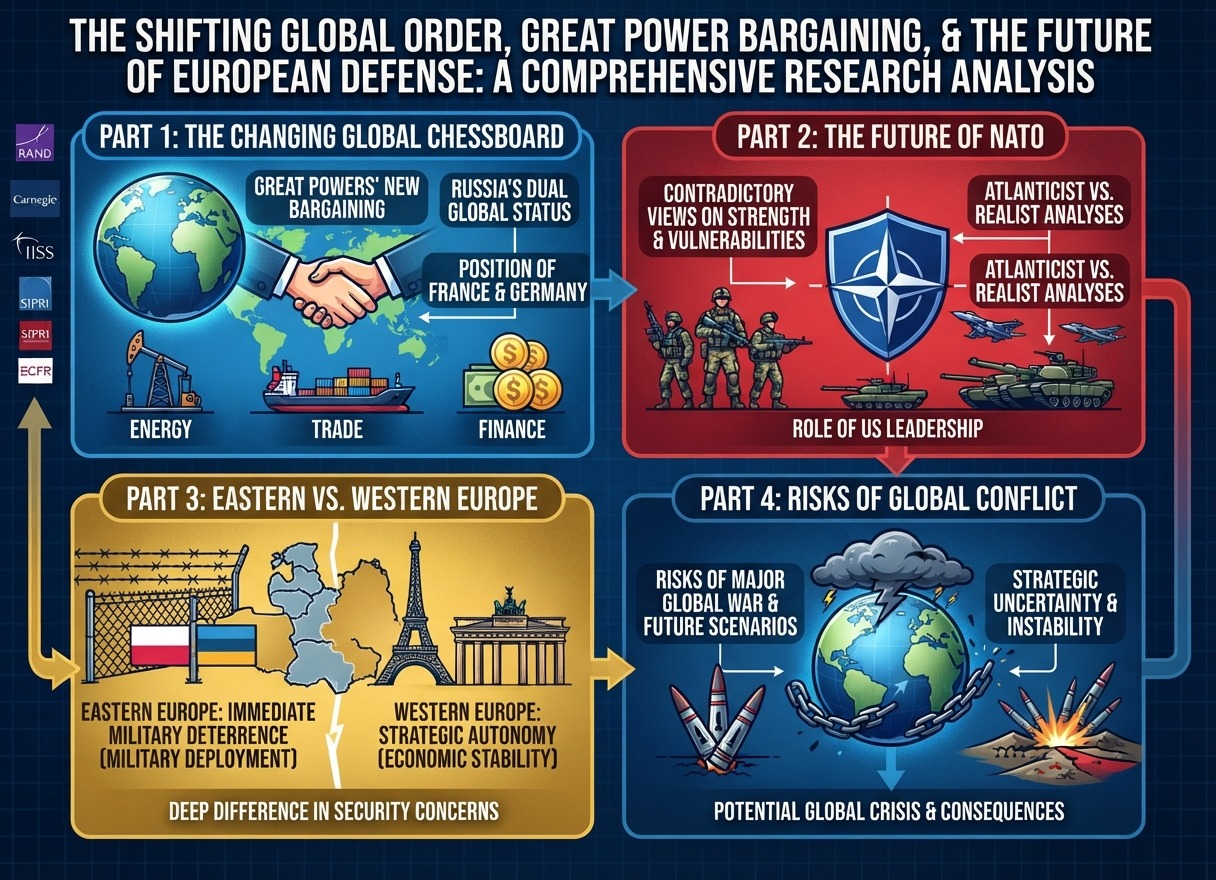
Global politics is currently standing at a decisive juncture where the balance of power established over the past several decades is rapidly dissolving, and the foundation of a new global order is being laid. In this new order, the priorities of great powers, the nature of alliances, and the diplomatic maneuvering room for small and medium-sized states are undergoing fundamental transformations. Recent global developments and direct or covert contacts between major powers have raised the pressing question of whether the world has entered an era of mutual understanding and bargaining among a few powerful centers, where traditional global institutions and old military alliances are losing their relevance. In this context, it has become crucial to debate the global status of Russia, whether NATO is heading towards its end, why Europe feels the need to create its own separate army, where traditional European pillars like France and Germany stand in this new scenario, what impact this will have on the restoration of diplomatic relations between Pakistan and India in South Asia, and whether the specter of a major global war looms over this game of great powers. Experts in international relations and reports from reputable global think tanks provide significant angles for understanding this complex situation; however, it is imperative to meticulously examine ground realities and theoretical analyses before reaching any definitive conclusion. Russia’s position in the global system has always been dual and complex. When directly compared with the world’s two largest economic and technological powers, Russia appears relatively small and limited in terms of economic volume and advanced civil technology. However, when viewed in comparison with dozens of medium and small countries across the globe, Russia remains an extraordinary military, nuclear, and geographical power today. Research reports from the Carnegie Endowment for International Peace and the RAND Corporation clarify this point, stating that Russia possesses the world’s largest nuclear arsenal, vast energy and mineral resources, veto power in the United Nations Security Council, and deep strategic influence in many regions of Asia, the Middle East, and Africa. Due to this, no global arrangement can be sustained by completely ignoring it. This is precisely why serious consideration is given to granting Russia a specific share or sphere of influence in global politics in any potential understanding among great powers. However, its realization depends on the extent to which other major powers accommodate Russia to protect their global interests, and how long Russia itself can sustain its economic and military energy. On the other hand, the perception is deepening in global politics that the world’s major powerful powers are now operating purely on the basis of transactional interests rather than old ideological slogans, resulting in increased economic and political pressure on developing and vulnerable countries. According to analyses by the Brookings Institution and Chatham House, with the rise of a multipolar world, major powers are weaponizing supply chains, energy, debt, technology, and security guarantees. Consequently, it is becoming difficult for countries with weak economies to make independent decisions, and they are compelled to undergo difficult diplomatic tests to maintain balance between major powers or to seek their favor. In this changing global environment, serious questions are being raised about Europe’s position, particularly the roles of France and Germany. When major powers conduct direct talks on global or regional affairs without taking European capitals into confidence, a sense of anxiety and helplessness arises within European leadership. However, reports from the European Council on Foreign Relations and the International Institute for Strategic Studies indicate that it would be unrealistic to consider France and Germany as merely ineffective in global politics, as Germany is Europe’s largest economy and industrial power, while France is the European Union’s sole nuclear power, a permanent member of the Security Council, and a country with a strong global diplomatic and military network. The real issue lies not in these countries’ capabilities but in their political division and long-term security dependence on Washington, which has rendered them slow-moving at decisive moments. This is the background against which the debate on Europe creating its own separate army and achieving strategic autonomy has resurged, as European policymakers have begun to fear that if US priorities shift away from Europe towards the Indo-Pacific region or internal affairs, Europe will be left alone to protect its borders. According to studies by the French think tank Institut Montaigne and the German Council on Foreign Relations, Europe is increasing its defense budget, and work on joint defense projects has also begun. However, several serious obstacles still hinder the formation of a complete and unified European army, including the lack of a joint command structure, the clash of member states’ national interests, the weakness of the defense industry, and uncertainty regarding nuclear defense. Similarly, in the context of South Asia, relations between India and Pakistan and the influence of major powers are also being closely scrutinized. Analyses by the Center for Strategic and International Studies and the Observer Research Foundation reveal that India is pursuing a policy of multi-alignment rather than being completely subordinate to any single global block. Under this policy, India maintains relations with the US, Russia, and Europe according to its interests. Therefore, India will not easily accept any global arrangement that limits its regional supremacy or autonomy. As for the restoration of diplomatic relations between Pakistan and India, a sentiment definitely exists in Washington and Gulf capitals that tensions in the region should decrease so that major powers can focus on their broader economic and geographical plans. However, experts in this region believe that sustainable diplomatic progress between the two countries is not possible merely through an external directive; rather, it necessitates mutual confidence, addressing security concerns, and serious dialogue on core disputes. The most alarming aspect of this entire scenario is the fears of a major global war, as global system instability increases when old agreements of power weaken and some powerful countries feel they are being excluded from major decisions. Reports from the International Crisis Group and the Stockholm International Peace Research Institute warn that the world is currently passing through the most dangerous post-Cold War arms race and strategic uncertainty, where misunderstandings, regional conflicts, or lack of trust among allies could spark a major confrontation, although the nuclear balance and global economic interdependence still remain the biggest factors deterring major powers from a direct, destructive war.
Shifting Global Chessboard, Great Powers’ Bargaining, and the Future of European Defense : The most prominent and strong defense viewpoint on the future direction of NATO comes from institutions belonging to the Atlanticist school of thought, among which analyses by the Atlantic Council and the RAND Corporation are at the forefront. According to them, Europe’s security situation has provided NATO with a new life and a clear purpose, as a result of which member states have been compelled to increase defense budgets, accelerate joint military exercises, and reactivate their defense industries. According to reports from the Atlantic Council, NATO’s greatest strength lies in its long-term institutional structure, joint command system, and interoperability among armed forces, which no new or rival alliance possesses. Meanwhile, RAND Corporation research indicates that the accession of Northern European countries has strengthened NATO’s geographical grip in the Baltic Sea and Arctic region more than ever before, raising the cost significantly for any potential aggression. Experts at the Brookings Institution also appear aligned with this view, stating that although differences and debates persist within NATO, the principle of collective defense and the presence of US military and nuclear capability make it an impregnable defense structure, and predictions of its immediate decline or collapse are contrary to reality. Conversely, analysts affiliated with the Realist school of thought and several European policy institutes label this perception of NATO’s strength as superficial and point towards structural weaknesses within it. Foremost among these points is that NATO’s expansion after the end of the Cold War generated new geographical tensions and insecurity instead of resolving security issues, due to which risks of direct confrontation with Russia increased, and the alliance’s defense responsibilities spread, becoming more fragile. Reports from the Carnegie Endowment for International Peace have placed special emphasis on this aspect, stating that changes in US global strategic priorities and internal political polarization have created serious uncertainty for European allies. This is because if the US throws its energy into the Middle East or the Indo-Pacific region, or if a leadership comes to Washington that imposes strict conditions on defense expenditures and collective responsibilities, NATO’s credibility and trust could suffer a severe blow. Research reports from the European Council on Foreign Relations, furthering this debate, clarify that there is no uniformity in European countries’ perception of security threats, and individual political and economic interests of some member states act as obstacles to collective decisions. This weakens mutual trust within the alliance and makes rapid joint decision-making difficult in an emergent crisis. According to military reports from the International Institute for Strategic Studies, a major practical weakness of NATO is the gap existing in defense production and logistics capacity. This is because after living in an environment of low defense expenditures and long peace, European countries have limited reserves of ammunition, air defense systems, and other military equipment required for a long and intense war, and replenishing them rapidly is a complex industrial and financial process. Analyses by Chatham House have also pointed out that the decision-making procedure based on consensus within the alliance, while providing a democratic and legal justification on one hand, can paralyze the entire alliance in the event of reservations or vetoes from one or two member states, especially at a time when global crises change rapidly and immediate response is needed. Additionally, experts at the German Council on Foreign Relations and Institut Montaigne also raise the point that the balance of power within NATO is not uniform, and excessive reliance on US military superiority has rendered European countries so strategically dependent that whenever a change or hesitation regarding policy occurs in the US, the entire European security system is shaken. Consequently, the debate has intensified in Europe on whether Europe needs to create alternative or additional capabilities for its defense even while remaining under NATO’s umbrella. Thus, these contradictory reports from think tanks paint a picture where NATO appears strong and organized militarily and institutionally on the surface, but its internal coherence, defense-industrial capacity, changing interests of member states, and US political uncertainty are subjecting it to challenges that will determine its future in the coming years, and the question will remain steadfast as to whether this alliance can adapt itself according to the requirements of the new era or weaken due to internal pressure and changing global balance.

Shifting Global Chessboard, Great Powers’ Bargaining, and the Future of European Defense : The countries of Eastern Europe, which particularly include Poland, Lithuania, Latvia, Estonia, and Romania, view security as a direct, immediate, and existential issue due to their geographical proximity and historical experiences. For them, the threat of a powerful neighbor’s military ambitions, border instability, violations of airspace, and regional pressure is a daily reality rather than a distant theoretical debate. Reports from the European Council on Foreign Relations and the International Institute for Strategic Studies highlight this point, stating that the primary security priority in Eastern European capitals is immediate military deterrence, the deployment of strong armed forces and air defense on Eastern borders, rapid increase in defense budgets, and unwavering belief in the principle of NATO’s collective defense, so that any potential aggression can be stopped at the very beginning. For these countries, US military presence and Washington’s direct security guarantee are considered the strongest shield for their sovereignty and regional protection, rather than just a diplomatic convenience. Consequently, they view any idea or project that weakens the US role or paves the way for diplomatic leniency with suspicion. Furthermore, Eastern European countries also face direct hybrid threats such as cyberattacks, information warfare, electoral interference, pressure of border migration, and disruption in navigation systems, due to which the element of defense readiness and immediate response is much sharper and stricter in their security policy. According to analyses by Chatham House and the RAND Corporation, Eastern European countries often surpass the European average in terms of defense expenditures and emphasize that the real test of European security must take place on the Eastern front, where weakness or hesitation can subject the entire region to instability. On the other hand, major powers of Western Europe, including France, Germany, Italy, and Spain, view the security issue in a more multifaceted, economic, industrial, and broader regional context. For these countries, security is not limited to the deployment of tanks and troops on the Eastern border but is also linked to industrial production, energy security, trade routes, and crises in the Mediterranean, the Middle East, and Africa. Reports from Institut Montaigne and the German Council on Foreign Relations clarify that France has long insisted on European strategic autonomy and the strengthening of the European defense industry so that Europe can remain safe from global politics and US electoral changes’ effects. Meanwhile, Germany is rapidly increasing its defense capability on one hand and keeping in view economic stability, industrial costs, alternative energy sources, and financial and institutional balance within the European Union on the other. According to analyses by the Carnegie Endowment for International Peace and the Brookings Institution, the sentiment also prevails in Western European countries that if security policy is confined purely to strict military confrontation, long-term economic pressure, social unrest, and other global threats could be neglected. Meanwhile, instability in the Middle East or Africa directly knocks on Western Europe’s door in the form of migration and energy crises. Thus, the biggest difference between Eastern and Western Europe appears in determining speed, intensity, and priority. Where Eastern Europe gives priority to immediate military guarantees and strict deterrence, Western Europe wants to carry forward strategic autonomy, industrial capacity, economic sustainability, and broader geographical balance alongside defense readiness. This difference, whenever it surfaces during a major crisis or policy decision-making moment, generates debates and conflicts within NATO. Despite this, a common reality is being increasingly acknowledged between both parts: that in the changing global system, Europe must increase its capability to bear the burden of its own defense responsibilities so that it can protect its security despite external uncertainty.
Shifting Global Chessboard, Great Powers’ Bargaining, and the Future of European Defense : In the changing global system, the impression is rapidly spreading that powerful centers are now engaged in drawing new lines of direct interest-based compromises and influence rather than old principles and traditional alliances. This directly exerts pressure on weak and developing economies because when major powers make energy, trade, debt, supply chains, and security guarantees part of bargaining, it becomes much harder for small countries to maintain diplomatic balance and continue their independent policy. Reports from the RAND Corporation and the Carnegie Endowment for International Peace clarify this point, stating that while Russia may appear limited in some respects in the direct economic and technological competition among great powers, it still holds an extremely heavy weight today in terms of military, nuclear, energy, and regional influence compared to dozens of small and medium-sized states. Due to this, no global balance can stand by completely excluding it, and it is for this reason that possibilities of granting it a specific share in global politics remain under discussion. On the other hand, it is contrary to reality to consider the status of countries like France and Germany in Europe as merely meaningless, as Germany is Europe’s largest economy and industrial center, while France holds a unique position due to its nuclear capability, permanent membership in the Security Council, and strong diplomatic and military structure. However, their real weakness is the lack of political coherence and long-term security dependence, which has compelled them to increase their defense capability and strategic autonomy, as highlighted repeatedly in reports from Institute Montaigne and the German Council on Foreign Relations, although the establishment of a complete and unified European army is still a long and difficult process due to complex financial, industrial, and command issues. Similarly, India’s multi-alignment policy in South Asia prevents it from blindly accepting any single system, while the possibilities for the restoration of diplomatic relations between Pakistan and India, and although they may be influenced by global and regional interests necessitate mutual confidence and resolution of core issues for sustainable peace and engagement. The most serious question in this entire scenario is whether this game of great powers and the trend of ignoring some powerful or allied countries can give rise to a major global war, and whether the NATO countries that are kept behind in any decision or action will silently accept everything. According to reports from the Stockholm International Peace Research Institute and the International Crisis Group, the world is currently passing through severe strategic uncertainty, a rapid arms race, and the spread of regional conflicts, which have increased the risks of major confrontation due to miscalculations and any unexpected event. However, the balance of nuclear weapons, the fear of destructive economic losses, and the interdependence of the global economy still remain the biggest factors deterring major powers from plunging directly into a global war. As for the countries that feel ignored or under pressure, history and think tank analyses indicate that no powerful or influential ملک stays silent for a long time by putting its security and dignity at stake. Instead, either they create alternative alliances and defense capability, or they try to assert their weight through diplomatic pressure, economic counter-measures, and new alignments, which further complicates the global landscape. Observing possible future scenarios, the first scenario is that of a divided but undeclared-balance multipolar world, in which great powers will continue bargaining over their respective spheres of influence; Europe will strengthen its defense industry and autonomy even while remaining within NATO; and a series of regional conflicts, cyber competitions, and economic pressures will continue. The second scenario is that of a deep crisis within NATO or increasing gaps between Europe and the US, in which changes in US priorities or severe differences among member states weaken the alliance’s effectiveness, and Europe has to bear the burden of its own security in a much more difficult and expensive environment. The third scenario is that of the emergence of a severe and broader crisis as a result of an unexpected regional flare-up or misunderstanding, which, although it will remain under the constraint of being limited or contained due to the nuclear balance, could subject the global economy, trade, and international system to deep shock. Thus, it can be said that the current global transformation is neither ending in a simple outcome nor can it be completely determined by the unilateral desire of merely a few powers. Rather, in the coming years, the bargaining of great powers, the reactions of allies, European defense preparations, and the conflict of regional politics will collectively determine the shape of a new and much more uncertain global system.