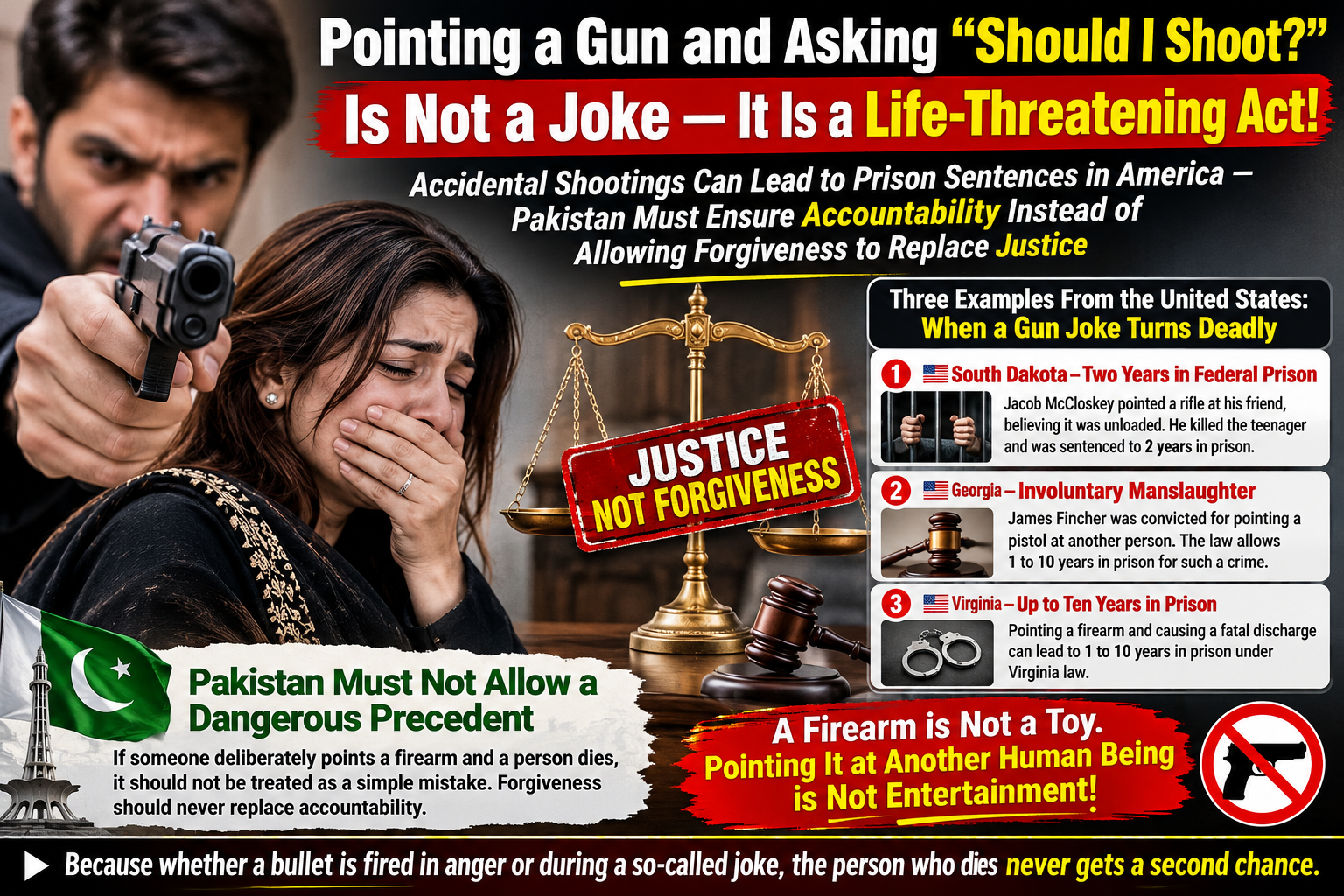
Pointing a Gun and Asking “Should I Shoot?” Is Not a Joke — It Is a Life-Threatening Act!
Accidental Shootings Can Lead to Prison Sentences in America — Pakistan Must Ensure Accountability Instead of Allowing Forgiveness to Replace Justice
By Asim Siddiqui
Washington, D.C. | November 10, 2026
The recent shooting death of Pakistani television anchor Rabia Ahsan in Rawalpindi has raised a disturbing question: Can pointing a loaded gun at one’s wife, calling it a joke, and then claiming the gun discharged accidentally be considered a simple mistake deserving forgiveness?
According to initial reports, Rabia Ahsan’s husband allegedly pointed a pistol toward her during what has been described as a joke. The weapon discharged, resulting in her death. The circumstances remain subject to investigation, and the husband’s criminal responsibility has not been established by a court.
Reports suggesting that the family may forgive the accused have triggered a broader debate about accountability, negligence, and the protection of human life.
The fundamental question is simple: If someone deliberately points a firearm at another person and that person dies, should claiming it was a joke be enough to escape punishment?
Three Examples From the United States: When a Gun Joke Turns Deadly
1. South Dakota — Two Years in Federal Prison
In a 2016 incident, Jacob McCloskey reportedly pointed a rifle at his 17-year-old friend, believing the weapon was unloaded. He pulled the trigger, killing the teenager.
In 2017, a federal court sentenced McCloskey to two years in prison, followed by supervised release and community service.
The case demonstrates that claiming a shooting was accidental does not automatically eliminate criminal responsibility.
2. Georgia — Involuntary Manslaughter
In Georgia, James Fincher was convicted following a fatal shooting involving a firearm he reportedly believed was unloaded. The incident involved pointing the weapon toward another person.
His conviction for involuntary manslaughter and pointing a pistol at another person was upheld on appeal.
Under Georgia law, certain forms of felony involuntary manslaughter carry one to ten years in prison. This is the statutory sentencing range, not a verified statement of Fincher’s individual sentence.
3. Virginia — Up to Ten Years in Prison
Virginia treats involuntary manslaughter as a serious criminal offense when a death results from legally sufficient criminal negligence.
Under Virginia law, involuntary manslaughter is a Class 5 felony, generally punishable by one to ten years in prison, although alternative sentencing provisions may apply.
Pointing a firearm at someone and causing a fatal discharge can potentially lead to criminal charges, depending on the evidence and circumstances.
Pakistan Must Not Allow a Dangerous Precedent
The death of Rabia Ahsan should not become another case in which questions of criminal negligence are overshadowed by appeals for forgiveness.
Forgiveness is a personal and, in some circumstances, legal right. However, forgiveness should not be confused with the absence of criminal responsibility.
Pakistan’s laws governing Qisas and Diyat permit forgiveness or settlement in certain homicide cases, subject to legal requirements and judicial oversight. Such provisions should never become a means of ignoring criminal negligence or bypassing lawful investigation.
If the allegation that the husband deliberately pointed a pistol at his wife is established, the courts must carefully examine whether his conduct constituted a criminal offense, regardless of whether he intended to fire.
Otherwise, a dangerous message could emerge: that someone can point a weapon at another person, cause a death, and simply explain afterward, “I was only joking.”
A firearm is not a toy. Pointing it at another human being is not entertainment. And a life lost cannot be restored through an apology.
Pakistan needs transparent investigations, independent judicial proceedings, and appropriate punishment wherever criminal responsibility is proven.
Because whether a bullet is fired in anger or during a so-called joke, the person who dies never gets a second chance.