SPECIAL ELECTION COVERAGE | 2026 US MIDTERM ELECTIONS
Democrats Seize Both Houses of Congress in Historic 2026 Midterm Wave
Seven Senate flips and a House majority usher in a new era of divided government, leaving President Trump facing a Congress he no longer controls
By Tariq Nehal Khan | Pakistan Chronicle, South Asian Chronicle, The Pakistan Journal | November 7, 2026
WASHINGTON — Democrats have won control of both chambers of the United States Congress, ending Republican control of Washington and delivering a sharp political rebuke to President Donald Trump at the midpoint of his second term. The Associated Press and major networks projected the results within hours of the polls closing on November 3, and the picture has only become clearer since.
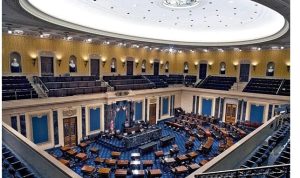
The U.S. Senate chamber in Washington, where Democrats will hold the majority when the new Congress convenes in January 2027.
A Senate Map Redrawn
The biggest surprise came in the Senate. Democrats flipped seven Republican-held seats in Ohio, Iowa, Maine, North Carolina, South Carolina, Kansas and Texas, lifting their total to 54 seats against 44 for Republicans. Fifty-one seats are needed for a majority. Republicans entered election night with a 53-seat advantage, so the swing is dramatic.
Several of the victories came in places that few analysts had expected to be competitive. In Texas, James Talarico won a seat that Democrats had not captured since 1988. In North Carolina, former governor Roy Cooper defeated Michael Whatley, a former Republican National Committee chairman backed by Trump, becoming the first Democrat to win a Senate race in that state since 2008. In South Carolina, pediatrician Annie Andrews unseated the Republican incumbent, while Adam Hamilton in Kansas, Josh Turek in Iowa, Troy Jackson in Maine and Sherrod Brown in Ohio completed the sweep. Democrats also comfortably held Georgia, where Senator Jon Ossoff won re-election.
Senate Democratic Leader Chuck Schumer described the outcome as a generational remake of the Senate map. Republicans, meanwhile, lost a majority that many in the party had considered safe only months ago.
Democrats Also Take the House
In the House of Representatives, Democrats also secured a majority, which requires 218 of the 435 seats. By Thursday, the Associated Press had called 240 seats for Democrats, with dozens of races still open, so the final margin is yet to be determined. Representative Hakeem Jeffries of New York is now poised to become Speaker and would be the first Black person elected to the post.
Speaker Mike Johnson acknowledged on election night that his party had faced the long odds of midterm history, in which the president’s party usually loses ground. The result also ended the Republican trifecta of the White House, Senate and House.

The U.S. Capitol at sunset. Both chambers of Congress will change hands when the new session begins.
Why Voters Turned
Reporting by NPR and the Associated Press suggests that the campaign was shaped by frustration over the high cost of living and concerns about public corruption. The AP’s voter poll found that many Americans were unhappy with the direction of the country and pessimistic about the future.
House Democratic Leader Hakeem Jeffries said voters were calling for transformational change, while Mr. Schumer promised that relief was on the way for Americans struggling with rising costs. That message of affordability and accountability appears to have resonated even in states that Mr. Trump carried by double digits two years ago, including Texas, Ohio, Iowa and Kansas, where Republicans spent hundreds of millions of dollars on defense.
President Trump spent much of the final month holding rallies in an effort to energize his supporters, yet he later pointed out that he was not on the ballot. He has said he is willing to accept the results and work with Democrats. Senate Majority Leader John Thune, who will lose his post, said Republicans would resist what he called an effort by the Democratic left to undo the party’s achievements.
What Changes in Washington
The practical consequences will be felt quickly. When the new Congress convenes in January 2027, Democrats will control the legislative agenda in both chambers, and Mr. Trump will need Democratic votes to pass major bills. Democratic control of the Senate will also end the steady confirmation of Trump-nominated judges and give the party greater influence over presidential appointments. House committees, for their part, will gain the power to launch investigations and expand oversight of the administration.
For readers in Pakistan and across South Asia, the change matters beyond American domestic politics. Congress plays an important role in foreign aid, trade and sanctions policy, and a divided government in Washington could shape how the United States approaches the region over the next two years.
What Is Still Undecided
These results are not yet final. The Associated Press has not called the Senate races in Alaska and Mississippi. In Mississippi, Democrat Scott Colom holds a razor-thin lead over Republican incumbent Cindy Hyde-Smith, and reports indicate the state has no automatic recount procedure. In Alaska, a ranked-choice tally is scheduled for November 18, and the race has already drawn a legal dispute over certification. If Democrats win both seats, they would finish with 56 Senate seats.
Every state must also complete its counting and certification process before the figures become official. Even so, the central outcome is no longer in doubt: when the new Congress meets in January, Democrats will hold the majority in both the Senate and the House of Representatives.
Note: Figures are based on Associated Press and major network reporting as of November 7, 2026, and remain unofficial until certified.