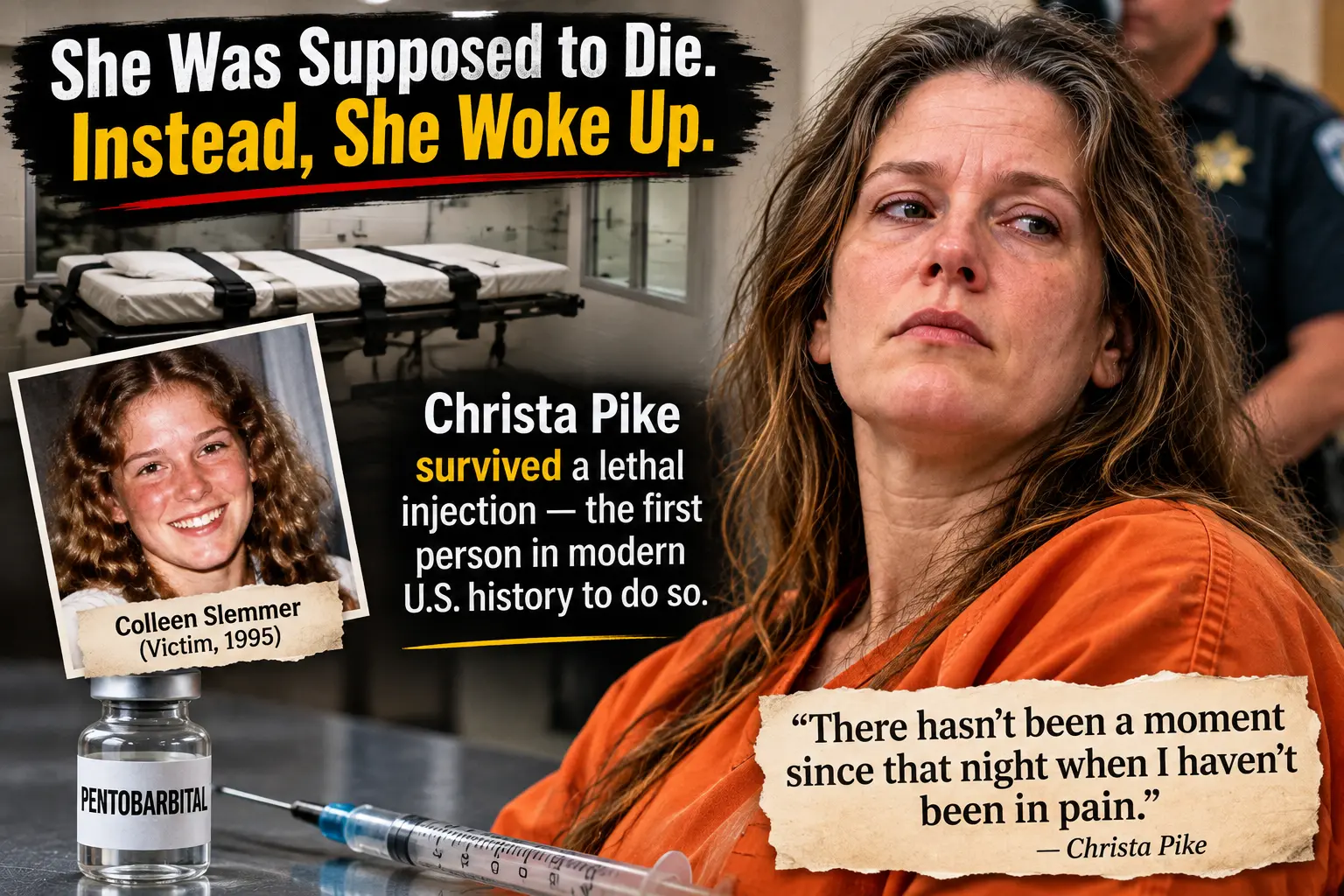
She Was Supposed to Die. Instead, Christa Pike Woke Up After a Failed Execution
NASHVILLE, Tennessee — Christa Pike entered Tennessee’s execution chamber on September 30, 2026, expecting to die. After spending more than three decades on death row for a brutal murder committed when she was 18, she was scheduled to be executed by lethal injection. Two doses of the execution drug pentobarbital were administered, but Pike remained alive in what experts have described as an unprecedented failure.
Instead of being pronounced dead, Pike was taken to a hospital for emergency medical treatment. Days later, she regained consciousness, beginning an unexpected recovery that has raised serious questions about Tennessee’s execution procedures.
In her first public statement, released on October 30, Pike described the physical and emotional suffering she has experienced since waking up in the hospital.
“There hasn’t been a moment since that night when I haven’t been in pain,” she said. “My body hurts. My arms hurt. My hands hurt. My throat hurts. I still struggle to speak. And the pain isn’t just physical. There is pain in my mind and in my soul.”
Her statement offered a glimpse into the aftermath of an execution attempt that failed despite the administration of two doses of the lethal drug. Her attorneys have described her recovery as medically unprecedented, while questions remain about precisely what happened during the procedure.
An Execution That Did Not Go as Planned
Pike’s execution was scheduled to take place at Riverbend Maximum Security Institution in Nashville. According to court filings and accounts reported by the media, she continued breathing after the drugs were administered. She was subsequently transported by ambulance to a hospital, where she received emergency care.
Her legal team later reported that she had regained consciousness and was able to speak, although her condition initially remained serious. She was discharged from the hospital on October 10 and returned to the Debra K. Johnson Rehabilitation Center in Nashville, where she had been held for years.
Pike’s survival is considered unprecedented in modern American capital punishment history. The incident has intensified scrutiny of Tennessee’s lethal-injection procedures and prompted renewed questions about the reliability and oversight of execution protocols.
The precise reason the execution failed has not been conclusively established in public reporting. Her attorneys have raised concerns about the placement of intravenous lines, suggesting that the drugs may not have entered her bloodstream as intended. The state’s investigation is expected to examine what occurred during the procedure.
The Crime That Led to Her Death Sentence
Pike was sentenced to death for the 1995 torture and murder of 19-year-old Colleen Slemmer, a fellow student in Tennessee. Pike was 18 at the time of the crime.
The killing was exceptionally brutal, and the case led to Pike’s conviction and eventual placement on death row. Slemmer’s death left her family waiting decades for the sentence against Pike to be carried out.
The failed execution has brought renewed attention to a case that has long been associated with questions about criminal responsibility, punishment, and the administration of the death penalty.
Pike’s survival does not erase the crime for which she was convicted or the suffering experienced by Slemmer’s family. It has, however, introduced a new and unexpected chapter into a case that had appeared to be approaching its conclusion.
Tennessee Orders an Independent Review
Following the failed execution, Tennessee Governor Bill Lee announced an independent review to determine what went wrong. He also postponed the state’s remaining scheduled execution for 2026 while the matter is examined.
The incident has prompted questions about the state’s execution protocol, the training of personnel responsible for administering lethal injections, and the procedures used to confirm whether an execution has been completed.
Tennessee officials have maintained that the state followed its established protocol. However, the outcome has intensified calls for a thorough investigation and greater accountability.
Whether Tennessee will make another attempt to execute Pike remains a matter for future legal and administrative decisions. The immediate focus is on understanding the failed procedure and assessing its consequences.
A Recovery Marked by Pain
Pike’s latest statement suggests that surviving the execution attempt has not brought an end to her suffering. She described persistent pain throughout her body, difficulties speaking, and emotional distress that continues to affect her recovery.
Although she has reportedly made progress since leaving the hospital, healing remains a difficult process. Her experience has raised questions not only about the medical consequences of the failed execution but also about the legal and ethical implications of what occurred.
For Slemmer’s family, the case remains tied to the devastating loss of a young woman whose life was taken in 1995. For Tennessee authorities, it has become a major test of the state’s execution procedures and accountability mechanisms.
Pike’s survival has transformed what was expected to be the final chapter of a decades-long death penalty case into an unresolved legal and medical controversy. As the investigation continues, questions remain about how the execution failed, what long-term effects Pike will face, and what the state will decide next.