Maulana’s interest in Khyber Pakhtunkhwa is not without reason.
Amir Muhammad Khan:
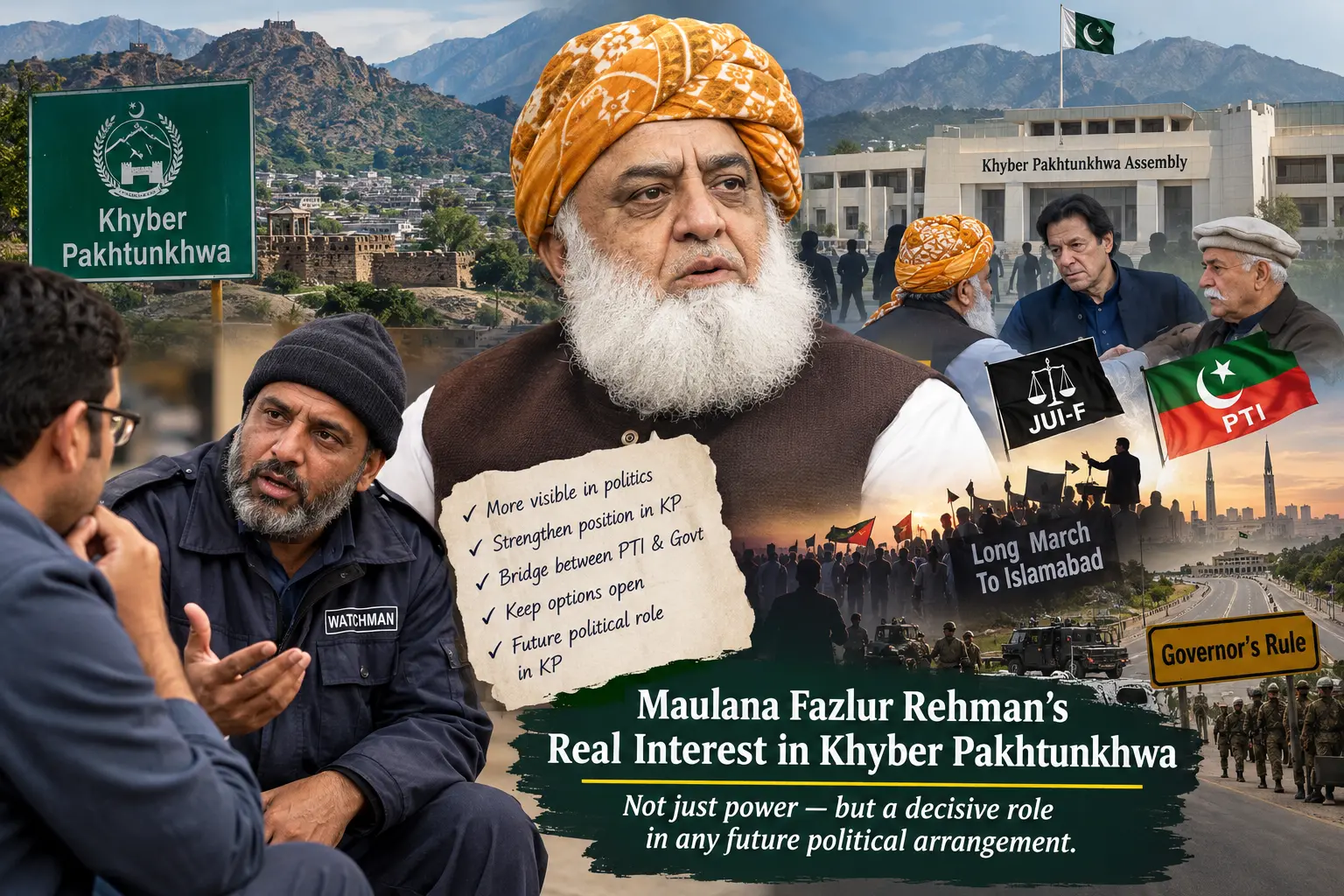
We newspaper readers often imagine ourselves to be the most well-informed people in the world after catching up on the news. Yet, I am amazed when the watchman at my residence—before I even get into my car for the office—briefs me early in the morning on the previous night’s events in Pakistani politics, having gathered information from various social media sources. He possesses not only a deep understanding of Pakistani politics—perhaps surpassing my own—but also offers remarkably candid commentary. Recently, regarding the PTI’s negotiations with the government—which dragged on until 2:00 AM—he informed me the next morning: “Sir, talks continued until 2:00 AM, and a solution might have been found, but the negotiators lacked the authority to make a final decision. They are politicians who genuinely want to resolve matters through dialogue; however, on every point, they feel compelled to consult a certain ‘de facto’ Chief Minister—a man devoid of political acumen who dreams of storming Islamabad while neglecting his actual duties in the province. He rejects the senior leaders’ proposals and scrutinizes any draft agreement solely to see if it mentions the release of the specific individual for whom he is willing to jeopardize the ministry, the province, and law and order. When that mention is missing, he rejects the deal, and those poor PTI leaders—despite their ‘senior’ status—are forced to return to the government delegation empty-handed.” This analysis was offered by my building’s watchman as he recounted the story of the late-night negotiations. I asked him for his take on whether an agreement regarding the ‘Long March’ would be reached. He replied, “Sir, the government views the Long March participants as a threat that must be eliminated. If you listen to the speeches they are making, Sir, it sounds just like a speech by Modi…” …he is advocating for the long march, stating that their demands are few and simple: release my leader and provide him medical treatment in a hospital (though rumor has it the gentleman isn’t actually ill; he simply has a penchant for hospital stays). They threaten that if their demands aren’t met, they won’t even salute the national anthem. Anyone uttering such words—tantamount to treason—is no less a terrorist than the terrorists themselves. As a sensible Pakistani—a watchman who constantly analyzes the news—I wonder: where are we headed? What kind of rhetoric and narratives are we passing on to future generations? Those entrusted by the public to steer the country—to manage its affairs and work towards improving law and order and the economy—seem inexplicably slow to curb such inflammatory slogans. People have grown weary of endless meetings, press conferences, and statements; when action on a necessary measure is delayed, the anti-state narrative of those seeking to harm the country gains ground, and the innocent public becomes disillusioned. At work, I keep a TV—with management’s permission—to stay updated on current affairs and listen to Quranic recitations. There, I received the welcome news that Governor’s Rule (or whatever one chooses to call it) had been imposed. Consequently, the street agitation ceased, the stubborn insistence on marching to Islamabad fizzled out, and the defiant boasts—”Let’s see who stops us from going to Islamabad”—collapsed completely. Amidst this, there was an amusing update: Maulana Fazlur Rehman—a man unparalleled in the art of “playing both sides of the wicket”—had returned from Umrah. I rushed home, knowing that only a watchman could offer the perfect commentary on this; upon arriving, perhaps he was… He was waiting; he ran over to me and shared the news—which had broken that afternoon—about the imposition of Governor’s Rule. I remarked that Maulana Fazlur Rehman hailed from the same region as him; the Maulana had—by his own account—tried hard to prevent Governor’s Rule from being imposed, yet his counsel went unheeded. He did not clarify *who* had disregarded his advice: was it the government, or the party that used to refer to him by a ridiculous nickname in its speeches? When I put this question to the watchman, he laughed and said, “You live in Karachi; what do you know about politics?” At my prompting, he began recounting the history of the Frontier Province. He explained that Maulana’s party had enjoyed the distinction of being the majority party in the MMA government of 2002. The Maulana was never so naive as to overlook the potential benefits hidden within any move before making it; it would be incorrect to limit his interests to a single objective. Given the current circumstances and his political role, one could argue that the greatest advantage for the JUI-F in the dissolution of the current KPK government lies in the opportunity to re-emerge as a formidable political force in the province. Currently, the JUI-F holds 18 seats in the KP Assembly and sits in the opposition rather than being part of the provincial government. The “resident of Adiala” used to refuse to even utter his name; he would even mock the veteran politician Mahmood Khan Achakzai by covering his face with a cloth—how the times change! Today, the entire leadership of that party is compelled to follow the lead of Mahmood Khan Achakzai. I asked my analyst about the nature of the Maulana’s interest in this matter; the analyst explained that the Maulana aims to strengthen his role as an intermediary between the PTI and the federal government, thereby enhancing his standing with both sides—while ultimately acting in accordance with his own interests. The Maulana is not pleased with the prospect of the PTI aligning itself with Mahmood Khan Achakzai; however, he seeks to bolster his credibility within government circles. Had negotiations between the PTI and the government—facilitated by the Maulana’s involvement with both parties—resulted in an agreement, his national political stature could have been significantly elevated. Furthermore, it was also among his aspirations that, regarding the current political situation in Khyber Pakhtunkhwa (KP)…The JUI-F aims to position itself as an essential ally should the crisis escalate or a new political arrangement emerge in the future; to this end, they are maintaining simultaneous contacts with the federal government, the PTI, and other political forces. Once again, the opposition is expressing a willingness to engage in dialogue—though one might well ask, “What is the use of regret after the birds have devoured the crop?” When I assessed the current standing of Maulana’s party in Khyber Pakhtunkhwa (KPK), the data revealed that it no longer wields the same political clout it once did; the JUI-F holds 18 seats in the provincial assembly and sits in opposition to the PTI government—one can only imagine the depth of Maulana’s “affection” for the PTI. Whether negotiations succeed or fail, the party has certainly become more visible in the political arena. If the PTI vehemently opposes the state’s stance, Maulana adopts at least thirty percent of that narrative as his own; regarding the Afghan issue and the military operations deemed crucial to crushing the Taliban and TTP in KPK, Maulana has frequently criticized both the operations and the counter-terrorism strategies employed. Even amidst the recent crisis, he maintained the stance—driven by a desire for public popularity—that the issue could not be resolved through the use of force alone and that a political strategy was also essential. I asked the analyst to give it to me briefly, as I couldn’t grasp the long-winded explanation; he replied… “In my view, Maulana Fazlur Rehman’s primary political objective is not merely to become Chief Minister or immediately secure the government in KP, but to establish his party as a political force that cannot be sidelined in any future political arrangement for Khyber Pakhtunkhwa.”