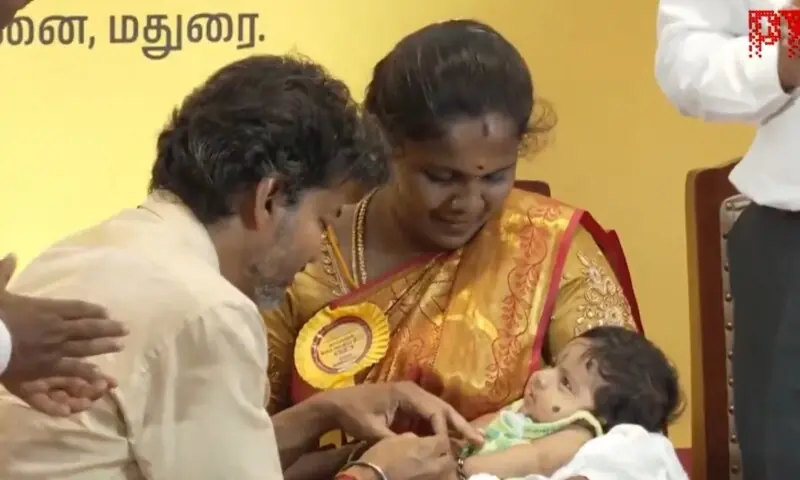
Tamil Nadu has started handing out a gold ring to babies born in its government hospitals. Chief Minister C Joseph Vijay launched the “Thai Maman Thanga Mothiram” scheme on Monday, under which eligible babies get a one-gram gold ring. The state says the Tamil Nadu newborn gold scheme is meant to celebrate childbirth and bring more families into public hospitals. It is one of the most unusual health-linked welfare offers in India right now.
Background: A Poll Promise Turned Into Policy
The idea did not come out of nowhere. Vijay first announced it on March 7, 2026, at a Women’s Day event of his party, the Tamilaga Vettri Kazhagam, in Mamallapuram, while campaigning for the Assembly elections. It was among the earliest promises aimed at women and young people. After his party formed the government, the plan moved from the stage to a government order.
The name carries a cultural meaning. “Thaimaman” means maternal uncle, and in Tamil families the mother’s brother traditionally gives a gift to a newborn. The scheme borrows from that tradition, so the state is in effect stepping into the uncle’s role for every eligible baby. That framing has made this Tamil Nadu government scheme easy for ordinary families to understand and talk about.
Gold also matters far beyond this one state. It has deep cultural value in India, appearing at weddings and religious ceremonies and seen as a safe asset to pass down. A gold gift for newborn babies therefore lands very differently from, say, a cash transfer or a baby kit. Families tend to keep it, and they remember who gave it.
Details: Who Gets the Ring and How Much It Costs
The main event took place at Government Rajaji Hospital in Madurai. Vijay presented rings to newborns there, and 25 babies received them at the launch programme. The ring is 22-carat and weighs one gram. Dawn puts its value at roughly $143.
On eligibility, the rules are fairly simple. Babies born alive in government hospitals and primary health centres from June 22, 2026 are covered, and the mother must be a permanent resident of Tamil Nadu. This means babies born in the months before the launch are also included, which is why hospitals have already been counting eligible births.
The numbers behind the plan are large. The first phase covers 1.28 lakh rings, each with a unique serial number and tamper-proof packaging. A government order issued on June 23 set aside ₹755.83 crore a year and planned procurement for 4,41,667 deliveries in government hospitals. For context, Tamil Nadu records about 7.8 lakh births a year, and roughly 4.2 lakh of them happen in government hospitals. So more than half of the state’s births could qualify.
Why Serial Numbers and Sealed Packaging?
Each ring is numbered and sealed, which is a practical detail worth noticing. With this much gold moving through hospitals, the state needs a way to show that every ring reached a real baby and that nobody swapped or skimmed it. Whether that tracking works in day-to-day practice is something reporters and auditors will be watching over the coming months.
Voices: What Officials and Mothers Are Saying
Officials describe the programme in soft, celebratory terms. The government says it wants to celebrate childbirth, honour motherhood and encourage families to choose government institutions for delivery. In other words, the ring is a small reward attached to a big goal. Officials also say it should highlight maternal and newborn care and strengthen trust in public healthcare in a state of more than 72 million people.
The reaction from mothers at the launch was warm. One mother at a Madurai government hospital, who did not give her name, said the ring gives her child something valuable to hold on to in the years ahead. Mothers at the event also spoke with the Chief Minister and took photographs with him, which shows how much political weight the state is attaching to the moment.
Impact: What Changes for Tamil Nadu and the Rest of India
The regional impact is easy to see. If even a fraction of families who might have used a private clinic choose a government hospital because of the ring, the state’s institutional delivery numbers could rise. Institutional deliveries matter because trained staff and emergency care are close by if something goes wrong. That is the real prize behind this India newborn gold headline.
There is a health backdrop too. India recorded 24 infant deaths per 1,000 live births and 88 maternal deaths per 100,000 live births, according to the latest official data. A gold ring will not lower those numbers by itself. Trust in a hospital also depends on clean wards, available doctors, short waits and respectful treatment, and no gift can replace those.
Beyond Tamil Nadu, other states will be watching. Cash and kit incentives for hospital births are common in India, but this India baby gold scheme is a bolder version of the same idea. If the Tamil Nadu newborn gold scheme shows results, other governments may consider something similar. If it turns out to be mostly a headline, it will be treated as a lesson in what incentives can and cannot do.
Conclusion: What to Watch Next
The next few months will show whether the scheme runs smoothly. The first phase covers 1.28 lakh rings, so how quickly hospitals hand them out, and whether every eligible family actually receives one, will be the first test. Data on delivery numbers at government hospitals will be the second, and it will be the fairest measure of whether the ring is changing choices.
For now, the picture is clear. Tamil Nadu has turned a campaign promise into a working programme, and thousands of babies will start life with a small piece of gold from the state. Whether that also builds lasting confidence in public hospitals is the question the government will have to answer with results.
Frequently Asked Questions (FAQs)
Why is Tamil Nadu giving gold to newborn babies?
The state government says the Tamil Nadu newborn gold scheme has two connected aims. The first is to celebrate childbirth and honour mothers. The second is to encourage families to choose government hospitals and primary health centres for delivery instead of private facilities. Officials believe a visible, valuable gift can build trust in public healthcare. The scheme was also an election promise made by Chief Minister Vijay in March 2026, so its launch fulfils a public commitment. The name “Thaimaman” links it to the Tamil tradition of a maternal uncle giving a gift to a newborn, which gives the programme a cultural meaning as well as a policy purpose.
Who is eligible for the newborn gold scheme in Tamil Nadu?
Babies born alive in Tamil Nadu government hospitals and primary health centres are eligible, provided they were born on or after June 22, 2026. According to the state’s information, the mother must also be a permanent resident of Tamil Nadu. Deliveries in private hospitals are not covered, because the scheme is designed to pull families toward the public system. Families who are unsure about their case should ask the hospital’s maternity or registration staff, since the hospital will be the one issuing the ring. It is also sensible to keep the discharge papers and birth details handy, as those are the documents hospitals normally rely on.
Could other Indian states adopt a similar baby gold scheme?
It is possible, but no state has announced anything yet. Many Indian states already offer cash support or baby kits to encourage hospital births, so the idea of an incentive is familiar. Gold is more expensive and needs careful tracking, which makes it harder to scale. Much will depend on whether Tamil Nadu’s numbers improve and whether the distribution runs without complaints. Other governments will likely wait for those early results before deciding whether an India newborn gold programme is worth copying.