

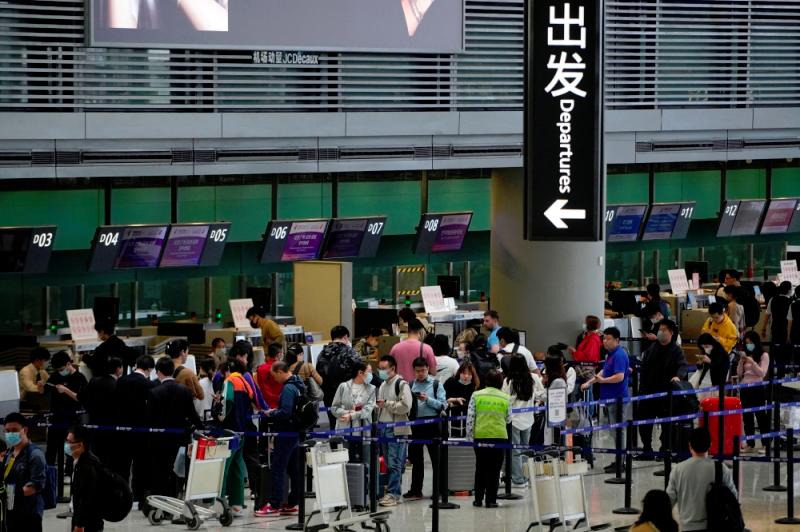

China’s exit-and-entry system just got a significant update. As of Tuesday, citizens can be blocked from leaving the country if officials judge them a risk to “industrial or technological security,” a category that did not previously carry this kind of weight in exit-ban law.
This is not a blanket travel ban. Most people crossing Chinese borders this week will notice nothing different. But for a specific slice of the population, particularly those working in tech, trade, and sensitive research, the legal risk of an overseas trip has changed.
Background
Exit bans are not a new invention in China. For years, senior officials, state-enterprise executives, and people involved in active legal disputes have faced restrictions on leaving the country, sometimes without being told in advance.
Data compiled by the rights group Safeguard Defenders and reported by the BBC shows how much this practice has grown. China’s Supreme Court database recorded only a small number of exit-ban references in 2016. By last year, that number had climbed into the hundreds of thousands, and the share of civil court cases involving an exit ban jumped from under 1 percent to more than 7 percent between 2019 and 2025.
What makes this week’s update different is the subject matter. Technology and industrial security have moved from a background concern to an explicit trigger for a travel block, a shift that tracks closely with the ongoing tech rivalry between Beijing and Washington.
Details
The new rules give authorities a legal basis to stop someone from leaving China if their actions are found to violate technology import or export regulations in a way that threatens industrial or technological security. That covers a wide range of roles, from researchers handling export-controlled equipment to executives negotiating tech deals abroad.
A second track applies to people accused of committing illegal or criminal acts overseas that harm China’s national security or interests. Anyone caught in that category can face a travel block of six months to three years, starting from the day they return to Chinese soil.
Foreign nationals are covered under a separate clause. Someone who submits false information on a Chinese visa application can now be denied entry for one to five years, a much longer window than what typically applied before.
Three details are worth keeping in mind. First, there is usually no advance notice. Most people who get stopped find out at the airport or border checkpoint, not beforehand. Second, the rules apply on top of existing restrictions that already cover officials and state-linked employees. Third, the definitions used in the law, terms like “harm to national interests,” are broad enough that legal scholars say much will depend on how individual cases are handled once they start showing up.
Quotes
Legal analysts who track Chinese policy are not treating this as a minor technical update. Dylan Loh of Nanyang Technological University told AFP the new rules are meant to send a message that Beijing intends to act against anything it views as a leak in security-sensitive areas.
Chong Ja Ian of the National University of Singapore raised a more practical concern: nobody outside China’s legal system will really know how the rules get applied until actual cases surface. He pointed to the recent detention of US citizen Min Zin in Yunnan province as an example of how unpredictable enforcement can look from the outside, since Washington and Beijing still disagree over whether he was treated fairly.
Impact
The most direct impact lands on people connected to strategic technology sectors, chips, AI research, advanced manufacturing, and anyone whose work touches export-controlled equipment or data. For that group, routine business travel now comes with a new layer of legal exposure that was not part of the calculation a few months ago.
There is a secondary impact on foreign companies operating in China. Vague legal language tends to make compliance harder to plan around, and multinational firms have already flagged similar concerns about earlier rounds of Chinese security legislation. Some may respond by tightening internal travel-approval processes for staff working on sensitive projects.
Taiwan’s government has also weighed in, warning its citizens to exercise caution when visiting mainland China. Beijing considers people from Taiwan to be Chinese nationals, which means they fall under the same legal framework as mainland citizens rather than being treated as foreign visitors.
Conclusion
The practical shape of these rules will become clearer only once real cases start appearing, which is typically how broadly worded Chinese security laws get defined in practice. Until then, expect continued uncertainty for people working in technology-linked fields who need to travel internationally, along with ongoing friction between Beijing and Washington over how far each side is willing to go to protect what it considers sensitive technology.
FAQs
What is the “0.1% rule” in China?
There is no officially recognized “0.1% rule” tied to China’s exit-and-entry system or its national security law. It does not appear in the new travel rules covered here. The closest verified figure comes from Safeguard Defenders’ analysis of China’s Supreme Court database, cited by the BBC, which found that exit bans showed up in roughly 0.23 percent of civil court verdicts in 2019, rising to about 7.3 percent by 2025. That is a real and well-documented trend, but it is not a formally named rule, and readers searching for a “0.1% rule” specifically should treat that phrase with caution since it does not match any confirmed Chinese government policy.
What is the national security of China?
Under China’s National Security Law, first passed in 2015, national security is defined broadly enough to cover political, economic, military, cultural, technological, and social stability, not just traditional military threats. This wide definition is central to understanding why the new exit-ban rules can apply to something as specific as a technology export violation. Legal scholars outside China frequently point out that this breadth gives authorities significant discretion in deciding what counts as a security risk on a case-by-case basis.
Why is 2027 important to China?
2027 is the 100th anniversary of the founding of the People’s Liberation Army, and Chinese leadership has attached a specific military modernization target to that date, often referred to as the “centennial military building goal.” It calls for major progress on mechanization, informatization, and the integration of artificial intelligence into military command and operations. While this goal is separate from the exit-ban rules discussed in this article, both fit into the same broader pattern: Beijing tightening its grip on strategically important technology as competition with the United States continues to intensify.