


Super El Niño Bears Down: What a Historic Pacific Warming Means for Texas, California and Beyond
By Tariq Khan | Pakistan Chronicle | August 21, 2026
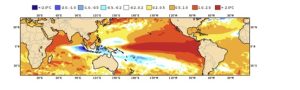
A Copernicus Climate Change Service forecast map, built on the ECMWF SEAS5 model, shows sea-surface temperature anomalies exceeding 2°C across the central and eastern equatorial Pacific by October 2026. (Image courtesy of Daniel Swain / American Community Media)
HOUSTON — For Tariq Khan, publisher of Pakistan Chronicle and South Asian Chronicle, extreme weather in Texas is not an abstraction. Nearly a decade after Hurricane Harvey dumped record rainfall on the Houston region in August 2017 — flooding that caused hundreds of thousands of dollars in property damage to his community after reservoir operators released dam water to protect Interstate 10 — he says he is still waiting on compensation from a case his community won in court. So when American Community Media (ACoM) convened a national news briefing on Friday, August 21, titled “Super El Niño and its Impact on Our Weather — In California and Across the U.S.,” Khan came with pointed questions: how prepared is Texas, really, for the next round of extreme weather, and how can ethnic-media outlets like his help coordinate community concerns with decision-makers?
The virtual briefing, offered with simultaneous interpretation in Korean, Mandarin and Spanish, featured climate scientist Daniel Swain, Ph.D., who holds joint appointments with the University of California Agriculture and Natural Resources (UCANR) and the NSF National Center for Atmospheric Research (NCAR). Swain, who authors the widely followed Weather West blog and hosts weekly “public office hours” on YouTube, walked reporters through what he described as a potentially historic El Niño event now taking shape across the tropical Pacific.
Data Swain presented showed the Relative Oceanic Niño Index (RONI) — a standard measure of Pacific warming used to classify El Niño strength — had already climbed to roughly +2.6°C above its 30-year baseline by early August 2026, tracking a path comparable to two of the strongest El Niño events on record, in 1997 and 2015. Forecast models from more than a dozen international weather agencies, including the UK Met Office, Japan Meteorological Agency, ECMWF and NOAA’s CFSv2, converged on a projection that the index would keep climbing through the fall, potentially peaking above 3°C between November 2026 and January 2027 — solidly in “very strong” territory — before gradually weakening and dropping back below the El Niño threshold by around May 2027. A companion forecast map from the EU’s Copernicus Climate Change Service, built on ECMWF’s SEAS5 model, showed sea-surface temperature anomalies exceeding 2°C across much of the central and eastern equatorial Pacific by October 2026 — the physical signature of the event reporters were being briefed on.
Khan used the briefing’s chat to press for Texas-specific answers, writing that the state is “never prepared” for severe weather — whether windstorms, flooding, extreme heat or hard freezes below freezing — and asking organizers to share contact information for weather-related agencies so local outlets could follow up directly. He also raised a question he asked panelists to correct if wrong: whether some extreme-weather patterns in the U.S. are human-influenced rather than purely natural — a question that reflects broader public uncertainty about the relationship between El Niño cycles and human-caused climate change that is central to Swain’s research.
Khan was far from alone in pressing for practical, community-level answers. Reporters from across the country used the briefing’s chat to submit dozens of questions. Alvin Galloway of KRDP radio in Phoenix asked how the event might affect the more than two-decade drought gripping Arizona, days after federal officials announced further cuts to Colorado River water allotments for lower-basin states. Elena Kuznetsova asked whether California’s Sierra Nevada could see its snowpack — badly depleted by an early, intense heat wave earlier this year — recover to normal levels this winter. Renee Barbee, describing months without rain and worsening water shortages in Southern California, asked when relief might actually arrive. Sunita Sohrabji of ACoM asked whether the same warm, wet conditions could fuel a rise in heat-activated illnesses such as cyclospora and tick-borne disease, while Cira Apitz asked whether the unusually warm Pacific could scramble NOAA’s Atlantic hurricane season forecasts. Laszlo Bartus of the Hungarian-language paper Amerikai Nepszava and fellow reporter Rebecca Bartus both asked how prepared rural and immigrant neighborhoods are for the coming weather extremes, and what infrastructure investments communities need to make now.
Nestor Fantini of HispanicLA connected the briefing directly to accountability questions raised after Los Angeles’s 2025 wildfires, asking whether city leaders should now treat the coming El Niño as a strategic regional threat requiring an immediate surge in disaster-prevention resources. Aitana Vargas pressed panelists on the media’s own responsibility, asking what journalists can do to convey the urgency of a phenomenon that affects everyone but is too often dismissed amid a landscape of climate misinformation.
For Khan and other publishers serving immigrant and non-English-speaking communities, the briefing’s built-in interpretation in three languages underscored ACoM’s broader mission: making scientific and policy information accessible to communities that mainstream coverage often overlooks — the same working-class and immigrant neighborhoods that reporters repeatedly flagged as least prepared for what is coming.
American Community Media said a recording of the full briefing would be made available to attending outlets. Questions about the briefing can be directed to Sandy Close or Sunita Sohrabji at American Community Media.
About the Briefing
Event: “Super El Niño and its Impact on Our Weather — In California and Across the U.S.” — an American Community Media national news briefing
Date & Time: Friday, August 21, 2026, 11:30 a.m.–12:15 p.m. PT | 2:30–3:15 p.m. ET
Format: Virtual Zoom briefing with simultaneous interpretation in Korean, Mandarin and Spanish
Speaker: Daniel Swain, Ph.D., Climate Scientist, UCANR; National Center for Atmospheric Research
Media Contacts: Sandy Close (sclose@americancommunitymedia.org), Sunita Sohrabji (ssohrabji@americancommunitymedia.org)
Speaker Bio
Daniel Swain, Ph.D.
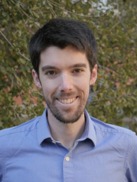
Climate Scientist, University of California Agriculture and Natural Resources (UCANR); Research Partner, NSF National Center for Atmospheric Research (NCAR)
Daniel Swain is a weather and climate scientist focused on the dynamics and impacts of extreme events — including droughts, floods, storms and wildfires — on a warming planet. He holds joint appointments as a climate scientist with University of California Agriculture and Natural Resources and as a research partner at the NSF National Center for Atmospheric Research. He engages extensively with journalists and other media partners, serving as a climate and weather science liaison to print, television, radio and web-based outlets. Swain is an alumnus of the University of California, Davis (B.S., Atmospheric Science) and of Stanford University (Ph.D., Earth System Science), and completed his postdoctoral work at UCLA. He authors the widely read Weather West blog (weatherwest.com) and hosts weekly live “public office hours” on YouTube (@WeatherWest), and can also be found on Bluesky (@WeatherWest) and Twitter/X (@Weather_West).