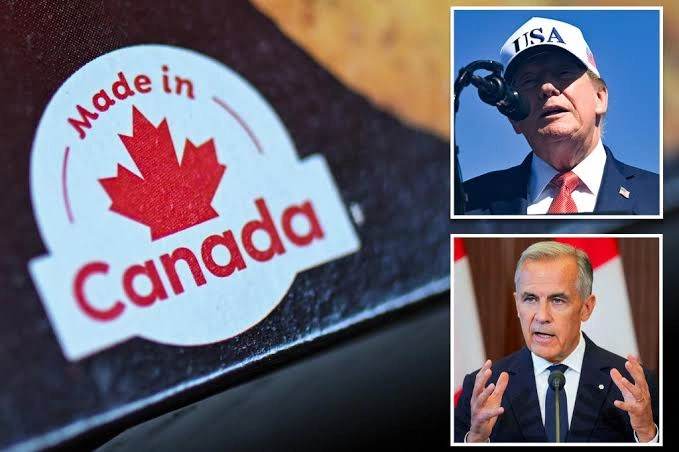
WASHINGTON: The US ban on Canadian goods has expanded sharply, with the United States blocking imports of a wide range of Canadian alcoholic beverages, motorcycles and dairy-related products as the trade dispute between the two longtime allies intensifies.
The new import restrictions, which take effect on September 29, were published on the White House website after Canada introduced retaliatory tariffs on US products earlier Tuesday.
The latest measures follow 50% US tariffs imposed on around $20 billion of Canadian goods last month after several rounds of trade negotiations between Washington and Ottawa failed to produce an agreement.
The escalating dispute has raised concerns about the future of the US-Mexico-Canada Agreement (USMCA), the North American trade pact that replaced NAFTA and has supported cross-border commerce for decades.
US ban on Canadian goods covers alcohol and dairy products
The US ban on Canadian goods appears to cover a broad range of alcoholic beverages, including Canadian beer, wine, whisky, bourbon, rum, vodka, vermouth, tequila, mezcal and brandy.
The restrictions also include several dairy-related and other products, including whey protein, invert molasses, cane molasses and non-alcoholic beer, according to notices published by the White House.
Meanwhile, several cheese products have been placed under a 50% tariff rather than being banned outright.
Other products added to the tariff list include paper, aluminum, wood, furniture, lighting products and various manufactured goods.
The restrictions could increase costs for US businesses and consumers while placing additional pressure on Canadian producers that depend heavily on access to the US market.
Canada’s latest countermeasures cover approximately $20 billion of US goods, with tariffs ranging from 15% to 50%.
Canadian duties target products including steel, furniture, clothing and electronics. Canadian officials say the measures are intended to pressure Washington while protecting domestic workers, farmers, families and businesses.
Prime Minister Mark Carney has also urged Canada to reduce its economic dependence on the United States.
“We have everything we need to pivot and prosper,” Carney said in a video message.
He acknowledged that changing Canada’s trading relationships would come with costs but argued that continuing to rely heavily on the US market could carry greater long-term risks.
Although the latest tariffs affect only a relatively small portion of total US-Canada trade, economists and business groups are increasingly concerned about an escalating trade war.
The US and Canada have deeply integrated economies, with supply chains crossing the border in industries ranging from automobiles and agriculture to manufacturing and energy.
Michael Harvey, executive director of the Canadian Agri-Food Trade Alliance and a member of Carney’s advisory committee on US economic relations, warned about the possibility of an “escalatory spiral.”
The dispute could also undermine confidence in the USMCA, which provides preferential trading terms for many goods moving between the United States, Canada and Mexico.
US President Donald Trump has continued to criticize Canada during the dispute.
On Monday, Trump said Canadian private jet manufacturer Bombardier would no longer be allowed to sell its aircraft in the United States unless it began manufacturing them domestically.
Trump also shared an image showing North America covered by the US flag and revived his criticism of Carney by referring to him as “Governor,” reflecting his repeated suggestion that Canada should become the 51st US state.
On Tuesday, Trump directed the General Services Administration to work with the US Trade Representative to remove Canadian-origin products from certain federal procurement schedules unless Canada restores what he described as full and fair reciprocity for American farmers and companies.
The US ban on Canadian goods could particularly affect beverage producers because alcohol products are among the Canadian exports facing restrictions.
Sapporo, which owns Ontario-based Sleeman Breweries, said it was considering moving a limited amount of non-alcoholic beverage production from Canada to the United States because of tariff risks.
Canada represents more than half of the Japanese company’s overseas beer sales, highlighting the importance of the Canadian market to international beverage companies.
Canadian exports remain heavily dependent on the US market. Government data show that nearly 68% of Canada’s exports have gone to the United States this year, with roughly 80% of those shipments moving duty-free under USMCA exemptions.
Trade war raises concerns for Canada’s economy
The latest confrontation comes as Canada faces the challenge of negotiating with an economy roughly 13 times larger than its own.
Previous US tariffs imposed under a Depression-era law did not allow Canada to use USMCA exemptions, increasing uncertainty for Canadian exporters.
Business groups and analysts warn that prolonged tariffs could weigh on investment, economic growth and employment on both sides of the border.
While Prime Minister Carney currently enjoys strong public support, political analysts say that support could weaken if higher prices, job losses and other economic consequences become more visible.
Trump has also threatened to increase tariffs on Canadian cars, trucks and automotive parts from 25% to 50% on January 1.
The growing confrontation between Washington and Ottawa now represents one of the most serious trade disputes between the two longtime allies in decades.